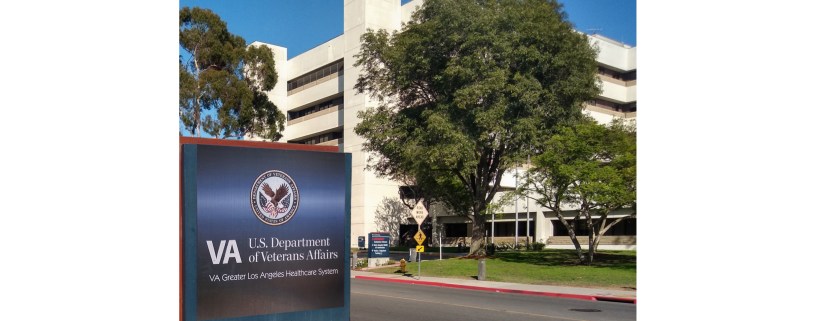
For more than a century, the 388-acre West Los Angeles VA campus was meant to serve disabled and homeless veterans. Yet the record tells a different story. From housing thousands of veterans in the 1950s (Addendum Table 1, 1950s) to today, when tiny “shed homes” sit in the shadow of elite athletic facilities, the land’s original mission has repeatedly been sidelined (Addendum Table 1, 1980s–2016).
Last month, local press coverage, including reporting by the Los Angeles Times and the Brentwood News, noted that the VA had “terminated” Brentwood School’s lease on part of the West LA campus. Rather than frame this as a long‑overdue step toward honoring the land’s original purpose, the coverage focused on the uncertainty and inconvenience the decision creates for Brentwood’s athletic programs and students. The tone in these reports reflects a broader pattern in which the needs and sacrifices of veterans, particularly those unhoused or struggling, remain peripheral to the narrative, while the potential loss of recreational space for affluent schoolchildren garners sympathetic attention.
A historical perspective reveals a long pattern of mismanagement, legal loopholes, and opaque agreements that have kept veterans on the margins while private institutions prosper on federally deeded land (Addendum Table 1, 1970–2026).
The Pattern
The timeline of events (Addendum Table 1) reveals a steady drift away from the campus’s founding purpose. From the 1950s, when thousands of veterans were housed (Addendum Table 1, 1950s), to recent decades, the West LA VA has repeatedly prioritized outside entities over direct care.
The pattern includes the systematic eviction of direct-service organizations under the guise of “reorganizing,” such as the Salvation Army and the American Red Cross, which provided essential services to veterans (Addendum Table 1, 2016–2020). Meanwhile, leases to affluent or institutional entities, including Brentwood School, UCLA, parking lot operators, and even an oil company, were preserved, often without public disclosure. The message has been consistent: direct assistance to disabled veterans was treated as a nuisance, while third-party partnerships, especially those benefiting privileged interests, were shielded and preserved.
Legal Loopholes and “In-Kind” Services
In 2013, a federal court ruled that the VA violated federal law by leasing property to entities unrelated to the care and treatment of homeless and disabled veterans (Addendum Table 1, 2013). That ruling was clear. Yet in 2016, Congress passed legislation permitting third-party leases if they “principally benefit” veterans or provide “in-kind consideration” (Addendum Table 1, 2016). That language created a loophole that enabled the VA to continue this selective prioritization.
Under this framework, Brentwood School has asserted roughly $1.8 million in annual “in-kind services.” Yet a congressionally mandated compliance report (2024) found that the West LA VA could neither confirm nor substantiate whether certain in-kind services were being provided as claimed. The same report noted access to athletic facilities was limited to early morning and late evening hours, times that were misaligned with the campus shuttle schedule (Addendum Table 1, 2023–2024). Such incongruencies makes one wonder, when access exists only in theory, are “in-kind” services merely paper currency to skirt the law?
The Legal Reckoning
Recent federal rulings escalated scrutiny. The United States Court of Appeals for the Ninth Circuit determined that land-use leases with the Regents of UCLA, Brentwood School, and other entities were unlawful and void (Addendum Table 1, 2025). Judicial oversight intensified rather than receded.
Yet even after termination notices were issued to certain leaseholders, operations continue while meetings with officials in Washington are pending. A reminder that a termination letter is not final, nor is it the same as restored land use (Addendum Table 1, 2026).
The Secrecy Question
Complicating matters further, the Department of VA has announced plans for a “National Center for Warrior Independence,” with the stated goal of housing up to 6,000 veterans by 2028. That initiative follows an executive order signed by President Donald Trump directing renewed focus on housing and healthcare at the site. On its face, this aligns with the original deed.
Yet the process raises deeper concerns. Non-disclosure agreements (NDAs) have reportedly been required of those working on the redevelopment plan. This selective secrecy is ironic, especially given that, for decades, the West LA VA quietly signed leases and executed deals favoring privileged entities without public input or scrutiny. Only now, these NDAs are widely reported as problematic, because the opacity and cloud of secrecy do not appear to extend to the local officials and wealthy benefactors behind the identified illegal leases. They remain left out of the loop. Unfortunately, it also seems to shield the inner workings from the very people the campus was originally meant to serve – veterans.
If the reform effort is genuine, why the opacity? Federal land granted explicitly for disabled veterans warrants transparency, not selective insulation from scrutiny. Public trust depends on visibility, yet in California we have repeatedly seen how clarity is obscured in direct proportion to the gaslighting perpetrated by political and institutional authorities.
Economic and Human Context
California has the largest homeless population in the United States, by a wide margin, and as of December 2025 (reported in early 2026), its unemployment rate stood at 5.5%, the highest of any state and well above the national average.
Against this backdrop, thousands of veterans remain unhoused across Los Angeles County, while some continue living in temporary shelters (8×8 sheds) within the VA’s gates (Addendum Table 1, 2020–2026). Meanwhile, Los Angeles County has advanced a $48 million project to provide interim housing for LA’s general homeless population, linked to VA-adjacent property at the Armory, once again underscoring the contrast: public resources mobilize for new civilian projects while veterans remain in precarious conditions.
Civic and Generational Critique
The deeper issue is cultural as much as administrative. We are witnessing a politically mobilized subset that is quick to act for causes (No-Kings, Anti-ICE), vocal in denouncing injustices, yet largely indifferent to the suffering of veterans living on the streets. Some are drawn to march by abstract policy ideals and catchy slogans, while real-life homeless veterans of Vietnam, the Persian Gulf, and more recent veterans remain unseen in plain sight.
Political activism is a luxury paid for by military sacrifice. The right to protest, to assemble, to demand justice, are freedoms preserved by men and women who accepted costs many will never fully understand. A society that elevates certain injustices while normalizing the neglect of its veterans risks moral incoherence.
To champion “justice” while stepping over those who bore the burden of preserving that right is not progress. It is selective conscious.
Optics vs. Substance
Visitors entering the West LA VA from Wilshire Boulevard may notice fewer tents in immediate view. But relocation is not resolution. Moving encampments out of sight does not constitute permanent housing. Nor does preserving lucrative third-party arrangements under revised terminology. The core question is not whether paperwork has shifted, but whether land use has.
A Civic Obligation
The West Los Angeles campus was not granted as discretionary development property. In 1888, it was deeded specifically as a permanent home for disabled soldiers (Addendum Table 1, 1888). That obligation is not merely symbolic; it is both contractual and moral.
Yet, thousands of homeless and disabled veterans remain on the streets of LA. In a city inclined toward political activism and civic protests (No-Kings, Anti-ICE, Pro Palestine, Pro-Iran), there is a conspicuous absence of sustained public outrage on behalf of veterans, the very individuals whose sacrifices preserved the rights that make such demonstrations possible.
A society that benefits from military sacrifice while tolerating the neglect of its veterans engages in willful indifference. Political activism, civic protest, and public debate endure because others bore the cost of defending those freedoms. When veterans who carried that burden are left untreated and unhoused, something foundational has broken.
The Bottom Line
The recent termination notice sent to Brentwood School may signal the beginning of meaningful reform. It may also prove to be little more than a procedural placeholder while negotiations continue behind closed doors.
Until the campus is measurably reoriented toward permanent housing and comprehensive services for disabled and homeless veterans, not merely restructured on paper, skepticism remains warranted.
The original deed promised a Permanent Home. That promise has yet to be fulfilled.
Addendum
Table 1
This table summarizes key historical events, court rulings, leases, and services on the West LA VA campus, highlighting the contrast between benefits provided to veterans versus other parties.
| Year | Veterans Benefited | Outside Interest Benefitted |
|---|---|---|
| 1888 | Grant Deed: Land donated by Arcadia Bandini de Stearns Baker specifically for a “Permanent Home” for disabled soldiers. | |
| 1940’s | 1947: West LA VA forms partnership with UCLA Medical School. Four buildings renovated for research space. | |
| 1950’s | Approximately 5,000 veterans housed on the West LA VA campus. | |
| 1960-1970’s | Veterans start holding a series of hunger strikes that continued into the 1980’s. | West LA VA stops accepting long-term veteran residents, and transitions from housing veterans to commercial leases that do not benefit veterans. |
| 1980’s | Only 2% of homeless veterans in Los Angeles received any benefits. UCLA Jackie Robinson Baseball Stadium is built on the West LA VA Campus | |
| 1990’s | President Bill Clinton signed the West Los Angeles VA Medical Center Veterans Programs Enhancement Act of 1998. The bill was to ensure that the 388-acre parcel was used to benefit veterans; medical, housing, and other veteran-related service | |
| 2000’s | 2001: The Department of Veterans Affairs – West LA VA and the surrounding community spar over how to commercially develop the 388-acre West LA VA campus. No mention of homeless or disabled veterans. The VA signs a 20-year lease with Brentwood School for its 22-acre sports complex. | |
| 2011 | Four veterans and the Vietnam Veterans of America sued the Department of Veterans Affairs then-Secretary Eric Shinseki and then-director of the VA Greater Los Angeles Healthcare System, Donna M. Beiter on behalf of hundreds of other homeless and disabled veterans in the Los Angeles area, for discrimination against those with serious mental disabilities by denying access to necessary medical services. The suit dragged on for four years. | |
| 2013 | Court, Judge Otero, ruled the West LA VA violated federal law by leasing its property to entities unrelated to the care and treatment of homeless and disabled veterans. UCLA and Brentwood’s School’s challenge of the ruling denied. | |
| 2015 | Senator Dianne Feinstein and Congressman Ted Lieu introduced the bill titled the “Los Angeles Homeless Veterans Leasing Act of 2015.” Donna Beite, Director of the VA Greater Los Angeles Healthcare System, stepped down. Eric Shineseki, Secretary of the Department of Veterans Affairs, resigned “apologizing for a scandal involving widespread coverups of months-long wait times for veterans seeking hospital care.” | |
| 2016 | Congress passed the “West Los Angeles Leasing Act of 2016” legalizing third-party leases only if they “principally benefit” veterans, or provide “in-kind consideration.” | The Loophole: Brentwood School and other lease holder claim “in-kind” services. |
| 2016-2020 | The VA evicted: a.) The POST program (PTSD Outpatient Services Team) providing services to over 1000 veterans b.) The Salvation Army – short term transitional housing for veterans c.) The Red Cross – told it was not a good fit. These groups, who provided direct, on-campus services for years, were systematically pushed-off campus to make space for renovations under the “Master Plan.” Renovations the veterans are still waiting for. | |
| 2020-2022 | As the pandemic worsened, the Department of Veteran’s Affairs established LA’s first “tent city” in 40 years for homeless vets. Over a dozen homeless veterans and the National Veterans Foundation filed a lawsuit against the West LA VA for housing homeless veterans and barring the VA from using the land for services not directly beneficial to veterans. | The West LA VA “ignored an oversight board’s call for more emergency shelter beds on the sprawling 388-acre campus.” None of the nearly 700 housing units that were supposed to be completed according to the 2016 Master Plan were actually completed by the Spring of 2022. |
| 2023-2024 | Judge Carter “rejected all of the federal government’s efforts to toss out a lawsuit that seeks to require Veterans Affairs officials to house veterans with disabilities “ A federal judge rejects the VA’s lawsuit officially voids the Brentwood lease as “illegal” and “wasteful.” | Brad Rosenberg, attorney for the VA, challenged Judge Carter’s assertions concerning the “VA’s legal duties to serve veterans at the West L.A. campus.” The VA and DOJ appeal the ruling to remove judicial oversight. Brentwood School and UCLA appeal the ruling. The congressionally mandated report to ascertain compliance with the West Los Angeles Leasing Act of 2016 was submitted. The committee was unable to confirm lease-holders (UCLA, Brentwood School, Safety Park Corporation, etc.) were indeed providing in-kind services to veterans. With regard to Brentwood School, the committee noted, “The BWS athletic facilities were not designed for the particular needs of Veterans and their families, and Veterans can only access the facilities during limited hours when students are not using them. Most of the facilities are open to Veterans early in the morning and late in the evening” – A schedule that is out of alignment with the provided shuttle service from 9:00-2:00 pm. |
| 2025 | President Donald Trump signed an executive order declaring a National Center for Warrior Independence will be established on the West LA VA’s 388-acre campus, with the goal of housing up to 6,000 homeless veterans by 2028. The Nineth Circuit Court of US Appeals determined “that the land-use leases the VA had with the Regents of the University of California, Los Angeles, Brentwood School, and Bridgeland Resources, LLC, were unlawful; voided these leases; and enjoined the VA from renegotiating them.” | The Armory Betrayal: While claiming “no room” for veterans, LA County advances a secret $48M civilian project at the West LA Armory. The Department of Veterans Affairs mandated non-disclosure agreements (NDAs) for anyone working on the 2028 housing plan, raising suspicion about the lack of transparency and the need to hide relevant details from the public |
| 2026 | The “Paper Victory“: VA sends termination notices to: a.) Safety Park Corporation – a parking lot company, b.) Bridgeland Resources LLC – an oil company, and c.) Brentwood School. However, the school continues to operate while its officials plan to meet with VA officials in Washington. | Veterans still barred from housing on West LA VA campus. Some permitted to continue living in sheds. |
Note: Table 1 illustrates the persistent contrast between benefits delivered to veterans and the gains accrued by outside entities on federally deeded land.
If this topic is of interest to you, please consider reading my other pieces on the West LA VA:
 Inside Out Odyssey