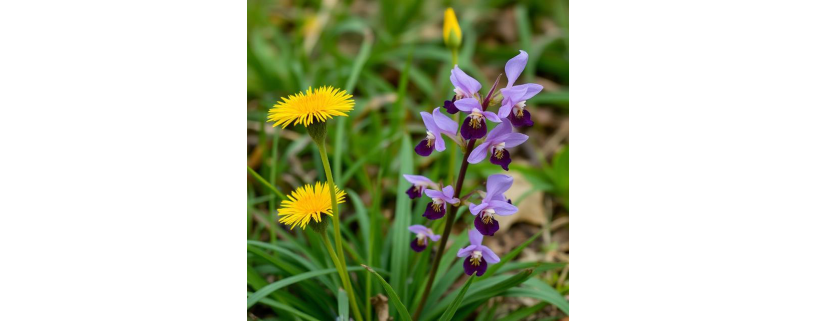
Every so often, a new metaphor sprouts, gains mainstream visibility, and sweeps across parenting circles. One of the latest to take root compares children to flowers: some are “orchids,” delicate and sensitive, and others “dandelions,” hardy and adaptable. Pediatrician W. Thomas Boyce, in his influential work, describes 80% of children as dandelions who thrive anywhere, while the remaining 20%, often more biologically sensitive “orchids,” require precise nurturing to flourish. The idea is tidy, appealing even. Orchids supposedly wilt under stress, while dandelions can somehow survive in any soil. But what strikes me most about these narratives is not their poetic allure, it’s who writes them. Almost always, the authors describing how to “raise a dandelion child” have never parented a neurodivergent child.
Reading one of these articles recently left me both amused and unnerved. Perhaps it poked too close to home, but mostly, it felt naïve. It seemed to reflect the kind of advice that is only ever given from a safe distance. When you’ve spent years coaxing your child to sleep, teaching them how to decode facial cues, navigating meltdowns and therapies, or explaining why friends slip away, resilience stops being a catchy metaphor. It becomes the scaffolding of life itself.
The Trouble with Pretty Metaphors
The orchid–dandelion analogy rests on a false binary: that temperament alone, not circumstance, privilege, or persistence, determines a child’s outcome. Boyce and others note that orchids may carry “pieces of neurodiversity,” facing heightened risks from adversity that neurotypical dandelions shrug off. Yet professionals and parenting writers often assume neurodivergent children default to the orchid category, overlooking how external treatment shapes their path: peer exclusion, teacher impatience, or extracurricular staff who lack tools for inclusion. Biology matters, as Boyce emphasizes, but so do the daily microaggressions: ridicule for “immature” behaviors, and lowered expectations in classrooms, that no category fully predicts.
Some writers do acknowledge that orchid children are highly sensitive, with stronger stress responses and bigger emotions. They point out that there are no universal parenting truths, only the need for responsible environments. Yet, even these more nuanced accounts rarely grapple with how those environments routinely fail neurodivergent children in practice; rejection by peers, labeling by schools, and the quiet calculations by adults about who requires “too much work.”
Recent developmental research has gone further, questioning the very premise of an orchid-dandelion split by showing that children’s susceptibility to environmental influence is not neatly bimodal, but spread along a continuum, with sensitivity varying by context and outcome. That scientific nuance rarely makes it into popular parenting articles, which still prefer simple categories over complex, lived realities.
As a former clinical researcher, I understand the appeal of frameworks. They organize complexity. But the categories used in popular parenting literature are often just that; intellectual shortcuts. Experts may stress that all children are unique, yet without parenting (or being) a neurodivergent child, true understanding eludes them. It’s like my brother’s congenital heart defects: tetralogy of Fallot and transposition of the great vessels. I learned these diagnoses as a nursing student, but only witnessing a sternum being cracked open revealed the raw pain he must have endured. Theory illuminated; experience transformed.
What Resilience Really Looks Like
My own neurodivergent child, now a graduate student, graduated valedictorian (high school) and magna cum laude (undergraduate), worked as a research assistant, and continues to persevere in a world with an inherent proclivity to disregard them. Whether being selected close to last in group formations in elementary school, ignored by all but a select few in high school, or being viewed as too risky by job employers, successful neurodivergent individuals run a proverbial marathon before the race even begins.
The Real Dandelions
One friend’s daughter with Tourette’s and anxiety is taking longer to complete college than some, but she is doing so. Another friend’s daughter has an autoimmune disease, mental health challenges, and an eating disorder, moving in and out of treatment programs. When these individuals experience success, however small the steps, the triumphs are rarely recognized. Why? Their milestones get recast as “delays” because they fall outside medically or psychologically approved timeframes.
Even sympathetic discussions of orchids admit that typical classrooms often struggle to accommodate highly sensitive children, and may affix ill-fitting psychological labels when their behavior doesn’t confirm. What these well-intentioned discussions don’t fully convey is how quickly those labels migrate from tentative descriptions to rigid categories used to shoehorn children into standardized plans, lowered expectations, and sidelined individuality.
The problem with medical labeling is that educators and the lay community grasp onto them whenever the square peg doesn’t fit the round hole. Standardized 504 and Individualized Education Plans (IEP’s) get demanded, but any hint of actual individualization quickly vanishes. Teacher time, school funding, and administrative efficiency take precedence over the unique developmental path of the child before them.
Neurodivergent children are the true dandelions in this analogy. They don’t just endure adversity; they adapt creatively, finding cracks in concrete classrooms and social circles designed for others. These aren’t “orchid” fragilities overcome by perfect soil. They are hard-won blooms from families who refused conformity as the only path.
Toward a Truer Definition of Strength
We need language honoring cultivation over constitution. Neurodivergent children teach us that in thriving, they reshape the world to fit them, not vice versa. Their strength grows amid judgment from peers, inconsistent teacher support, and extracurricular exclusion that one-size-fits-all models rarely address. Lived experience, yours and mine, fills the gaps that theory leaves.
The next time someone tries to pigeonhole or belittle “orchid” sensitivity, let them consider these dandelions: not lucky, but unfailingly adaptive. They grow because they refuse not to.
P.S. If this topic resonated with you, I’ve written a few other pieces on neurodivergence you might enjoy:
 Inside Out Odyssey