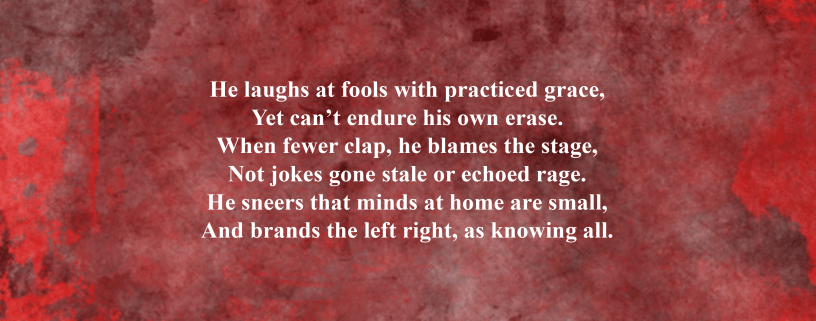
I’m old enough to remember watching Johnny Carson and Jay Leno, when late-night television was a shared ritual rather than a partisan broadcast. Carson knew that if you wanted everyone to laugh, you couldn’t afford to alienate half the room. Leno, too, kept the humor broad, his barbs light, and his stage open to all sorts of guests. They understood that the heart of comedy was connection.
Today’s hosts have chosen a narrower stage. Jimmy Kimmel and Stephen Colbert no longer poke fun at both sides. They preach to one. The laughter that once united now divides, replaced by monologues that sound more like op-eds than openers. As ratings wane, explanation turns outward: blame Trump, blame fatigue, blame “the other side.” Yet self-awareness, once a comedian’s sharpest tool, seems the first thing they set aside.
Late night used to be where America met at midnight for release and reflection. Now, it feels like the day’s arguments set to a laugh track. Perhaps Carson’s philosophy still holds true: the best punchline lands on everyone, including the one telling it.
Reveal: The riddle unveils Jimmy Kimmel, once a ringmaster of laughter, now a mirror of late night’s uneasy turn from humor to hubris.
 Inside Out Odyssey