
California has done it again. We’re number one! Unfortunately, not in tech, innovation, or public education. No, as of mid-2025, California now leads the nation in unemployment, proudly clutching the gold medal in “How to Tank an Economy While Pretending It’s Thriving.”
Naturally, state officials and media allies sprang into action. Not to fix it, of course, but to blame . . . well, everyone else.
- “Tariffs,” whispered a legislative aide from under a pile of ESG paperwork.
- “Immigration chaos,” said a masked intern clutching her reusable straw like a weapon.
- “Late-stage capitalism,” tweeted a tenured sociology professor from a loaded $10,000 MacBook Pro hand-assembled by underpaid factory workers in China.
Sure. Let’s blame everyone except the state that spent years piloting its own economic Hindenburg, fueled by hydrogen-grade hubris and wrapped in regulatory red tape so explosively flammable, even basic logic is a fire hazard.
Let’s unpack this flaming dirigible.
The Entertainment Industry: Lights, Camera, Get Out
Once the jewel of California’s economy, the entertainment industry now resembles a ghost town with a Netflix password. What was once synonymous with glamor, jobs, and global influence has become yet another causality of self-inflicted policy wounds and missed opportunities.
In 2023 alone, roughly 40,000 entertainment jobs vanished during the SAG-AFTRA and WGA strikes. The industry has yet to recover.
Visual effects, animation, and post-production work, once booming in places like Burbank and Culver City: gone. Vanished. Subsidized into oblivion by countries like Canada, UK, Ireland, and Australia. Apparently, those nations discovered a radical idea: supporting the entire pipeline of content creation, not just the bits with actors and boom mics.
And let’s not forget the gaming studios. So many have closed that tracking them now requires a spreadsheet, a bottle of wine, and some grief counseling.
But fear not, Governor Newsom rode in with a camera-ready solution: more filming incentives! In a move so on-brand it hurts, the state rolled out new subsidies that – surprise! – forgot to include post-production (animation, VFX, etc.). Minor oversight, albeit a very common one. Apparently, post-production crews are expected to live off residuals from their abandoned dreams and maybe a viral TikTok video or two.
Meanwhile, states like Georgia, Texas, Kentucky and North Carolina are luring productions away. Yes, North Carolina. The state better known for barbecue and basketball is giving California a run for their money in entertainment job creation, literally! Somewhere, Mickey Mouse is filing a complaint with HR.
Eventually, someone in Sacramento realized, possibly after a staffer’s toddler asked why Bluey wasn’t made in LA, that animation was a thing. Enter Assembly Bill 1138, which extends tax credits to animated projects. It only took mass layoffs, industry flight, and the slow death of post-production in California to realize that animation jobs count too. Bold leadership!
The fallout? Highly skilled professionals (artists, editors, and mid-career animators) are now competing for glamorous new roles such as substitute teaching ($18/hr), warehouse labor, or front desk work at clinics that can’t afford electricity. Progress!
Businesses Leaving Faster Than U-Haul Can Keep Up
California businesses are fleeing the state like it’s the final scene of Titanic. Only there still aren’t enough lifeboats, and Sacramento is playing the violin as the ship goes under.
As of April 2024, over 500 companies have left California, or significantly downsized. Since 2022, the state has proudly held the distinction of being the worst state in the nation to do business. A gold medal! But one no one actually wants. Why the exodus? Take your pick: crushing taxes, endless regulations, energy costs, and a sky-high cost of living. Then, of course, there’s the added thrill of showing up to your looted storefront . . . again!
Who wouldn’t want to pay $6/gallon for gas and $5,000/month for retail space, in exchange for rampant theft and bureaucratic gridlock? But wait, it gets better. For companies brave or stubborn enough to stay, insurance providers are now fleeing too. Entire zip codes are being dropped. Commercial insurance? Sorry, unavailable. Your business might end up surrounded by barbed wire, while you say your nightly prayers. Your landlord can’t get coverage for your office, but rest easy, your local café now offers oat milk, carbon offsets, and pronoun pins. Progress has never been so . . . performative.
Crime Is Down (Except Where It Isn’t)
In August, Governor Newsom proudly declared that both violent and property crime are down statewide. According to official data, California is safer than ever; a shining beacon of law and order.
That’s great! So why are the crime maps for huge chunks of Los Angeles, especially the San Fernando Valley, mysteriously blank? According to CrimeMapping.com, crime in North Hollywood, Studio City, Sherman Oaks, Encino and Woodland Hills has simply . . . disappeared. Poof. Vanished. Possibly relocated to the metaverse. SpotCrime took a subtler approach. They just removed entire Valley cities from their listings. Probably just a glitch, right?
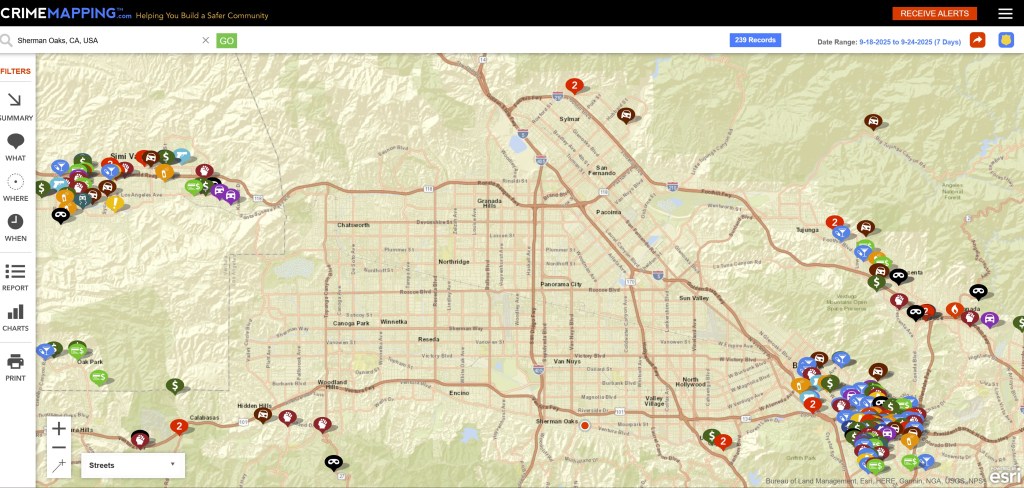
Meanwhile, one San Fernando Valley neighborhood reported 27 burglaries in a single week. You read that correctly. And if that seems extreme, don’t worry, it’s just part of a growing trend of break-ins, brazen thefts, and “smash and grabs” that seem to occur in LA’s more “affluent” zip codes.
Still not concerned? In Oakland, officials decided to ban most high-speed police chases, because the last thing you want is for the police to catch the guy who robbed your store or stole your car. Why risk public safety catching a criminal when you can let them escape in the name of social equity?
When Displaced Professionals Compete with Day Laborers
Let’s be clear: illegal workers are not the reason computer graphic (CGI) artists, editors and animators are unemployed. No one is blaming the guy picking oranges for someone’s inability to land a job in post-production. But here’s the economic reality: Greater Los Angeles is now home to nearly 2.3 million illegal residents, comprising 7.1% of its population. Many of them work in industries with low barriers to entry; housekeeping, agriculture, construction, food service, delivery, etc. Now, displaced middle-aged professionals who once made their living in specialized, middle-class creative jobs, are vying for those same low-pay entry level jobs.
So what happens when an “overqualified” and maybe “too old” 52-year-old laid-off VFX artist, with two kids and a mortgage, applies for the same $18/hour warehouse job as a 25-year-old who surreptitiously arrived in the country and doesn’t require employer-provided healthcare? You get a labor market so oversaturated it’s less “competitive” and more economic swamp! And even if you land that $18/hour job, good luck paying for rent, groceries, gas, and the privilege of living within five miles of a store that has been robbed three times this month (Target, Walgreens, Kroger, etc.).
This isn’t a workforce transition. It’s a game of musical chairs, where half the seats are stolen, the other half are broken, and the DJ is playing La La Land’s rejected soundtrack on endless loop.
California Logic: $20/hour to Flip Burgers, $18/hour to Teach Kids
And here’s where things get truly golden. As of 2023, thanks to AB 1228, the minimum wage for fast-food workers in California is $20/hour. Meanwhile, many substitute teachers, medical receptionists, and research assistants still earn less than that. So yes, California has finally achieved the progressive pinnacle: high school students can now earn more working at In-N-Out than their teachers do explaining the Constitution. If this is equity, it might need a software update!
In Conclusion: Let’s Blame Trump. Or Elon Musk. Or Both.
So what really caused California’s soaring unemployment?
- Was it Trump’s tariffs?
- Global trends?
- Climate change?
- The Ghost of Reagan?
Nope. It was:
- Bad regulation,
- Relentless state overreach,
- Disregard for industry shifts,
- Skyrocketing crime,
- A labor market torn between politics and reality,
- And more virtue signaling than an Ivy League DEI seminar.
But don’t worry. I’m sure Newsom has it under control, probably drafting another bill that mandates gender-neutral vending machines, bans forks manufactured before 2003, and allocates $10 million to study why people keep leaving the state. After all, why fix the economy when you can tweet about progress?
 Inside Out Odyssey