According to the United States Central Intelligence Agency, the US is the third most populous country in the world, with an estimated total population of nearly 342 million people. Yet despite its size, the CIA notes that only a tiny proportion of its denizens – 1.31 million individuals – are actively serving in all branches of the US Armed Forces combined. This equates to roughly 0.38 percent of the total US population, a remarkably small number for a leading member of the North Atlantic Treaty Organization (NATO), with the most powerful armed force in the world. It is doubly impressive considering the vast range of global responsibilities the US military shoulders in protecting the interests and well-being of the US and its international partners. Nor is this a safe or easy task, with US service members contending daily with very real and deadly threats from a complex array of hostile actors and situations, as many of our veterans can attest – and which Vice President Harris would be well-served to keep in mind before ever again claiming that there presently “is not one member of the United Stated military who is in active duty in a combat zone.”
As one might expect, ensuring the high level of domestic security and free flow of international commerce to which we in the US are sleepily accustomed does not come cheap. For FY 2024, the US national defense budget totaled $883.7 billion. Surprisingly however, not one penny of this is allocated for veterans, their families, or survivors. Our mighty defense budget does not account for them at all. Rather, the Department of Veterans Affairs (VA) is responsible for the budgeting of all such benefits including pensions, healthcare, disability compensation, housing, education, and life insurance.
When our service members return home, with scars both visible and invisible, they have earned the right to be treated with respect, and provided, or at least offered, the care they are due. The VA’s FY 2024 budget request, at a lesser yet still-enormous $325.1 billion, seems like it should go a long way for those who have served. And for some, it does. But not all veterans fare as well, with some doing substantially worse. Circumstances vary from one individual to another. In some cases, the VA itself may be failing them, while for others, a variety of factors may be at play. But in regards to the plight of homeless vets in particular, one institution stands out for its abject, decades-long, obstinately repeated failure to address the problem sitting almost literally right at their doorstep: the West Lost Angeles VA, situated amidst the multimillion-dollar homes of exclusive, affluent Brentwood, California.
Veterans
According to the VA’s FY 2024 Budget Submission, there are approximately 18.6 million veterans, of which an estimated 41,000 are facing homelessness, up from 35,574 veterans in 2023. Living conditions for homeless vets are generally categorized as either (a) “sheltered homelessness” – those in emergency, transitional or safe haven programs, or (b) “unsheltered homelessness” – those living in cars, dilapidated recreational vehicles (RV’s), abandoned buildings, or on the streets in makeshift shelters or tents (often situated in public parks, under freeway overpasses, or on sidewalks). Mission Roll Call, a nonpartisan veteran advocacy network, reported, “A staggering 15,507 veterans were living without any shelter at all.” Sadly, although veterans make up only 6% of the total US populace, they comprise 7% of the US adult homeless population. California is in a uniquely unenviable position, as it hosts not only the largest number of active duty military personnel nationwide, roughly 158,000 (12-14%; numbers vary by source), but also the largest number of homeless vets (10,589 or roughly 30%) nationally. Even more disturbing, 70.2% of California’s homeless veterans experience unsheltered homelessness.
Why Are There So Many Homeless US Veterans?
Mission Roll Call identified the following seven factors as major contributors to veteran homelessness: (1) Difficulty transitioning from active duty to civilian life, (2) Gaps in healthcare, including mental health support, (3) Inability to effectively navigate the VA’s bureaucracy to access benefits, (4) Legal difficulties (lack of legal identification, documentation, or a fixed address to receive and pay fines or misdemeanors, thereby triggering an arrest warrant), (5) Military-related disabilities, (6) The often-substantial disparity between income and housing costs, and (7) Substance abuse. These factors are often exacerbated in California thanks to the high cost of living and the scarcity of low-income housing. In 2021 and 2022, the University of California-San Francisco (UCSF) conducted one of the largest mixed-method studies on homelessness in the state of CA. Employing a combination of surveys and interviews, they discovered a highly stressed, aging homeless population that were victims of sexual violence and suffering from substance use and mental health issues. Researchers also discovered that loss of income, not drug addiction or mental health issues, was perceived to be the leading cause of homelessness in the state.
California’s Veterans Affairs Hospitals
California is home to some of the most prestigious medical centers in the nation: University of California-San Francisco (UCSF) Medical Center, Stanford Health Care-Stanford Hospital, University of California-Los Angeles Medical Center, Cedars Sinai Medical Center, University of Southern California’s Keck Hospital, University of California-San Diego Health-La Jolla and Hillcrest Hospitals, and many others. According to US News, five of these health care systems rank in the top 20 of “Best Hospitals” in America for 2024. Given California is home to the largest number of active-duty military and the largest number of homeless veterans, it is unsurprising that it is also home to eleven VA Medical Centers, and numerous outpatient VA clinics. Equally impressive is that three of CA’s eleven VA Medical Centers: VA Northern California Healthcare System, Palo Alto VA Medical Center, and VA San Diego Healthcare System, all received the highest rating (5/5) in CMS’ Overall Hospital Star Ratings. Notably, Palo Alto VA Medical Center ranked among the top 25 in the nation of all VA hospitals and medical centers for patient satisfaction and “quality of healthcare.” Conspicuously absent from this distinguished list, however, is the Greater Los Angeles VA Healthcare System in affluent Brentwood, CA.
The Greater Los Angeles VA Healthcare System (aka West LA VA and Brentwood VA)
The Greater Los Angeles VA is the fourth largest VA Healthcare System in the United States, and despite being surrounded by prominent medical schools and medical centers, it received a ranking of 3/5 in CMS’ Overall Hospital Star Ratings. Why such a mediocre rating? After all, the Greater Los Angeles VA is affiliated with more than 45 colleges, universities and vocational schools that provide training for several healthcare professions including dental, chiropractic, nursing (both registered and advanced practice), orthopedic physical therapy, and psychology. Additionally, both UCLA’s and USC’s renowned medical schools are affiliated with the West LA VA Medical Center, with each having residents complete a rotation at the site. This is a common practice nationwide, as most medical professionals will attest that young physicians and surgeons work in VA medical centers to build their skill set. Surgical residents and fellows are afforded the opportunity to operate more than they would have been able to in private practices, where many patients are looking for more experienced hands. Don’t get me wrong, these young physicians and surgeons do not go without senior supervision, they are simply not competing with more experienced colleagues in private practice. As in many teaching hospitals, medical research is also common in VA medical centers. The VA is very proud of its contribution to advances in medicine and technology over the years.
The Greater Los Angeles VA’s undistinguished standing is therefore indeed peculiar, considering the impressive slate of eminent institutions and strategic relationships it seemingly has accruing in its favor. Moreover, its unremarkable ranking appears to conflict with two Centers for Medicare and Medicaid Services (CMS) nationwide surveys (2022-2023) that found that VA Hospitals “outperformed” their non-VA Hospital counterparts. In CMS’s “Overall Hospital Quality Star Ratings” roughly 58% of VA hospitals received a four- or five-star rating, in comparison to 40% of their civilian hospital counterparts. Similarly, The Federal News Network reported “nearly 80% of VA medical facilities received a four or five star rating in the most recent Hospital Consumer Assessment of Healthcare Providers and Systems (HCAHPS) conducted by the Centers for Medicare & Medicaid Services.” It begs the question: why? Why does the Greater Los Angeles VA Healthcare System have such lackluster ratings in comparison to other VAs, and surrounding hospitals? An examination into another, more litigious issue plaguing Los Angeles’ VA healthcare system, may shed some light.
Veterans Row and the City of Tents
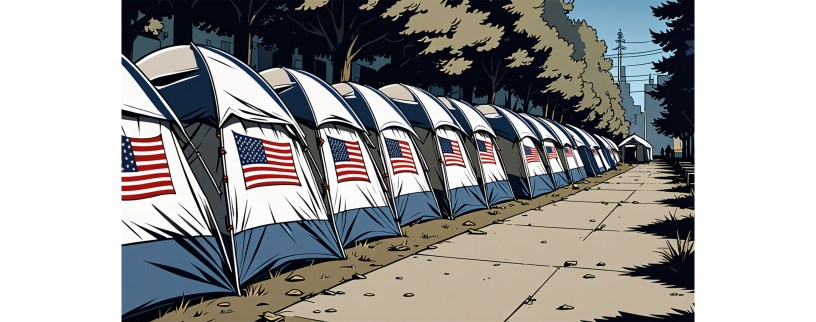
During the COVID-19 pandemic, the Greater Los Angeles VA (aka the West LA VA or Brentwood VA) was thrust into the limelight as oversized tents adorned with the American flag started appearing outside its campus. The tents, initially donated to the Brentwood VA by the conservative group Judicial Watch, were rejected because of their size. They were subsequently gifted directly to the veterans themselves, who gratefully employed them for their intended purpose. Unlike the vast number of typical homeless encampments in and around LA, the vets kept the immediate area around the tents well-maintained. It didn’t take long before the media and lay community assigned them the moniker “Veterans Row.” It was deemed apropos as it was “home to approximately 40 people who had fought in the Iraq, Gulf, and Vietnam wars.” (See Figure 1) Rob Reynolds, a homeless veteran advocate, noted “It just goes to show that if they were given the tools in the first place—a place to stay, somewhere to get stable, dumpsters, all that—they can clean up and take care of themselves.” Residents adhered to a chain of command, and were assigned duties (trash, sweeping, patrol). Reynolds recognized that its inhabitants ran it similarly to that of a military encampment, stating, “They’re running it like a patrol base in Iraq.”
Figure 1: Veterans Row in Brentwood, California (reprinted sans permission)
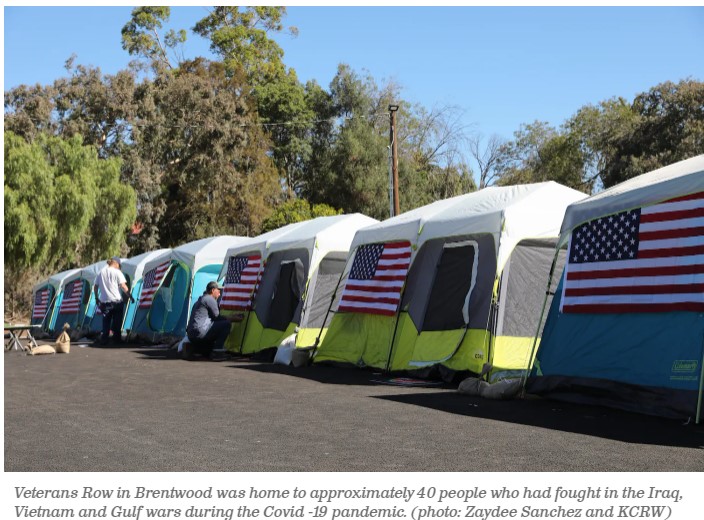
Reporter Anna Scott from radio station KCRW spent a great deal of time on Veterans Row interviewing its denizens. She described her amazement at how organized the camp was, noting “If you were driving by, you could easily mistake this for some kind of government-run emergency shelter program.” But that it was not. People were both intrigued, and dismayed, by Veterans Row. Political rallies and barbecues were held there. The hashtag #VeteransRow was created. Veterans Row eventually became a sanctioned tent city during the pandemic; a place where homeless vets could receive medical care and rehabilitation assistance.
Veterans’ Affairs spokesman, Steve Ruh, attempted to put a positive spin on the encampment, “This is the first time in the VA’s history where we have had this opportunity for Homeless Veterans to fall under the Care, Treatment, Rehabilitation Services.” A breathtakingly shameless bit of face-saving, considering the VA rejected the donation of the tents in the first place. Ironically, and inaccurately, the California American Legion referred to Veterans Row as “an internment camp.” Veterans Row remained intact until the Fall of 2021. Following the murder of two homeless veterans, and a visit from Denis McDonough (The Department of Veterans Affairs Secretary), the encampment was disbanded. Some vets were relocated to an Inglewood supportive housing site, or given hotel vouchers. Others, as homeless veteran’s advocate Rob Reynolds related, were relocated into “new tents on the other side of the [VA campus] fence, the same ones that they have with American Flags.” And so, in a remarkable about-face, the Greater Los Angeles VA decided those unusable tents weren’t so bad after all. Nothing a little public embarrassment couldn’t fix.
The Greater Los Angeles Veterans Affairs Nearly 400 Acre Campus
The Greater Los Angeles Veterans Affairs campus in Brentwood, CA, sits on 388 acres of prime real estate. It may be hard to imagine what nearly 400 acres looks like. Think roughly the size of Universal Studios Hollywood, including the Universal Studios movie lot (@ 415 acres), or half the size of New York’s Central Park (@ 843 acres). The land was donated in the late 1880’s by Arcadia Bandini Steams de Baker “for the purpose of providing homes to U.S. military veterans.” It was formally designated the Western Branch of the National Home for Disabled Volunteer Soldiers, but known colloquially as Soldier’s Home. Following President Hoover’s abolishment of the National Home System, formerly the National Asylum for Disabled Volunteer Soldiers, the homes dedicated to the treatment of disabled soldiers were brought under the purview of the newly created Veterans Administration (later called the Department of Veterans Affairs). Many of the buildings on the Los Angeles VA campus were constructed for the treatment of psychological illness, primarily “shell shock” in the vernacular of WW I, or what is known today as post-traumatic stress disorder (PTSD). However, during the 1960’s and ‘70’s, the VA surreptitiously shifted its focus away from housing and treating veterans to “giving Veterans the tools to return to the ‘outside world’ rather than risk them becoming institutionalized at the medical center,” as if those were the only two available options. As a consequence, the only veterans remaining on campus were those fortunate few recipients of the new, greatly reduced scope of services, offlining an enormous amount of valuable real estate in the process.
Not only did the “powers-that-be” decide to subvert the original, clearly mandated purpose of de Baker’s land grant, they also decided they, not the veterans, could profit off of it. The land granted to be used solely “for the purpose of providing homes to U.S. military veterans” was, according to the VA’s own Inspector General leased to:
- Westside Breakers Club – Youth soccer club
- Brentwood School – 21/22 acres for a sports complex
- Brentwood Construction – ingress and egress access to accommodate construction at Brentwood School
- Breitburn (Bridgeland Resources LLC ) – oil drilling on the VA campus
- UCLA – Jackie Robinson Stadium
- The Association for Parrot C.A.R.E. – a parrot sanctuary
- Barrington Parking Lots – parking lot operators
- Barrington Park – the City of LA for two softball fields, a dog park and a parking lot
- The Shakespeare Center of Los Angeles – production of Shakespearean plays for the general public
LAist, a Southern California Public Radio affiliate, identified several other lessees:
- Enterprise Rent-A-Car
- 20th Century Fox movie studio (to store sets)
- Marriott Hotel – laundry facility
- Private Transportation Company – parking for 194 buses
The Los Angeles VA has claimed that the millions of dollars collected from the above leases were being used for veteran services. Given the nearly 4,000 homeless veterans residing in LA (the largest in the nation), anyone remotely aware of the continuing circumstances of LA’s homeless veterans would likely scoff at such claims.
The Lawsuits and Inaction
Valentini v. Shinseki 2011-2016 and Valentini v. McDonald
In 2011, the Department of Veterans Affairs then-Secretary Eric Shinseki and then-director of the VA Greater Los Angeles Healthcare System, Donna M. Beiter, were sued by “four homeless veterans suffering from Post Traumatic Stress Disorder and other disabilities . . . on behalf of hundreds of other severely disabled homeless veterans in the Los Angeles area,” over the lack of “on-campus supportive housing” on the VA campus. The Vietnam Veterans of America were later added as plaintiffs in the lawsuit. The suit claimed that nearly 30% of Los Angeles VA’s land, circa 2011, was being used for purposes not intended by the original land grant. It further alleged that not only was the land not being used to house disabled vets, but the Los Angeles VA was discriminating against “veterans with serious mental disabilities.” The lawsuit garnered the attention of many prominent organizations including the ACLU, Vietnam Veterans of America and Harvard Law School. Carl M. Loeb, Professor of Constitutional Law at Harvard commented, “If our nation’s laws are enforced, soldiers who risked their lives on the battlefield won’t be condemned to live in dumpsters or under freeways while land donated to house them is used instead to house a rental car company and a laundry facility for luxury hotels.” The accusations were beyond troubling because, like today, LA was home to the largest number of homeless vets in the nation. However, the situation was even more dire in 2011, with an estimated 8,200 homeless vets then living in Los Angeles.
The lawsuit dragged on for four years. In 2012 the U.S. Department of Veterans Affairs motion to dismiss the case was denied. In 2013 the court ruled in favor of the plaintiffs that the Los Angeles VA violated federal law in leasing parts of the campus to outside entities with no association to the care of homeless and disabled veterans. The same year, it also denied a motion filed jointly by the Brentwood School and the UCLA Regents to challenge the court’s prior ruling deeming their leases illegal. In 2015, then-VA Secretary Bob McDonald settled with the veterans, promising a redevelopment plan focusing on care for disabled, elderly, and female veterans.
2016 Draft Master Plan
The result of the four-plus year lawsuit was the 2016 Draft Master Plan. The overarching goal of the plan was to guide the future development of the West Los Angeles VA Campus, with the primary goals of revitalizing the campus, improving medical care and supportive services to veterans, and eliminating veteran homelessness. The ambitious plan included 1,200 permanent supportive housing units, a “450,000 gross sq. ft.” new replacement hospital, a care coordination center to navigate veterans to appropriate on- and off-campus services, and a town center to serve as a “downtown” community square for various everyday and special events.
The West Los Angeles Leasing Act of 2016
Possibly in an effort to monitor the ongoing revitalization of the West LA VA Campus, and to ensure that only those property leases and land-use agreements with a principal focus of benefitting veterans and their families were entered into, President Obama signed the West Los Angeles Leasing Act of 2016 into law on September 29, 2016. Congress subsequently restored leasing authority to the West Los Angeles VA, thereby allowing them to enter into partnership agreements with developers and other providers to fulfill the objectives of the Master Plan.
Implementation
So, of the numerous leases ruled illegal, who got the boot? Surprisingly, the Salvation Army’s “program offering short-term transitional housing for veterans with mental health conditions,” and the Red Cross. Who didn’t? The affluent Brentwood School, Breitburn’s Energy oil well, the Barrington Park complex (see above), the Association for Parrot C.A.R.E. sanctuary, and of course UCLA’s Jackie Robinson baseball stadium. Somehow this group of lessees were able demonstrate that they provided “healthcare benefits, services, or resources being provided directly to veterans and/or their families,” that neither the Salvation Army nor the Red Cross were able to. Hmm.
2018
In 2018, Libby Denkmann, a writer for LAist.com wrote, “But despite its lush surroundings, driving onto the VA campus feels like stepping back in time. Some roads are crumbling or poorly marked, and it’s tough for a newcomer to navigate. Many buildings are visibly decaying or empty.” No discernable progress toward fulfilling the 2016 Draft Master Plan was apparent. As Denkmann reported, “it’s been slow to roll out and it’s threatened by bureaucratic red tape and neighborhood NIMBY [not in my back yard] concerns.” Those pesky rich folks in Brentwood, home to the West LA VA, weren’t too happy about the proposed changes.
Despite objections from the surrounding community of affluent Brentwood, the Greater Los Angeles VA Healthcare System “promised” Congress in 2016 they would construct 490 of the 1,200 permanent supportive housing units within 30 months (March 2019) of Congress returning leasing authority back to them. In June of 2017, 54 veterans were moved into Building #209 on the West LA Campus. You may be thinking: kind of slow, but it’s a start. Well, not so much. Those 54 units were not part of the 1,200 units agreed upon in the 2016 Draft Master Plan. Building 209’s renovation was announced back in 2007; nine years prior to the crafting of the 2016 Draft Master Plan. Imagine, if it took a decade to outfit just 54 units, how long would the recalcitrant West LA VA take to construct 1,200 units, not to mention the other buildings mentioned in the Draft Master Plan?
Homeless vet advocates and a few local reporters kept the pressure on the West LA VA to fulfill their obligations. In 2018 the VA admitted things were moving too slowly and sought to hire a “Principal Developer” to supervise “the renovation and construction of hundreds of housing units.” As of 2018, the total cost and funding for the 2016 Draft Master Plan remained unclear. But typical of prior West LA VA “strategic” thinking, the VA issued an eviction notice to the POST program: a PTSD outpatient clinic that serviced over 1,000 veterans in Building 256 on the VA campus. They purportedly did so “to make way for development,” development that is likely years away. To recap: the West LA VA, whose mission it is to help veterans suffering from a myriad of disabilities including PTSD, disbanded a successful PTSD program on its own campus in preparation for a development that is years away from realization. Richard Aprahamian, a navy veteran, asserted that should a temporary location not be found, “you’re going to see a lot more guys back on the streets, needle in their arm or dead.”
COVID-19 Pandemic (2020-2022)
The arrival of the COVID-19 pandemic upended the lives of most Americans, including thousands of homeless Angelinos. When restaurants and businesses closed, so did the food supplies and bathroom facilities that many homeless relied upon. The physically and medically frail homeless veterans living in tents and dilapidated cars were left to care for themselves. Why? Because the West Los Angeles VA “ignored an oversight board’s call for more emergency shelter beds on the sprawling 388-acre campus, with rolling green hills and decrepit buildings that are largely empty.” While some Los Angeles officials and homeless services personnel were willing to “try anything,” the West LA VA appeared to be only interested in justifying their own foisted roadblocks.
In spite of the West LA VA’s self-imposed obstacles, homeless veterans received Judicial Watch’s donation of large tents that the West LA VA had rejected. Veterans Row was established, and started to gain media attention. Advocates for homeless veterans began speaking out, capturing additional attention from the media. These advocates reminded anyone who cared to listen that although the number of homeless vets in the LA area decreased more than 50% since 2011, LA was still the nation’s leader in homeless vets with over 3,900 in 2020.
The pandemic was viewed by many as uncharted territory. People who otherwise may not have been inclined to, stepped up to help: family, friends, neighbors, and even strangers. Therefore, it was unsurprising that anger grew among those seeking assistance for homeless vets as the West LA VA appeared to slow-walk any such assistance. Reginald Smith, a retired Marine veteran, noted that the West Los Angeles VA “property [is] sitting just behind an imposing black iron fence . . . [while] every day, 22 veterans die because of homelessness, mental health issues.” Dean Lee, an Army veteran, commented “We’re standing our ground as a peaceful protest.” Rob Reynolds noted, “A lot of what’s going on here ties right into the pay-for-play corruption that you see going on at L.A. City Hall.” However, Reynolds pointed out that the more outreach he and others do, the more it forces “the VA’s hands to do its job, because now that we’re bringing them here and passing them the paperwork, you don’t have a choice, you have to start doing something.”
It turns out the settlement reached between the West LA VA and veterans in 2015, which included the conceptually sound 2016 Master Plan, was not “court-enforceable,” and contained no legal mechanism to hold the West LA VA’s feet to the fire. Predictably, the revitalization of the West LA VA campus had therefore been proceeding at a snail’s pace. Blame was placed on a myriad of factors from environmental reviews to financing to construction. Steven Peck, President and CEO of U.S. VETS, conceded the project was made more challenging by the current state of the campus noting, “The infrastructure is 50 years or 60 years old, . . . All the buildings need to be renovated significantly.” Maybe one should ask, why was the campus allowed to deteriorate so badly? The stark contrast between the decrepit buildings of the VA campus, the 22-acre Brentwood Sports Complex, and UCLA’s gleaming Jackie Robinson baseball stadium and locker rooms, could not be more glaring. It is the very personification of the gaping chasm between the haves and the have-nots.
In blatant disregard of Congress’ West Los Angeles Leasing Act of 2016, which mandated that any leaseholders on the West LA VA campus “principally benefit veterans and their families,” the VA signed new agreements with an oil drilling company, UCLA (for an additional practice field) and Brentwood School. The contemptuous indifference to Congress’ mandate, and the lack of implementation of the 2015 agreement, including the 2016 Draft Master Plan, led fourteen homeless veterans and the National Veterans Foundation to file another lawsuit against the West LA VA. The lawsuit sought permanent supportive housing for at least 3,500 eligible homeless veterans on the West LA Campus and nearby apartments, and an injunction against the VA from using the land for purposes unrelated to disabled veterans’ housing and healthcare.
CNN’s Nick Watt spoke with Joshua Petitt, one of the plaintiffs associated with the most recent lawsuit (2022). Understandably, Petitt was frustrated and angry about the lack of compliance and follow-through of the prior court decisions. When discussing the residents of Brentwood, Petitt noted the following, “They don’t want us here, bro. I mean, I get it. But I don’t care. People always talk about Beverly Hills. But Beverly Hills ain’t nothing compared to Brentwood. That’s why they don’t want us here, because we might be hard to deal with, we have some problems. But they can send us to war to get those problems? But then not have to deal?” Mark Rosenbaum, an attorney on the current (2022) and prior lawsuit (2011) reminded Watt, “This is a battle that’s been going on for decades. And it’s tragic that we have to go to a federal court in order that vets who served this country can be served by this country.”
2023-2024
Good news finally arrived for LA’s homeless veteran plaintiffs on December 14, 2023. A federal judge, David Carter, rejected the federal government’s challenge to the fundamental mandate that the West LA VA is required “to house veterans with disabilities.” Imagine that! A federal judge willing to hold VA officials accountable for the housing of disabled vets when it is deemed essential for the treatment of their disabilities. More importantly for the West LA VA plaintiffs, Carter’s decision enabled their case to move forward, and he committed to doing so expeditiously. Carter encouraged the government to work with the plaintiff’s attorneys to reach a settlement. In reference to Los Angeles, he also reminded everyone, “We’re the homeless [veterans’] capital of the world right now. So, I don’t want to hear excuses about [how] we can’t afford it. We can’t afford what’s happening right now.” Carter stated that he aimed to return the West LA VA campus to housing roughly 4,000 veterans, as it did decades ago before the illegal leases were concocted. Furthermore, he expressed a complete disregard for any potential pushback from the surrounding community. Unsurprisingly, the VA’s counsel, Brad Rosenberg, challenged Carter’s contentions concerning the “VA’s legal duties to serve veterans at the West L.A. campus.” Unbelievable! I guess the West LA VA and its counsel believe that their duty is to host baseball games at UCLA’s Jackie Robinson Baseball Stadium, watch youth sports at the 22-acre luxury sport complex for the very exclusive Brentwood School, or profit from the negligible returns from an oil rig – anything but care for veterans and their families.
No settlement was reached. So the 2022 lawsuit, now a class-action lawsuit, moved forward with Judge David Carter presiding. In May, Judge Carter issued a partial summary judgment stating that the VA is discriminating against veterans whose disability compensation exceeds certain income thresholds. This situation is preventing many veterans from qualifying for planned housing on the campus due to their disability payments pushing their income above the VA’s eligibility limits. The non-jury case between Los Angeles veterans and the West LA VA began on August 6, 2024. At the heart of the case is how much housing will be built for homeless and disabled vets, and what will become of the many leases Judge Carter has already ruled illegal.
Judge Carter, law clerks and attorneys walked the 388-acre campus. Carter saw first-hand the pristine Brentwood athletic complex, which included “a football field, workout tent, covered basketball courts, a baseball field, six tennis courts and a 10-lane pool.” They saw UCLA’s Jackie Robinson Stadium complex and its associated practice field, along with Bridgeland Resources’ oil operation. Over the course of the trial, Carter listened to attorneys from all sides. However, by all accounts, one thing was clear: Carter didn’t want the veterans to get shafted yet again. Further, he repeatedly warned the defendants that he would not tolerate continued efforts to slow-walk the case.
Bribery, Cronyism and Corruption
On September 6, 2024 Judge Carter filed a 125-page ruling. In his opening summary he wrote:
“Over the past five decades, the West LA VA has been infected by bribery, corruption, and the influence of the powerful and their lobbyists, and enabled by a major educational institution in excluding veterans’ input about their own lands . . . In a series of lengthy, renewable leases, the VA authorized leaseholders to build permanent athletic facilities—after permitting these concrete structures to be built on veterans’ land, the VA now points to the waste that would be incurred by tearing them down. In effect, the VA has quietly sold off these lands just as surely as granting a quitclaim deed . . . The VA must remediate its mishandling of this resource so that the land may once again be available for its intended purpose: the housing of veterans.”
At last, it appears the LA vets were blessed with a Judge who was unable to be swayed by CA’s powerful elite. He recognized that the VA’s problems were of their own making. Further, he expressed his dissatisfaction with the defendants and empathy for the plaintiffs, observing:
“The West L.A. VA promises they finally have a plan that will end veteran homelessness in Los Angeles — but only if the plaintiffs leave them alone and the court does not issue an injunction. After years of broken promises, corruption, and neglect, it is no surprise that veterans are unwilling to take them at their word.”
Judge Carter strongly suggested that the lawyers for the holders of the illegal leases (principally UCLA, Brentwood School, and Bridgeland Resources LLC – oil drilling) draft proposals that predominately served veterans, and work with the government and veterans to negotiate an agreement. To the judge’s dismay, that did not happen. As a result, Judge Carter initiated the negotiations himself at a September 25, 2024 hearing. UCLA’s attorney, Ray Cardozo, voiced that UCLA was willing to increase “services to veterans.” Bridgeland Resources offered to trade 1.5 acres of its property and increase royalties from 2.5% to 5.5%. Unmoved, Carter ordered their primary well capped. Similarly, Brentwood School offered to “give back about five acres of its 22-acre lease for housing.” Unimpressed, Judge Carter threatened to “put sand in” or bulldoze the pool and destroy the track and other athletic facilities built on VA land, should a more viable plan not be put forth. What was interesting was the defendants’ willingness to give back acres to the VA, as if it was theirs to give in the first place. It simply confirms the notion that these “leaseholders” viewed their land grabs as permanent leases, with no intention of returning any of the land to the veterans. Without Judge Carter, that may very well have been the case.
Frustrated and tired after eleven hours of negotiating with the defendants, Carter ordered UCLA’s Jackie Robinson stadium and adjacent practice field closed as of noon on September 26, 2024 until further notice. Brentwood School’s athletic complex was purportedly allowed to remain in use as the school, its attorney Louis “Skip” Miller, and the veterans and their attorneys continued negotiations.
Ceding Land One Doesn’t Own
On October 3, 2024, The Daily Journal reported that Carter and attorneys for Brentwood School were working on a tentative agreement for shared use of the athletic complex that Brentwood constructed on VA land. Judge Carter wanted it clearly stipulated that “the property belonged to the homeless and temporarily housed veterans in the area” and that they were “graciously” allowing the Brentwood School to use the land. Correspondingly, MyNewsLA reported that UCLA proposed a 12 month increase in rent from $320,000 to $600,000, and ceding 2 acres of land, in addition to their continuing to care for veterans “at little or no cost.” Once again, an interesting choice of words – “ceding” – given the land was never theirs to cede. By Monday, October 7, 2024, the Daily Journal reported that UCLA, through its attorney Raymond Cardozo, was “pleading” with Carter to reopen Jackie Robinson Stadium. Cardozo stated, “that the weeklong closure of UCLA’s Jackie Robinson Stadium has caused nothing but ‘trauma’ to the school’s baseball team and did nothing to benefit homeless veterans in the area.” Of all the nerve. So, UCLA’s baseball athletes are experiencing ‘trauma’ from the comfort of their dorm rooms for not being permitted to play baseball, while thousands of LA’s homeless vets are traumatized every day as they sleep on the streets, hoping not to be assaulted, while unsure where their next meal will come from. Maybe the UCLA baseball team ought to consider swapping living arrangements with the homeless vets. Possibly then, they would understand what the vets are fighting for. UCLA can also find, or share, another stadium. Any unhappy baseball players could transfer to another school. However inconvenient these and other options may be, UCLA and its ball players do in fact have other options, unlike the homeless vets subsisting and dying on the streets of LA.
UCLA Intends to Appeal
Based upon the Daily Journal’s reporting, it seems apparent that UCLA intends to appeal should things not go their way. Cardozo stated, “We have to end this lockout, judge. It’s fundamentally unjust and it’s not necessary. We are providing something much more to the veterans than the law requires and they don’t benefit a lick from an empty stadium.” An empty stadium no, but a place to put hundreds of units of housing for homeless and disabled vets, yes. Judge Carter indicated the stadium would remain closed for another week, giving him time to weigh the proposal.
On October 7, 2024 Judge Carter again met with the relevant attorneys. He inquired whether anyone representing UCLA was present. No one responded. Carter expressed his frustration over the University’s ongoing lack of participation in the hearings. He indicated that the university was both “complicit” and “not innocent” in using veteran land “literally for free up until the 1990s,” despite being told by a federal inspector general that their lease was illegal. Later in the hearing, Carter got his answer. A UCLA attorney graced Carter’s presence at the hearing to notify him that the University would be appealing his ruling.
“The Wizard Behind the Curtain“
Knowing UCLA’s position, Carter focused his attention on the Brentwood athletic complex. He indicated that he and the school were close to finalizing a deal. The deal included expanding the hours veterans are able to use the sports complex, and $5 million dollars for veteran services. Two stumbling blocks were reported – who would control how the money was spent, and when the money would be paid. However, what transpired next was most astonishing. Perplexed and frustrated at how the VA’s own lawyers were unwilling to make decisions on behalf of the VA, including whether the VA planned on appealing Carter’s ruling, Carter stated, “Who’s the wizard behind the curtain here? Can anybody share with me?” He finally received an answer from the VA’s attorneys that helped make sense of the last two years of inaction and delays. “Decisions are made after being sent ‘up through the chain’ at the U.S. Department of Justice and the VA.” Apparently, there is uncertainty regarding whether the Biden-Harris Administration will challenge Carter’s rulings. Given the myriad of affluent and political connections between the upper echelon of UCLA’s administrators and Regent’s Board members, Brentwood School alumni and the Brentwood Community (home to Harris and Emhoff) and the DNC, it is no wonder that little has been done to help the thousands of veterans who served this country, yet have not received the care and services they are rightly due.
The West LA VA litigation has been ongoing for over a decade, with more than just Judge Carter deeming the landgrab leases illegal. And yet, little to nothing has been accomplished. Quite possibly, it is because the affluent leaseholders knew that those in a position to hold their feet to the fire would not do so. When Kamala Harris was Attorney General of CA, she did nothing to hold the leaseholders accountable, and neither has current CA Attorney General Rob Bonta. Why? Could it be that too many of their benefactors prefer things to remain as they are, and just want someone to make the lawsuits go away? Who cares about the roughly 4,000 homeless veterans who are in dire need of housing, mental and substance abuse treatment, and other services? Has the principle that “the needs of the many outweigh the needs of the few” become so inverted that the needy “many” are now the privileged students and ball players of Brentwood School and UCLA, while the fortunate “few” are the homeless vets?
The disingenuous conduct of UCLA is most astonishing. They really thought they could buy their way out of this by just increasing their contribution to be more in line with what they should have been paying for decades, but failed to do so. Their failure to bother to show up at Carter’s hearings showed their unwillingness to negotiate. When Carter pushed them, they finally revealed their true intentions: they were going to appeal. They believe they can get what they want. After all, VA administrators, and local and state politicians, have allowed them to do so for decades.
Will Veterans Finally Get Some Temporary Modular Housing?
On October 18, 2024, Judge Carter ratcheted proceedings forward another step, much to the displeasure of the US Department of Veterans Affairs, along with the unhappy holders of nullified VA leases, including UCLA. Undeterred by the threat of their appeals, present or future, Carter pressed on with his directive to get as many homeless vets off the streets of LA as he possibly could prior to the start of the rainy season. He ordered the parking lot for Jackie Robinson Stadium to be the new home of 32 temporary modular housing units, with another 24 units placed on a lot owned by the National Cemetery Administration (See Figure 2). At the end of the day, the VA tentatively agreed to fund 106 units, with the caveat that in doing so, they were not conceding their “right to appeal the order.” Stupefyingly, Brad Rosenberg, the Department of Justice attorney for the Department of Veterans’ Affairs, reiterated “that the government disagreed with Carter’s underlying ruling that the VA had a fiduciary duty to build housing for veterans on the campus at all.”
Figure 2: Schematic of 32 Units of Modular Housing on the Parking Lot of UCLA’s Jackie Robinson Stadium (reprinted sans permission)

As anticipated, on October 25, 2024, VA attorney Brad Rosenberg notified Judge Carter that he would be filing an appeal with the 9th Circuit Court of Appeals, on behalf of his clients. Yes the VA, on behalf of the Biden-Harris administration, is actually arguing that they have no fiduciary responsibility to construct emergency housing for LA’s homeless vets. Rosenberg noted that they will argue in part “that the payment will cause irreparable harm to the V.A.’s funding.” How brazenly self-serving, given the decades of illicit profit the VA reaped from their illegal leasing of land granted solely “for the purpose of providing homes to U.S. military veterans.” Once again, it is testament to the fact that the VA and its distinguished partners in crime view these leases as permanent, and will fight bitterly to keep them that way. And what do the veterans get in exchange? They get to live on the streets of LA in squalor, with many having little to no healthcare, including much needed psychological services. So, Mr. Rosenberg, where did all the money go? It surely has not gone to the veterans living in LA. By all accounts, neither has it gone to maintaining the buildings on the West LA VA campus. Whose pockets has the money lined?
Judge Carter promised to continue moving proceedings forward until and unless the 9th Circuit of Appeals overrules him. He doesn’t want LA’s roughly 4,000 homeless vets living on the streets during the cold winter rainy season. Neither the Biden-Harris administration nor the VA may care, but Judge Carter appears to. Carter has repeatedly noted the failed promises, cronyism and corruption, the blatant kowtowing to the affluent Brentwood community, and the stark contrast between a government that “swiftly deploy[s] its resources to send [veterans] into conflict, then claim an inability to overcome funding shortfalls and administrative hurdles when they need shelter and housing back at home.”
This Land Is Not Your Land
What has happened to America? Our veterans defended the freedoms that allow for the abhorrent – yet constitutionally protected – antisemitic protests, tolerated on college campuses under the guise of free speech, to even happen. They helped protect US interests and allies across the globe when called upon to do so. They put their lives on the line so that Americans can live free of the worries experienced by many in other countries. And what have they received in return? Indifference and an inability to live on land that was gifted to them. Maybe the US military ought to go on strike until the veterans’ demands are met. As for California’s Democratic leadership (remember it holds a supermajority), it is up to the rest of the nation to hold them accountable, as it is apparent there are not enough Californians willing to do so. Unless real action that benefits veterans is achieved, just chalk up everything else you read to virtue signaling. CA is good at it. After all, it is the home of Hollywood and everything that is manufactured illusion.
As this case continues to unfold, let’s hope Judge Carter remains unbiased and fair-minded, and that he is able to continue his work unencumbered by any attempted influence-peddling on the part of the eminently well-heeled and well-connected players associated with this lawsuit. His impartiality, up to this point, is the only thing saving LA’s roughly 4,000 homeless vets from being permanently shunted aside by the City of Angeles’ entitled elites. Sadly, as it stands now, Judge Carter appears to be the only one, aside from the plaintiffs, who is willing to actually honor the original terms of the deeded land grant.
How Is This Allowed To Happen?
Given the extent (in both magnitude and years) of privation endured by LA area veterans, one may wonder: how can this be allowed to happen? Plain and simple, the two big C’s: cronyism and corruption. In spite of media attempts to paint CA Senator Dianne Feinstein in a positive light, Veterans Today reported in 2012 that then-Senator Feinstein had “rewarded a U.S. Attorney who waged war against the landmark ACLU lawsuit [2011] that exposed what Veteran activists have known and openly protested over the past six years, that the VA is dealing in illegal real estate contracts.” She did so by submitting his name, Andre Birotte Jr., to then President Barack Obama for a Federal District Judgeship. Obama subsequently nominated Birotte for the position. Birotte did not just represent Shinseki and Beiter in their initial case for misappropriation of the West LA VA (federal) land, he also appealed U.S. District Judge Otero’s decision that the many leases his clients executed were illegal. This resulted in further delays for the roughly 8,200 homeless vets in LA at the time. Even more troubling was Feinstein’s association with two of the nine illegal leases. Purportedly, Feinstein’s “affluent and influential friends . . . manipulated a 30-year agreement to build a public park on Veteran’s property.” Additionally, Feinstein’s husband was an active member of the California Board of Regents when the essentially “permanent” lease for UCLA’s Jackie Robinson Stadium and associated facilities were negotiated. Interestingly, Democrat Henry Waxman was the Representative for the Beverly Hills District (2013-2014) where the West LA VA is located. Waxman’s alma mater was UCLA. As a result, some believed he placed his allegiance to his alma mater over his allegiance to LA’s veterans.
In all fairness, Waxman would likely dispute the above-mentioned accusation. In 2012, NPR’s Ina Jaffe interviewed several people regarding the West LA VA including Waxman, who stated “the West L.A. VA was in business for itself.” Jaffe reported Waxman had been “trying to protect the property from commercialization for years.” She further noted that both Waxman and Feinstein passed legislation making it illegal for the West LA VA to sell or lease the property. However, the VA skirted around the legislation citing another law that allows them to share facilities “to secure health care resources which otherwise might not be feasibly available.” Yes, somehow Jackie Robinson Baseball stadium, Brentwood School’s athletic complex, a parrot sanctuary, parking lot and studio set storage have been justified “to secure health care resources.” Waxman further expressed his dismay that the VA was unable to provide an accounting of where the millions in lease money have gone. However, that should not have come as a surprise to Waxman. Most political measures involving taxpayer money that have graced CA’s ballots rarely have any degree of transparency or accountability associated with them. Thanks to the Freedom of Information Act, NPR was given access to extended lease agreements and associated correspondence. This led them to estimate the West LA VA had taken in somewhere between $28 million to more than $40 million between 2002-2012. Just think how many of the over 8,000 homeless vets in LA (at the time) that money could have been put towards to provide housing, mental health and other disability-related services.
Undeterred by Judge Otero’s decision that virtually all of the leases on the West LA VA campus were illegal, the VA appeared to do little to change or modify the unlawful lease agreements. This led to the aforementioned additional lawsuits, and the VA’s further malfeasance in failing to effectuate the ruling and subsequent agreed upon actionable items of the Draft Master Plan. Why? Because there was not sufficient oversight or enforcement, not even from California’s “top cop,” then-Attorney General Kamala Harris. True, Harris did make some effort to help CA vets. She was willing to issue a consumer alert to CA military personnel against scams, go after the Help Hospitalized Veterans charity for “excessive compensation” of executives and various state code violations, and reach a settlement with a private military contractor for illegally evicting active duty military and their families.
Harris touted her commitment to military servicemembers and veterans during a 2012 interview with the Associated Press, stating she “made going after those who exploit veterans a top priority when she took office in 2011.” She again reiterated her obligation to veterans in 2016 stating, “It is unconscionable that 22 veterans take their own lives each day. We must ensure that they have support to adjust to civilian life.” She pledged to “’clean up’ the scandals and reduce wait times at the U.S. Department of Veterans Affairs, [stating] it is a matter of life and death.” Kamala’s words would be commendable if she were willing to turn them into action. Unfortunately, her commitment to veterans apparently did not extend to the West LA VA in her own back yard. Her lack of any definitive action taken when the West LA VA failed to comply with Judge Otero’s decision is testament to that. Could the fact that Harris and Emhoff resided in Brentwood, home of the West LA VA, prior to becoming VP of the US play a role? Or maybe Harris simply didn’t want to upset her affluent neighbors, and likely future benefactors, who expressed their “NIMBY concerns.”
The consequences of cronyism are broad and pernicious. Decisions purportedly made in the best interests of the many are stealthily hijacked by the selfish favoritism and allegiances of the few. Years or even decades of rot may proliferate unchecked in the shadows while the elites are preoccupied with favorites and alliances of their own. Kamala’s rise in politics began with her sleeping with an influential politician. It appears that the cronyism that propelled her early ascent has remained a foundation of her political career.
Where Has All the Money Gone?
California, the most populous state in the nation, is home to such iconic locations as the Golden Gate Bridge, Silicon Valley, Hollywood, Disneyland, Universal Studios, Balboa Park and the San Diego Zoo. It is also home to many of America’s rich and famous. Unfortunately, it is equally “home” to the nation’s largest homeless population, including the largest number of homeless veterans. Once known for its beautiful landscapes, weather, attractions, and as the ultimate land of opportunity in a land of opportunity, it is now overcome by an affordability crisis, wildfires, earthquakes, and illegal immigrants. One may wonder why the state doesn’t do more to address these issues.
California is a very progressive liberal blue state. It has held a Democratic legislative supermajority since 2012. Accordingly, Democrats have held unfettered power in both the executive and legislative branches of its state government for over a decade. It is therefore difficult to blame Republicans for anything negative that happens in the state. Yet, taking responsibility and owning their mistakes and misdeeds are qualities that California’s Democratic political leadership do not appear to possess.
Over the years, Californians have seen numerous ballot measures purporting to address the issues of homelessness and a lack of affordable and low-income housing. Since 2000, there have been, by a conservative count, at least 67 ballot measures statewide and in several major California cities. This includes 9 statewide measures, 8 Los Angeles County measures, 23 San Francisco County measures, 21 Alameda County measures and 6 measures in San Diego County (See Annex). The vast majority of these, with the exception of those in San Diego County, won approval. Most necessitated a rise in taxes, in one form or another. So, what happened to the billions of dollars dedicated to eradicate homelessness in the state? Many Californians and CA organizations are seeking answers to that question. It turns out a state audit found that the California Interagency Council on Homelessness (Cal-ICH) “has not consistently tracked and evaluated the state’s efforts to end homelessness.” They further determined that only “two of the five state-funded programs reviewed [were] likely cost-effective, but the state lacks outcome data for the remaining three.” Cal Matters reports that California has “allocated an unprecedented $24 billion to address homelessness and housing during the last five fiscal years.” However, where that money went, and whether it led to measurably successful outcomes, are unanswerable questions. What is answerable, however, is the number of homeless individuals on California’s streets. Over the last five fiscal years, CA’s homeless population has increased from 151,000 to 181,000, with more than 2/3 of those individuals living on the street or in some makeshift outdoor shelter. Sadly, the audit came as no surprise to advocates and outreach personnel, such as Todd Langton, who works with the homeless community in Silicon Valley. Langton stated, “We just shake our heads and say, ‘They’re spending so much money on this. What’s going on?’”
Given the overwhelming lack of accountability and transparency, it is no wonder Californians are growing wary of voting for additional ballot measures that claim to address issues related to homelessness, such as affordable housing, mental health treatment and substance abuse. They are losing faith in local and state governments to use their heavily taxed money wisely. While some argue that CA’s tax system is less regressive than many other states, with its affluent citizens paying more, others will argue that simply looking at tax rates paints an incomplete picture.
California has 10 brackets in their income tax system. The high cost of living in CA is across the board – housing, insurance, food, utilities, gasoline, etc. Therefore, in dollars and cents, what is considered middle class elsewhere, is very likely not middle class in the state of CA. So when the government inexplicably loses track of $24 billion of taxpayers’ hard-earned money, forked over in good faith, ostensibly to eradicate homelessness in the state, it is simply inexcusable!
Following the above-mentioned California State Auditor’s report on homelessness, two Republican Assemblymen, Joe Patterson and Josh Hoover, authored separate legislation aimed at accountability and transparency for taxpayer funds spent by any state agency or department on homeless programs. Patterson’s bill, AB 2570 (July 2024) which had bipartisan support, required the relevant data to be collected, reported to the California Interagency Council on Homelessness, and ultimately made available to the public annually. Hoover’s bill, AB 2903 (September 2024) sought to reduce the reduce the reporting time to the Agency from 60 days to 45 days. Gov. Newsom vetoed both bills saying they were duplicative to AB 799. One may wonder, if Patterson’s bill was so repetitive of existing legislation (AB 799), why did it not receive one opposition vote from any of CA’s democrats? Newsom’s vetoing of accountability and transparency legislation may just shed some light on how high CA’s backroom dealings must go.
Los Angeles’ Own Questionable Dealings
Now, if you are an optimist, you could argue that CA is a very large state that has a very large bureaucracy, so it is understandable that the state government lost track of $24 billion dollars to fight homelessness. You might further believe that local governments would not be as careless as the grownups-in-charge in Sacramento. For brevity’s sake, and because the West LA VA is the primary focus of this article, let’s look at the city and county of Los Angeles.
When Karen Bass was campaigning for Mayor of LA in 2022, she promised to provide housing (interim or permanent) for 17,000 homeless Angelenos during her first year. She claims to have surpassed her goal, purportedly housing 21,694 homeless individuals in “tiny homes” or “Inside Safe” units, provided 7,717 individuals with housing vouchers and placed 3,551 people in permanent housing units.
Tiny homes are 64 square-foot shed-like structures. Once all fees, permits, concrete foundations, utilities and an associated office were constructed at the designated site, the cost for each unit was roughly $130,000. Yes, you read that correctly, $130,000 for a structure smaller than some DIY Home Depot sheds. Even building a shed community in LA is expensive! Understanding this may help you gain an appreciation for why housing is so costly, and affordable housing is in short supply.
“Inside Safe” was an initiative supported by LA Mayor Karen Bass that aimed to reduce LA’s homeless population by providing immediate interim housing (primarily motel rooms) and support services to those living on the street, thereby boosting their ability to manage their own well-being and stability.
Project Homekey, a CA emergency housing program initiated during COVID, grants local government agencies funds to purchase and refurbish housing (hotels, motels, vacant apartment buildings, etc.) into affordable housing for those living on the street, or at risk of living on the street.
While the aforementioned numbers provided by Bass’ office are impressive, the problem lies in their accuracy. As LAist points out, “A person may be counted more than once across categories.” So, if a person started out moving into an Inside Safe motel room, then moved to a tiny home, then onto a more permanent unit, that person would be counted three times. Conversely, “Anyone who left temporary or permanent housing and returned to living on the streets has not been subtracted from these numbers.” Thus, the statistics reported are crafted to make the programs appear more successful than they may actually be. A quick drive in and around LA serves as testament to that.
Despite their strategically massaged statistics, Mayor Bass and her administration continue, in their own way, to strive to combat LA’s homeless crisis. This year, they touted receiving the additional funds needed to secure four more Project Homekey sites. While commendable, they once again fail to provide all the details. Westside Current, an LA-focused news group, conducted a months-long investigation into the success of LA’s Project Homekey program. They discovered that 71% of LA’s Project Homekey rooms are vacant (1,538 of 2,157 rooms). Why? Have all the homeless in the City of Los Angeles fortuitously seen their prospects improve and secured housing on their own? Clearly, no. Rather, the purchased buildings are reportedly in such a state of disrepair that it will costs millions of dollars to renovate them. In fact, buildings purchased in 2020 have an anticipated date of completion of April 30, 2025. However, when Westside Current investigators visited the sites, they found only a handful of construction workers present.
CA politicians, from the state executive branch to local politics, appear incapable of not misusing their power. Whether it is providing favors for benefactors, or showing favoritism in issuing contracts, some governmental officials are abusing their power for private gain. You may be thinking, “this happens everywhere.” Yes, it does. But its pervasiveness in CA not only subverts the fair bidding process, but also leads to an enormous misallocation of public funds and a dismally mediocre record of progress for tax dollars spent. In the end, in LA’s case, it is the poor and homeless that suffer, while CA’s politicians and affluent, influential elites live comfortably with little concern for the downtrodden.
Conclusion
The West LA VA has suffered from cronyism and corruption for decades. The VA, California politicians, and various well-connected businesses (Bridgeland Resources, Paramount Studios, etc.), educational institutions (Brentwood School and UCLA), and an entire community (Brentwood), have been more than happy to continue to leech off of needy and broken soldiers. It does not matter that their privileged lifestyles might not exist without the service and sacrifice these men and women provided our country. The roughly 4,000 homeless veterans living under overpasses, in tents, or makeshift “homes” comprised of boxes and anything else they can find, do not matter. It doesn’t matter that the land grant deed specifically stated that the land must be used “for the purpose of providing homes to U.S. military veterans,” clearly inclusive of those veterans most in need of a home. None of this matters. What does matter is that a group of privileged students continue to play baseball, and an affluent school’s children continue to have a lavishly equipped athletics complex in which to play their sports.
Enter the honorable Judge David O. Carter, the jurist overseeing the current West LA VA case. Carter has ruled the “permanent” leases on the West LA VA campus illegal. He has demanded that any organization with a nullified lease, who wishes to continue to use VA land, must draft a proposal showing how veterans will “principally benefit” from the leaseholders’ continued use of the land. Two of these organizations, UCLA and Brentwood School, have deep pockets and high-profile attorneys. UCLA and the US Department of Veterans Affairs, on behalf of the Biden-Harris administration, have informed the court that they will appeal. Only time will tell if Brentwood School will follow suit. Thankfully, Judge Carter and the attorneys representing LA’s homeless veterans have indicated they are in this for the long haul. Let’s hope and pray that Carter is able to succeed where others have failed. At present, he appears to be the one person in a position to help LA’s vast veteran homeless population, unencumbered by the considerable cronyism and corruption that has plagued past efforts.
Annex
California Ballot Propositions Related to Housing and Mental Health Treatment of Veterans (2000-2024)
| Election Date | Proposition # | Pass/Fail | Title | Summary |
| California State-wide Ballot Measures | ||||
| March 7, 2000 | 16 | Passed | Veterans’ Homes Bond Act 2000 | Not provided |
| November 7, 2000 | 32 | Passed | Veterans’ Bond Act of 2000, A.B. 2305 | Not provided |
| November 5, 2002 | 46 | Passed | Housing and Emergency Shelter Trust Fund Act of 2002, S.B. 1223 | Not provided |
| November 7, 2006 | 1C | Passed | Housing and Emergency Shelter Trust Fund Act of 2006 | Not provided |
| November 4, 2008 | 12 | Passed | Veterans Bond Act of 2008, 1572 | Not provided |
| June 3, 2014 | 41 | Passed | Veterans Housing and Homeless Prevention Bond Act of 2014 | Not provided |
| November 6, 2018 | 1 | Passed | Veterans and Affordable Housing Bond of 2018 | “Mandatory proposition, placed by the state legislature and the Governor, will authorize $4 billion in bonds to fund various veterans’ home loans and affordable housing programs.” |
| 2 | Passed | No Place Like Home Act of 2018 | “This mandatory proposition, placed by the state legislature and the Governor, will allow revenue generated by 2004’s Proposition 63, the 1 percent tax on incomes above $1 million, be used for $2 billion in bonds for homelessness prevention housing.” | |
| March 5, 2024 | 1 | Passed | Bonds for Mental Health Treatment Facilities | “Authorizes the issuance of $6.38 billion in bonds to build mental health treatment facilities, as well as fund housing for veterans and homeless individuals. Shifts about $140 million of annual existing tax revenue for existing tax revenue for existing mental health, drug, and alcohol treatment care from the counties to the state.” |
| Los Angeles County Ballot Measures | ||||
| November 4, 2008 | B | Passed | City of Los Angeles Low Rent Housing Authorization | Using money acquired from Prop 1C, and not via additional tax increases, “create a potential 52,000 low income housing units according to Los Angeles Area Chamber of Commerce.” |
| November 8, 2016 | HHH | Passed | Los Angeles Homelessness Reduction and Prevention Housing and Facilities Bond Issue | “$1.2 billion in bonds to fund housing for homeless people and people at risk of becoming homeless and to fund facilities that provide mental health care, addiction treatment, and other services” with an estimated average cost to repay being “$9.64 per $100,000 in assessed property value.” |
| March 7, 2017 | H | Passed | Los Angeles County Sale Tax for Homeless Services and Prevention | Authorizes “a 0.25 percent county sales tax for 10 years in order to fund homeless services and prevention.” |
| November 3, 2020 | Multiple | Passed | Bellflower, CA, Measure M, Sales Tax; Culver City, CA, Measure RE, Property Transfer Tax; Hawthorne, CA, Measure UU, Utility Tax; Lancaster, CA, Measure LC, Sales Tax; Palmdale, CA, Measure AV, Sales Tax; Santa Monica, CA, Measure SM, Property Transfer Tax; West Hollywood, CA, Measure E, Sales Tax; | Several cities in LA County had ballot measures to increase sales tax. Proceeds would go to addressing homelessness, veteran issues, mental health, and other things. |
| November 8, 2022 | LH | Passed | Low-Income Rental Housing Measure | Authorizes “the city to develop up to an additional 5,000 low-income rental housing units per city council district for a total of 75,000 additional units.” |
| ULA | Passed | Tax on $5 Million House Sales Initiative | Authorizes “a 4% tax on properties sold or transferred for more than $5 million and a 5.5% tax on properties sold or transferred for more than $10 million [with revenue allocated] to projects that address housing availability at certain income thresholds and homelessness prevention.” | |
| DTS | Passed | Tax Transfer Advisory Measure | Authorizes “the city to spend 30% of additional revenue provided by the Comprehensive Real Property Transfer Tax Measure (Measure DT)” on various public services including homelessness and behavioral health services. | |
| GS | Passed | Property Transfer Tax for Schools and Homelessness Prevention Initiative | Authorizes “the city to enact a third tier (in addition to the previous two tiers) of real estate transfer tax of $5,600 per $100,000, with revenue going to fund homelessness prevention, housing projects, and schools.” | |
| San Francisco County Ballot Measures | ||||
| November 4, 2008 | B | Failed | Housing Fund | Establish city fund for affordable housing |
| November 5, 2012 | C | Passed | San Francisco Creation of a Housing Trust Fund | Set aside funding “to create, acquire and rehabilitate affordable housing and promote affordable home ownership programs” for next 30 years. Stabilize regulations on private housing projects. Develop up to 30,000 affordable rental units. |
| November 4, 2014 | K | Passed | City of San Francisco Additional Affordable Housing Policy | Secure funding to achieve goals from Proposition C (11/5/2012). |
| November 3, 2015 | A | Passed | City of San Francisco Housing Bond Issue | Authorizes “the city to issue up to $310 million in bonds to fund affordable housing programs.” Estimated property tax increases range from $4.35-$11.25 per 100,000 assessed valuation. |
| K | Passed | City of San Francisco Housing Development on Surplus Public Lands | “Expands the affordability criteria for housing developed through [Proposition K]” | |
| I | Failed | City of San Francisco Mission District housing Moratorium Initiative | Establish a “temporary 18-month prohibition on the construction of any housing project larger than five units” in the Mission District. Prohibit permits for “The demolition, conversion, or elimination of Production, Distribution and Repair” of structures. Purpose is to “grant exceptions for the construction of units to be used exclusively for affordable housing.” | |
| November 8, 2016 | C | Passed | San Francisco, California, Affordable Housing Bond Issue | Amend Proposition A (1992) to authorize $260.7 million ”general obligation bonds” to be repurposed “to fund the purchase and improvement of buildings in need of safety upgrades in order to convert them into affordable housing.” |
| I | Passed | San Francisco, California, Funding for Seniors and Adults with Disabilities Amendment | Amending city charter “to allocate $38 million per year – with scheduled increased – until June 30, 2037, to [fund] services for seniors and adults with disabilities.” | |
| J | Passed | San Francisco, California, Homeless Services and Transportation Funds Amendment | Amend “the city charter to allocate an initial $50 million per year [to homeless services] and $101.6 million per year [for transportation services] for 24 years” | |
| P | Failed | San Francisco, California, Minimum Three-Proposal Requirement for Affordable Housing Projects on City Property | “Citizen initiative to require three competing proposals to the mayor’s Office of Housing and Community Development for any affordable housing projects on city-owned property.” | |
| Q | Passed | San Francisco, California, Prohibiting Tents on Public Sidewalks | Prohibits “the use of tents on public sidewalks and [requires] the city to offer temporary shelter before removing tents.” | |
| S | Failed | San Francisco, California, Allocation of Hotel Tax Funds | Allocate “revenue from the city’s base hotel tax of 8 percent—a little over half of the city’s total 14 percent hotel tax—to arts programs and family homeless services.” | |
| U | Failed | San Francisco, California, Increased Income Qualifications for Affordable Housing | Authorizes “increasing the rental rate that qualifies a unit toward affordable housing minimum requirements to a rate affordable by a household with an income level of up to 110 percent of the median income.” | |
| June 7, 2016 | C | Passed | San Francisco, California, Affordable Housing Requirements Charter Amendment | Amend “the city charter to increase requirements for affordable housing on developments with 25 or more units and to give the San Francisco Board of Supervisors the authority to alter the existing and impose new affordable housing requirements through ordinances.” |
| November 6, 2018 | C | Passed | San Francisco, California, Gross Receipts Tax for Homelessness Services | Authorize “the city and county of San Francisco to fund housing and homelessness services by taxing certain businesses.” |
| June 5, 2018 | D | Failed | San Francisco, California, Commercial Rent Tax for housing and Homelessness Services | Authorizes a new tax of 1.7% of annual gross receipts on commercial property to fund low-medium housing, homelessness, and the general fund. |
| F | Passed | San Francisco, California, City-Funded Legal Representation for Tenants Facing Eviction | Provide “legal representation funded by the city for any residential tenant facing an eviction lawsuit.” | |
| November 5, 2019 | A | Passed | San Francisco, California, Bond Issue for Affordable Housing | Authorizes “the city to increase its debt by issuing up to $600 million in bonds to fund affordable housing, with an estimated average property tax rate for repayment of $0.019 per $100 in value and a repayment period of 30 years.” |
| E | Passed | San Francisco, California, Reduced Zoning Restrictions for Affordable Housing and Educator Housing Projects | Reduce the zoning restrictions and allow expedited review of residential development of “100% affordable housing or educator housing on public zoning districts.” | |
| November 3, 2020 | A | Passed | San Francisco, California, Bond Issue | Authorize “the city to issue up to $487.5 million in bonds with bond revenue going to fund permanent investments in transitional supportive housing facilities, shelters, and/or facilities that serve individuals experiencing homelessness, mental health challenges, or substance use, improve the safety and quality of parks, and improve the safety and condition of streets and requiring an estimated property tax levy of $14 per $100,000 in assessed value” |
| November 3, 2020 | K | Passed | San Francisco, California, Affordable Housing Authorization | Authorize “the city to develop or acquire up to 10,000 units of low-income rental housing.” |
| November 8, 2022 | C | Passed | San Francisco, California, Create Homelessness Oversight Commission Amendment | Create “a Homelessness Oversight Commission to oversee the Department of Homelessness and Supportive Housing and requiring the city controller to conduct audits of services for people experiencing homelessness.” |
| M | Passed | San Francisco, California, Create Tax on Certain Vacant Residential Units Imitative | Authorize the city “to levy a tax on owners of vacant residential units in buildings with three or more units if the units have been vacant for more than 182 days in a year, at a rate between $2,500–5,000 per vacant unit in 2024 with adjustments for inflation in future years, continuing through 2053, and dedicating tax revenue for rent subsidies and affordable housing.” | |
| Alameda County Ballot Measures | ||||
| November 6, 2012 | S | Failed | Berkeley Sit-Lie Ordinance | The measure “would have made it a crime to sit on sidewalks in Berkeley’s commercial districts from 7:00 a.m. to 10:00 p.m., with four exceptions. After a warning, a first violation would have carried a $75 fine. A second violation would have been charged as a misdemeanor, with a fine of up to $1,000 and/or a jail sentence of up to six months.” |
| November 8, 2016 | A1 | Passed | Alameda County, California, Affordable Housing Bond Issue | Measure A1 issued “$580,000,000 in bonds for affordable local housing.” |
| L1 | Passed | Alameda County, California, Rent Stabilization Ordinance Adoption | “The city’s proposed rent control ordinance that would (1) require mediation for any annual rent increases more than 5 percent, (2) limit the reasons for eviction, and (3) require landlords to pay for relocation when ending certain leases.” This measure competed with Measure M1. | |
| M1 | Failed | Alameda County, California, Rent Control City Charter Amendment | An amendment to the city’s charter “to (a) limit annual residential rent increases for certain units to 65% of the percentage increase in the Consumer Price Index, (b) create an elected Rent Control Board separate from the City with authority to hire staff, impose fees on landlords for program funding and assess penalties, (c) limit the reasons for terminating tenancies and (d) require rental property owners to pay relocation fees to tenants when terminating certain tenancies?” | |
| Z1 | Passed | Berkeley, California, Additional Low-Rent Housing Allowance | Allows “local, state, and/or federal entities to construct an additional 500 units of low-rent housing for low-income individuals.” | |
| AA | Passed | Berkeley, California, Owner Move-In Eviction Changes | Change owner move-in eviction procedures “to prohibit evicting families with children during the academic year” and increasing re-allocation payment requirements from $5,000 to up to $20,000. | |
| November 6, 2018 | K | Failed | Alameda County, California, Rent Control Charter Amendment | “The proposed measure would incorporate the Ordinance into the City Charter and make two significant changes. First, it would eliminate the City Council’s authority to amend the Ordinance instead requiring a vote of the people for any amendment. Second, it would eliminate the Sunset Provision currently established as December 31, 2019, meaning the law would remain in effect unless the voters voted to amend or repeal it.” |
| O | Passed | Berkeley, California, Housing Bonds | Authorizes “the city to issue up to $135 million in bonds at an estimated tax rate of $23 per $100,000 in assessed property value for 36 years to fund housing for “low-, very low-, low-, median-, and middle-income individuals and working families, including teachers, seniors, veterans, the homeless, students, people with disabilities, and other vulnerable populations,” according to ballot language.” | |
| Q | Passed | Berkeley, California, Rent Control Ordinance Amendments | “Ordinance amending the Rent Stabilization Ordinance to: account for potential repeal of the Costa-Hawkins Rental Housing Act by preserving vacancy rent adjustments; update the new construction exemption from rent stabilization to a 20-year rolling period; and exempt all lawfully permitted Accessory Dwelling Units from rent stabilization and eviction for good cause protections, be adopted” | |
| W | Passed | Oakland, California, Vacant Property Tax | “Tax on property that is used for fewer than 50 days a year at annual rates of $6,000 per parcel and $3,000 for condominium units to fund resources to address homelessness and illegal dumping.” | |
| X | Passed | Oakland, California, Graduated Real Estate Transfer Tax | “Measure graduating the real estate transfer tax as follows: 1% up to $300,000; 1.5% over $300,000 – 2,000,000; 1.75% over $2,000,000 – 5,000,000 and 2.5% over $5,000,000; a lower rate for low-moderate income first-time homebuyers; and reducing the tax up to 1/3 for seismic retrofit or solar energy work costs incurred by low-moderate income homebuyers” | |
| Y | Passed | Oakland, California Eviction Limitations Amendments | Amend Oakland’s evictions ordinance to: “(1) remove the exemption for owner occupied duplexes and triplexes; and (2) allow the City Council, without returning to the voters, to add limitations on a landlord’s right to evict under the Ordinance” | |
| June 5, 2018 | C | Passed | Emeryville, California, Bonds for Housing and Homelessness Services | Authorize “the city of Emeryville to issue $50,000,000 in bonds with a tax rate of 4.912 cents per $100 of assessed property value to fund housing projects and assistance for low-income and middle-income households and for people experiencing homelessness.” |
| April 9, 2019 | B | Failed | Alameda, California, McKay Avenue Parcel Open Space Designation Initiative | “Change the land use and zoning designations for a 3.65-acre parcel on McKay Avenue, from Office/Administrative-Professional to Open Space, which prohibits the conversion of vacant federal buildings into a senior assisted living facility, medical clinic and supportive services for homeless individuals, and limits the use of the property to parks and related uses.” |
| November 3, 2020 | Z | Failed | Alameda, California, Multi-family housing Charter Amendment | Amend “the City Charter to repeal the prohibition against the building of multi-family housing in Alameda and amending the City Charter and the General Plan to repeal the citywide density limitation of one housing unit per 2,000 square feet of land.” |
| MM | Passed | Berkeley, California, Rent Stabilization Ordinance | Amend “the Rent Stabilization and Eviction for Good Cause Ordinance to: prohibit eviction of qualifying tenants for nonpayment of rent during state or local emergencies; authorize the Rent Stabilization Board to set registration fees for certain partially exempt units; and limit the Accessory Dwelling Unit exemption to owner-occupied properties with a single-family home and one accessory unit.” | |
| November 8, 2022 | L | Failed | Berkeley, California, Housing Infrastructure Bond Measure | “Measure to create affordable housing; repair streets and sidewalks; underground utilities; and enhance buildings, infrastructure, and safety, authorizing the issuance of $650 million in general obligation bonds, subject to independent oversight and audits.” |
| M | Passed | Berkeley, California, Vacant Residential Property Tax Measure | “Measure to tax property owners who keep residential units vacant more than 182 days per year, $3,000 for each nonexempt condominium, duplex, single family dwelling, or townhouse vacant unit in the first year, increasing to $6,000 for each subsequent year, and $6,000 for all other residential units vacant in the first year, increasing to $12,000 for each subsequent year, with exceptions, from January 1, 2024 to December 31, 2034, generating between $3,900,000 and $5,900,000 annually.” | |
| N | Passed | Berkeley, California, Low-Rent Housing Measure | Measures allows “any federal, state or local public entity be empowered to develop, construct or acquire an additional 3,000 units of low-rent housing in the City of Berkeley for persons of low income.” The measure does not detail what type of financing will be used for this measure. | |
| Q | Passed | Oakland, California, Low-Rent Residential Units Measure | “Authorize the City of Oakland to develop, construct, or acquire, or assist the development of, up to 13,000 low rent residential units in social housing projects within the City for the purpose of providing affordable rental housing.” | |
| V | Passed | Oakland, California, “Just Cause for Eviction Ordinance” Measure | Amend “the Just Cause for Eviction Ordinance to: (1) prohibit no-fault evictions of children and educators during the school year; (2) extend eviction protections to tenants in recreational vehicles (RVs), tiny homes on wheels, and newly constructed units except during the first 10 years after issuance of the certificate of occupancy; (3) remove failure to sign a new lease as grounds for eviction; and (4) make other clarifying amendments.” | |
| San Diego County Ballot Measures | ||||
| June 8, 2010 | C | Passed | San Diego, California, Preference in Hiring Veterans | “Extend eligibility for veterans’ preference points in any original Civil Service examination to veterans who have served in the United States Armed Forces during any war, major military action or peacekeeping mission, and to provide an additional five percent credit for any veteran or the spouse of any veteran who has a qualifying service-related disability?” |
| November 8, 2016 | M | Passed | San Diego, California, Increase in Affordable Housing | Authorizes the city to increase the number of low-income housing units by 38,680. |
| November 8, 2016 | T | Failed | Encinitas, California, Compliance with State Housing Law | Change municipal housing laws to be in compliance with state housing laws thereby encouraging the construction of affordable housing. |
| November 6, 2018 | U | Failed | Encinitas, California, Housing Plan Update | Replace existing 1992 Housing Plan with 2018 Housing Plan. |
| November 3, 2020 | A | Failed | San Diego, California, Housing Bond Issue | Authorize “the city to issue up to $900 million in bonds with bond revenue going to fund low-income, substance abuse, and mental health service housing requiring an estimated property tax levy of between $3 and $21 per $100,000 in assessed value.” |
| March 3, 2020 | C | Overturned | San Diego, California, Lodging Tax for Convention Center Expansion, Street Repairs, and Homelessness Programs | While measure C was reportedly approved in 2020, it took the San Diego City Council over one year officially announce that approval. In 2022, a Superior Court Judge ruled “the city waited too long to declare the outcome of the measure and invalidated the city’s approval declaration.” |
Data abstracted and quoted from Wikipedia: List of California Ballot Propositions https://en.wikipedia.org/wiki/List_of_California_ballot_propositions, https://ballotpedia.org/Los_Angeles_County,_California_ballot_measures#2022, https://ballotpedia.org/San_Francisco_City_and_County,_California_ballot_measures#2022, https://ballotpedia.org/Alameda_County,_California_ballot_measures#2022, https://ballotpedia.org/San_Diego_County,_California_ballot_measures#2023
If you like what you’re reading, or simply appreciate an alternate point of view, please consider subscribing. Thank you!
 Inside Out Odyssey