
Who is Kamala Harris? Is she California’s version of Barack Obama? Some Democrats seem to hope so. Kamala comes from a highly educated mixed-race family. Her mother, Shyamala, was of Indian heritage, while her father, Donald, was Jamaican. Kamala earned an undergraduate degree from Howard University, and then attended UC’s Hastings Law School. She failed the bar exam on her first attempt, but was successful on her second. She ascended San Francisco’s political scene as the mistress of Willie Brown, who was thirty years her senior at the time. Willie introduced her to the who’s who of local (San Francisco) and state (California) politics, and the high society donors who fund their campaigns. After Kamala ended her relationship with Willie due to its lack of “permanence,” she continued to cultivate those prominent connections, placing her on the trajectory that shaped much of her political career. This article will touch upon some of Kamala’s strengths and successes, but primarily focus on what the mainstream media (MSM) wants to keep hidden from the public’s eyes: her weaknesses and failures. Missing from the glossy, officially sanctioned narrative is the fact that Kamala has managed to pull off some stunning defeats, and made some shockingly ill-advised decisions, that have left even senior members of her own party dumbfounded. Morality aside, her assailable and chaotic leadership style, poor communication skills, lack of accountability and wishy-washiness on policy issues simply cannot be overlooked. The intent of this post is to provide a more complete picture of who Kamala Harris is based upon those who have worked with and for her, and her career as a lifelong politician.
Kamala’s Political Shaping
Kamala’s mother, Shyamala, was the daughter of an “outspoken community organizer” and an “accomplished Indian diplomat.” After graduating from the University of Delhi at the age of 19, Shyamala left India to study at Berkeley, where she received a doctorate in nutrition and endocrinology, and later became a cancer researcher. While at Berkeley, Shyamala met and later married Donald Harris (1963), who was pursuing a doctoral degree in Economics, which he earned in 1966. After a holding a few faculty positions at universities in Illinois and Wisconsin, Donald accepted a position at Stanford University, where he later became “the first Black scholar to be granted tenure in Stanford’s Department of Economics.”
Kamala was 5 years old when her parents went through a bitter divorce, the enmity of which was apparently long-lasting. In 2018 Donald Harris wrote that close interaction with his daughters “came to an abrupt halt in 1972 when, after a hard-fought custody battle in the family court of Oakland, California, the context of the relationship was placed within arbitrary limits imposed by a court-ordered divorce settlement based on the false assumption by the State of California that fathers cannot handle parenting.” He reportedly both regrets the contentiousness of the divorce and is bitter over his estrangement from his daughters.
Kamala’s Cultural Heritage
In the past, Kamala frequently referenced her Indian heritage, and the influence her mother and her maternal grandparents and relatives had on her world views, activism and political aspirations. In her book The Truth We hold: An American Journey (I did not read the book), Kamala reportedly wrote “There is no title or honour on earth I’ll treasure more than to say I am Shyamala Gopalan Harris’s daughter. That is the truth I hold dearest of all.” She has also recalled walks along an Indian beach with her retired Indian grandfather, where they discussed politics, corruption and justice. Upon reflection, she stated, “They would laugh and voice opinions and argue, and those conversations, even more than their actions, had such a strong influence on me.” During her 2020 speech at the Democratic National Convention as Joe Biden’s Vice-Presidential running mate, Harris “spoke fondly and profusely about her mother but had limited words for her father.”
As Harris’ political star ascended over the years, there were reports “that she [was] inclined to the culture of her mother [more] than that of her father. She said she has very good relations with Indians and India. She goes to India every couple of years.”
Given this strong identification with the cultural heritage of her Indian mother and maternal ancestry, it makes one wonder why Kamala allows the mainstream media (MSM) and the DNC to promote her Black heritage and identity while giving scarcely more than a nod to the Indian heritage she has long openly cherished and celebrated. The pragmatic, if not cynical answer, is that as presidential candidate Harris rather than Vice President Harris, her focus is shifting from an international to a domestic audience. Yet still the question remains: must one identity win out over the other? The issue here is not Ms. Harris’ dual heritage, which is beyond question, but rather the singular focus on only one of these, when surely both are deserving of equal respect and attention. This “oversight” is sadly obligatory from the subservient, eyeball-chasing MSM. But it is notably baffling, if not an outright dereliction, coming from such a champion of inclusiveness as the DNC, much less from Harris’ campaign itself. Michael Kugelman, the Wilson’s Center Director of the South Asia Institute noted, “Harris doesn’t wear her Indian roots on her sleeve, choosing instead to emphasize her Jamaican heritage.” True enough perhaps, but only recently. It is also curious, given her decades-long estrangement from her Jamaican father and his family. It must be an awkward balancing act to embrace an aspect of one’s heritage while at the same time holding it at arm’s length. One wonders if this dilemma paves the way to a fortuitous reconciliation with the paternal side of her family in the near future. A true silver lining. Better late than never.
Ambition Above Family
It begs the question: are Kamala, and the DNC, so intent on gaining the support of the black community that she is willing to disregard the race and ethnic identity she has repeatedly identified as germane to her personhood – her Indian heritage – for political gain? Are her political aspirations so overriding that she has chosen to run her campaign on a heritage she did not previously strive to meaningfully associate herself with? As we will see: yes, Kamala Harris is willing to place her political ambitions above family, for her political ambition appears to be all that matters. Some will counter that this goes without saying, for it is the natural state of career politicians. Others may say her message is simply tailored to whichever audience she is speaking to in the moment, with no true personal commitment given to any particular issue. For in the end, if a change in position or policy will elevate Kamala to the next political office, that is undoubtedly the position she will take. Happymon Jacob, a professor at Jawaharlal Nehru University said it best, “When Indians look at Kamala Harris, they’re looking at an American official more than someone of Indian origin.” And how do Indian American voters feel about all this? Perhaps the Harris campaign and the DNC have calculated that Indian Americans don’t constitute a large enough voting bloc (1.35% of U.S. population) for their feelings to factor significantly into the cold hard numbers of election math. Campaign resources are precious and limited, after all, and one can only do so much.
Before anyone says “oh, Kamala is just code-switching,” let us reiterate that she has buried her Indian heritage – the one she once proudly claimed shaped her into the woman she is today – so deep it may not be found until one reaches the center of the earth! Radio silence on half of one’s heritage is not “switching” anything. If Kamala were indeed code-switching, she would employ her notoriously opportunistic political instincts to remind the press of her Indian heritage at advantageous moments. But Harris has not demonstrated any code-switching in the media recently. She is not moving from community to community switching between her Jamaican and Indian heritages. Instead, she has simply turned off the flame on her Indian heritage, very likely because in the end, 1.35% of the voters are simply not as important as 14.2%.
If so, what does that truly say about her character? Does her political ambition supersede who she is and where she came from? Is she comfortable disregarding the principles of her Indian lineage which purportedly got her to where she is today, in favor of her Jamaican lineage, because she believes this will help propel her to her ultimate goal, namely the Presidency of the United States? They say all is fair in love, war and politics. However, it would be refreshing for Kamala to show she is above the political fray, by proving she can serve without favor as a role model for young women of all colors, including those of both Black and Indian descent.
Kamala’s Political Start
Kamala Harris got her political start in the San Francisco Bay area of California in the 1990’s. She graduated from the U.C. Hastings College of Law in 1989, but was unsuccessful in her first attempt to pass the California Bar Exam. She did pass on her second attempt, which paved the way to her position in the Alameda County District Attorney’s Office.
Willie Brown’s Mistress
Early in her career, Kamala became best known as Assembly Speaker Willie Brown’s mistress. Those in the Capitol referred to her as “Brown’s girlfriend,” while a writer at the San Francisco Chronicle labeled her “the Speaker’s new steady.” In other words, the relationship was no secret. Rather, it was out in the open for all to see, including Brown’s estranged wife Blanche Brown.
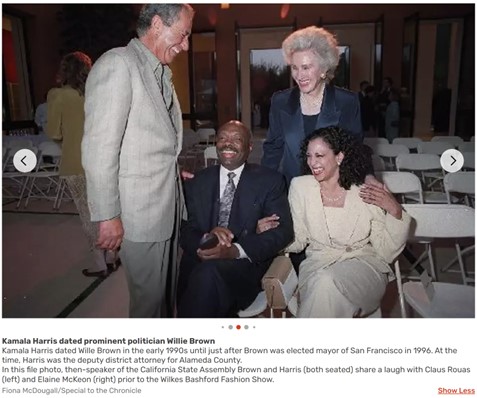
The years-long relationship ended when Willie Brown was elected mayor of San Francisco. Harris ostensibly ended the affair due to its lack of “permanence.” But it was Willie who announced to the press, “It’s all over” in December 1995, prior to his January 1996 swearing in ceremony. A reporter at the time caught up with Blanche Brown and asked her “And what was it like to live with the future mayor of San Francisco?” Blanche, understandably, replied, “Difficult.” Brown was subsequently sworn in by Jimmy Carter on January 8, 1996.
Brown’s Influence on Harris’ Career
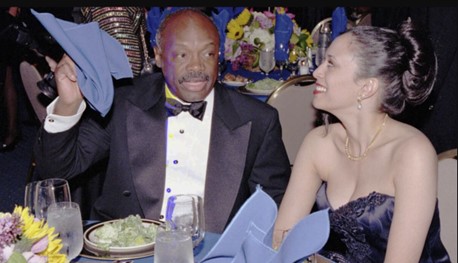
Kamala Harris’s political ambitions were also no secret. The true degree to which they played a part in her affair with Willie Brown, who was thirty years her senior at the time, only she and those closest to her know. What we do know is that Brown helped launch Harris’ political career. During their affair, Brown was both popular and powerful. He was the speaker of the California State Assembly; the first African American to hold the position. By virtue of being Willie’s girlfriend, Harris was introduced to the who’s who of the California Democratic Party – from politicians to elite donors. He helped her overcome the critical barrier to entry into the upper echelon of California politics. Years later (2019) when asked about Willie Brown’s impact on Harris’ political career, two influential political influencers, Jack Brown and John Burton noted the following:
“She was the girlfriend, and so she met, you know, everybody who’s anybody, as a result of being his girl.” – Jack David, Brown’s one-time mayoral campaign manager
“I would think it’s fair to say that most of the people in San Francisco met her through Willie.” – John Burton – former San Francisco congressman and chairman of the California Democratic Party
Kamala appeared to have learned early on the need to foster, and dare I say exploit to her advantage, relationships with San Francisco’s High Society political donors. She hobnobbed and dined with Brown and “grande dame Denise Hale . . . [and] had Sunday dinners with the Gettys.” These elite donors financed much of her California political career, and there is no reason to think they will fail her now in her quest to become the first South-Asian and African-American female President of the United States.
A Mistress’s Political Benefits
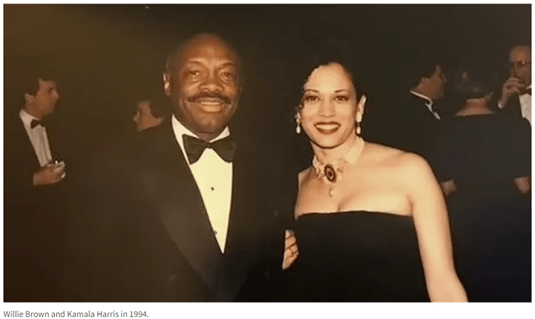
Aside from the invaluable introduction to the political elite of California, what else did Brown do for Kamala Harris? He appointed the young prosecutor in the Alameda County district attorney’s office to two notable state commissions. First to the “Unemployment Insurance Appeals Board,” and six months later to the “California Medical Assistance Commission.” These positions paid Harris handsomely at the time: nearly $100,000 for the first, and $72,000 for the latter. While Harris reportedly took a leave of absence from the DA’s office for her position on the Unemployment Insurance Appeals Board, she purportedly resumed her work at the District’s Attorney’s office when she assumed her post on the California Medical Assistance Commission. Michael Kruse, senior staff writer at Politico, wrote “He [Brown] put her on a pair of state boards that required not much work and paid her more than $400,000 across five years on top of her salary as a prosecutor.” Therefore, to say Kamala “made it on her own” would be quite an overstatement. Brown, without question, paved her road to success. He provided the network, the visibility, and ultimately opened the doors to the coveted money pool. But it was Harris herself who cultivated those inroads throughout the rest of her career.
While Harris’ supporters tout her qualifications, her detractors believe she slept her way into San Francisco’s socialite society; the same affluent families who have become some of her most prominent backers. The truth is probably somewhere in the middle. Back in the 90’s, just like today, Harris’ appointments were criticized, with Dan Walters from The Signal and Saugus Enterprise commenting, “And politicians wonder why the voting and taxpaying public holds them in such ill repute.”
Warranted Criticism in the Face of Political Feminism
If some criticism leveled against Kamala at the time was sexist, not all of it was. Harris choosing to have an affair with a married man, thirty years her senior, who undeniably could dramatically improve her trajectory in California politics, didn’t exactly sit well with women either. The ‘90’s saw women coalesce around workplace advancement and recognition on the basis of merit, not gender. Women were (and still are) advocating for equal pay and more managerial positions; and not just those supervising other females. Women wanted to have their viewpoints heard, and more importantly to have a seat at the decision-making table. One notable example is Sherry Lansing, who in 1980 not only became the first woman to head 20th Century Fox, but was also the first woman to head ANY major Hollywood studio. By 1992, Ms. Lansing earned the position of chairman and CEO at Paramount Pictures. Sherry Lansing hadn’t just made it into the studio C-suite, she was heading it! In addition, her momentous breaking of the entertainment industry’s glass ceiling was viewed by some as a way to finally get rid of the infamous, predatory casting couch once and for all.
Women were rising in politics in the 1980’s. In 1981, Ronald Reagan appointed Sandra Day O’Connor to the United States Supreme Court; the first woman to ascend to the position. In 1984, Walter Mondale, the Democratic Party’s nominee for President, selected Geraldine Ferraro as his VP running mate, although they lost to Republicans Ronald Reagan and George H. Bush. 1986 saw Barbara Mikulski become “the first Democratic woman elected to the Senate without previously filling an unexpired Congressional term.” Interestingly, Mikulski, along with Republican Senator Nancy Kassebaum, are best known for leading the “Pantsuit Rebellion of 1993,” which paved the way for future powerhouses Hillary Clinton and Kamala Harris to do something so mundane as wear pants to work. Other prominent female politicians that were making headway in Washington included: Barbara Kennelly (D-CT) – 1989, first female House Democratic chief deputy whip, Ileana Ros-Lehtinen (R-FL) – 1989 first Hispanic woman and first Cuban American elected to congress, Carol Moseley Braun (D-IL) – 1992, first Black woman elected to the U.S. Senate, Janet Reno (D) – 1993, first female to serve as U.S. Attorney General, and Madeleine Albright – 1997, the first woman to serve as U.S. Secretary of State. 2001 was a great year for female politicians. Nancy Pelosi, Hilary Rodham Clinton, Condoleezza Rice, Elaine Chao and Christine Whitman, among others, rose to positions of prominence. Unlike Kamala Harris, however, none of these women were known for sleeping their way to political success. They represented female empowerment for so many young women striving for equal pay, recognition, and a chance at coveted leadership positions. These pioneers significantly advanced the role of women in politics.
Lest we not forget the 1991 Anita Hill-Clarence Thomas scandal. Hill accused Supreme Court nominee Thomas of sexual harassment, which he denied. Despite Hill’s testimony and that of others she reportedly discussed the matter with, Thomas was confirmed. But the matter was not forgotten. Women reporting and filing sexual harassment claims spiked, which ultimately led to Congress passing the Civil Rights Act of 1991. All the while, Kamala Harris was engaging in an open affair with a prominent politician 30 years her senior. The fact that he was estranged, although not divorced from (and is still married to) his wife at the time, is of little importance. Kamala Harris chose to engage in questionable moral conduct at a time when women were fighting for justice for sexual harassment in the workforce. It simply is a bad look, one that she must take ownership of. But as we will see later, accountability is not one of Kamala’s strong points.
In the end, Harris appears to have taken the oldest shortcut known to womankind to jump to the front of the line. Just as the left’s progressive liberal faction wants all white people, no matter their ancestry or socioeconomic standing, to declare their white privilege, Harris too must admit she slept her way into San Francisco’s high society, which has since financed her political career, and therefore very likely buoyed her political trajectory. For this reason, it is not sexist, nor is it misogynistic, for pundits like Megyn Kelly to call out Kamala Harris on her horizontal privilege. It’s simply fair game.
Harris’ Political Career Highlights
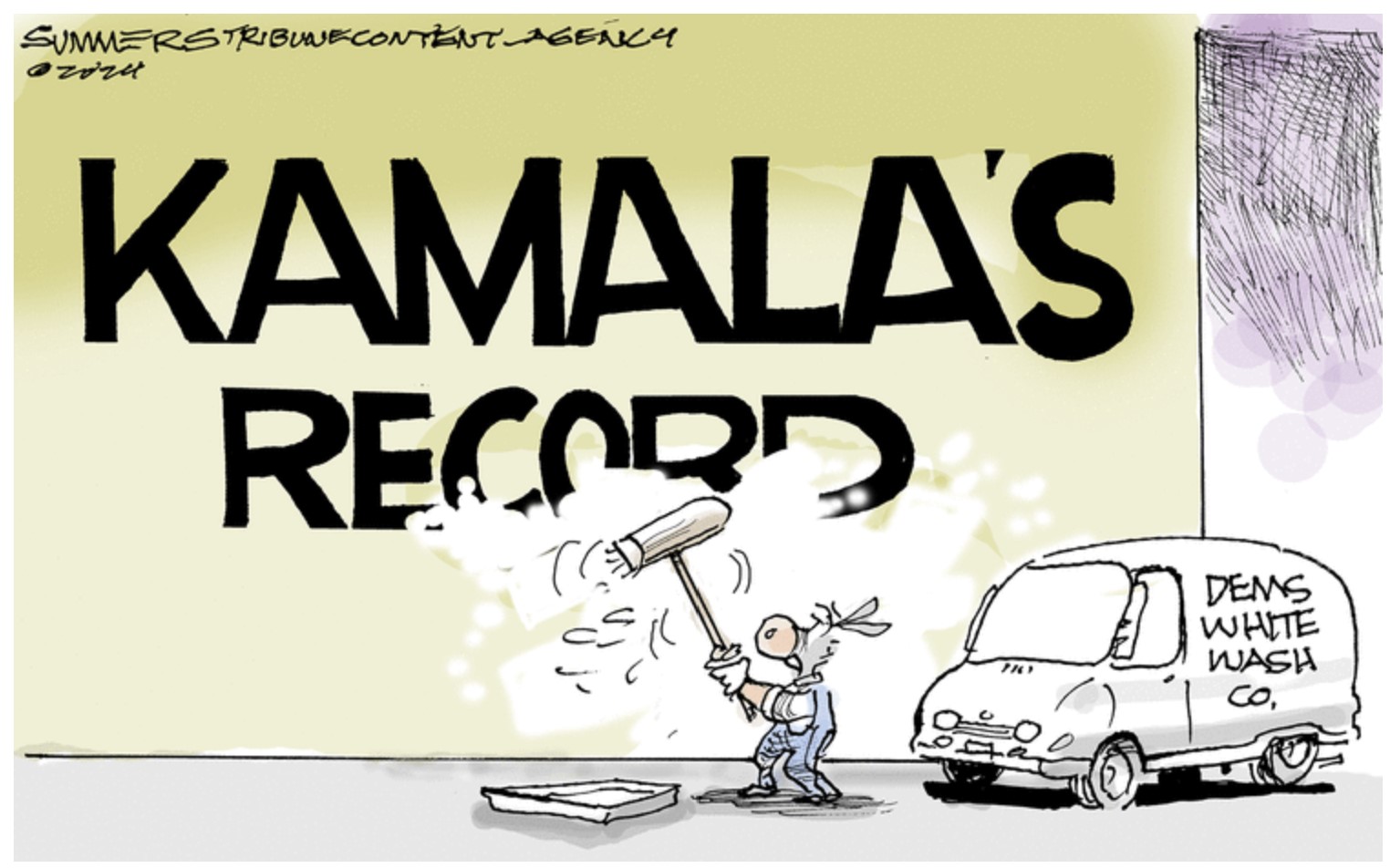
As mentioned above, Harris was deputy district attorney in Alameda County in the San Francisco Bay area in the 1990’s. Following her stint in the Alameda County DA’s office, she was recruited in 1998 to work in the San Francisco DA’s office by then DA Terence Hallinan. Two years later she accepted a position at San Francisco City Hall leading the Family and Children’s Services Division focusing on child abuse and neglect cases. In 2002, Harris ran against, and defeated, her former boss Terence Hallinan to become San Francisco’s first person of color to hold the position of DA. Eight years later in 2010, she ran against Republican Steve Cooley for the office of State Attorney General. She was ultimately successful but nearly lost, winning by only 0.8 points (74,000 votes) despite being endorsed by prominent California politicians and donors, as well as Barack Obama, who traveled to California to campaign for her. Harris won a second term as California’s Attorney General in 2014, but opted not to complete the term. Instead, she chose to run for the California Senate to fill retiring Barbara Boxer’s seat. Once again, Harris was heavily endorsed by California’s Democratic Party, receiving over 80% of the vote, which helped her defeat Lauren Sanchez, a fellow Democrat who challenged her for the position.
Harris was not content to remain a Senator for long. She threw herself into the mix for the 2020 Democratic Presidential nominee race, only to bow out early, citing a lack of funds, when her poll numbers plummeted in the summer and fall of 2019. Harris’ political savvy didn’t go unnoticed however, as she was later selected as Joe Biden’s Vice Presidential running mate, a selection that came with much scrutiny. Why Harris? It was reported that she was not Biden’s initial choice. But following the riots associated with the killing of George Floyd, the Biden campaign, in a likely attempt to quell growing divisiveness within the Democratic base, committed to selecting a woman of color as his running mate. On this basis, Harris ultimately made the cut, and became the Vice President of The United States when Joe Biden won the 2020 U.S. Presidential election.
Political Office Management
Harris has of history of discontent within the ranks of her subordinates, something she has historically appeared to care little about. A Democratic official’s son who worked for Harris while she was California’s Attorney General commented “There is another side of Kamala Harris which the general public does not know.”
The Washington Times reported “an ‘extraordinarily high’ exodus rate from Ms. Harris’ vice presidential office . . . [with] those who have worked for her over the past decade [reporting] that she was a tyrannical boss who terrified her employees, cursed, discouraged direct eye contact and made employees stand at attention when she entered the room.”
So, before people single out Donald Trump for the high turnover rate in his office, they might just want to note that researchers at the watchdog group Open the Books discovered through payroll records that Kamala Harris had a “92% staff turnover.” That is higher than both Donald Trump (72%) and President Biden (77%) during the same time frame. And that estimate is conservative, as Harris’s office claims to be exempt from providing relevant data, and “rejected public information requests to provide all the information.”
Becoming Part of California’s High Society on the Donor’s Dime
Don’t let Kamala, her campaign, or her supporters try and fool you. She is as far away from lower and middle class as Lebron James (well not quite that far, but you know what I mean). She has been living a life of luxury for decades, and has no more intention of giving it up for you, than she did while serving political office in California. She has shown time and time again that she not only sees herself as affluent, but that she believes she deserves to continue living a life of affluence. Whether it is donors or taxpayers who fund that lifestyle appears to be of little consequence to her.
Kamala has been notorious for using campaign funds to pay for ritzy hotels, expensive airfare, and luxury cars. When she assumed the office of Attorney General, California was in state of financial turmoil. Budget cuts were ordered from all departments, including staff cuts in the Department of Justice – the Department she then oversaw. Governor Jerry Brown subjected himself to the same frugality that he required of his staff. But not Kamala. Then-current and former staff, many of whom were uncomfortable with her lavish spending, couldn’t help but notice in dismay as her upscale expenditures continued. The following comments were made to the online newspaper The Hill on condition of anonymity:
- “She treats the campaign like a personal checking account to fund a lifestyle she aspires to”
- “Kamala demands a life of luxury.”
- “I kind of walked into the system … and within a few weeks a lot of things made me feel uncomfortable.”
Guess you can take the girl out of the swanky affair, but you can’t take the affair’s swank out of the girl.
Staff Turnover
Kamala’s questionable leadership and management style has plagued her from her earliest days in California politics. As with most unfortunate personal characteristics that fester unchecked for years, they tend to follow wherever one goes. Such appears to be case for Kamala. In 2021, Politico published a piece aptly named, “’Not a healthy environment’: Kamala Harris’ office rife with dissent.” The byline: “There is dysfunction inside the VP’s office, aides and administration officials say. And it’s emanating from the top.” That pretty much sums up the entire article. An overwhelming lack of communication and trust among aides and senior officials, blame-shifting, anger and abuse. Ardent supporters were (and still are) quick to throw out the term misogynoir, which refers “to the combined force of anti-Black racism and misogyny directed towards black women.” That may apply some of the time, but when there are repeated patterns of maladaptive behaviors not attributed to other Black female politicians, it sounds more like a virtue-signaling deflection. And such deflection only makes it harder for Harris to recognize past mistakes, learn from them, and change. As Politico reporters Cadelago, Lippman and Daniels report “for some of the people who know Harris best, it’s become an all-too-familiar pattern for a politician who has churned through several iterations of staff on her rise.” Harris has routinely attempted to sidestep any and all leadership crises by stating she was unaware of them. To that, current and former aides and confidantes replied: “She’s been in public life for 30 years. F—. You don’t just all of a sudden go radio silent.” And “She is the most perceptive person on the planet. She might not have first-hand knowledge, but it’s hard to imagine she doesn’t have a sense of what’s going on.”
Business Insider did a follow-up story where they reportedly spoke to twelve former Harris staffers, who worked for her during her tenure as San Francisco’s District Attorney (2004-2011), California State’s Attorney General (2011-2017), and U.S. Senator (2017-2021). To no one’s surprise, what Business Insider reported was Harris’s poor and abusive behavior. Examples included a tendency to hang up on staffers who didn’t answer her questions quickly enough, changing deadlines without warning, and subjecting staffers to angry, verbal abuse if she felt they failed. Once again, supporters were quick to claim “misogynoir,” while staffers critical of her behavior noted, “the buck stops with the VP herself.”
Months later, in December of 2021, after additional high-profile departures from Kamala’s team, The Washington Post ran another piece questioning her leadership style and ability to manage the office of President of the United States. The Post reported, “Critics scattered over two decades point to an inconsistent and at times degrading principal who burns through seasoned staff members who have succeeded in other demanding, high-profile positions.” The piece quoted Gil Duran, a former Harris aide and prominent Democratic strategist as saying, “One of the things we’ve said in our little text groups among each other is what is the common denominator through all this and it’s her . . . . Who are the next talented people you’re going to bring in and burn through and then have (them) pretend they’re retiring for positive reasons?”
Why should Harris’ “managed chaos” concern us? The ability to retain loyal and competent staff signals a stable and friendly team environment, which fosters community and productivity in the workplace. As one staffer noted, “Politics is about relationships and the relationships with the people around you. I think there’s a lot of improvement needed there.” Harris’ decades-long history of being incapable of fostering the morale of her own staff does not bode well for her capacity to foster the morale of an entire country; something that is much needed in the divisive time we are living in. We are not seeking another “Apprentice” host to compete for the title of POTUS. We already have one candidate who held that position. It is the same candidate that the Democratic base purports to despise more than the devil himself.
“Word-Salad” Speech
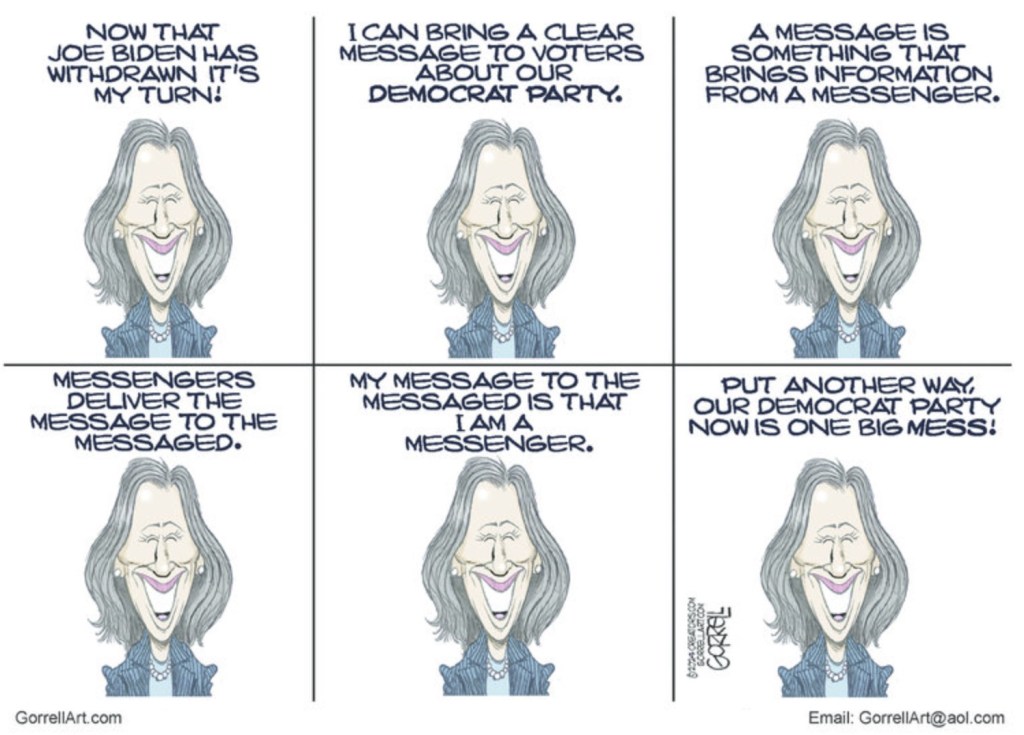
Despite her academic achievements, and her thirty-plus years in politics, Harris is not known for her public speaking skills. In fact, one of her unfortunate “hallmarks” is to utter words that say and mean absolutely nothing. It is so frequent and comical a trait of hers that the Daily Show aired a skit with Julia Louis-Dreyfus reprising her former role in the HBO series “Veep” to imitate what everyone has come to expect from Kamala. I encourage you to check it out for a good chuckle! Examples of Kamala’s actual “word salad” include:
- “When we talk about the children of the community, they are the children of the community.”
- “We’ve got to take this stuff seriously, as seriously as you are, because you’ve been forced to take this stuff seriously.”
- “The governor and I and we were all doing a tour of the library here and talking about the significance of the passage of time. Right? The significance of the passage of time.”
- “I can imagine what can be, and be unburdened by what has been”
- “I love Venn diagrams. Always ask, ‘Is there a Venn diagram for this?’ I’m telling you, it’s fascinating when you do. So, Venn diagram, those three circles, right?”
- “’I don’t know what’s wrong with you young people, you think you just fell out of a coconut tree,’ Harris said midway through — breaking into a wild cackle. ‘You exist in the context of all in which you live and what you came before you.’”
- “Culture is — it is a reflection of our moment in our time, right? And in present culture is the way we express how we’re feeling about the moment.”
- “So, I think it’s very important, as you have heard from so many incredible leaders, for us at every moment in time — and certainly this one — to see the moment in time in which we exist and are present, and to be able to contextualize it, to understand where we exist in the history and in the moment as it relates not only to the past but the future.”
Biden is also known for his gaffes. But at least there is an explanation for his less comical and more egregious ones: cognitive decline that comes with aging. Kamala, on the other hand, is a “young” 59-year-old. Are we expected to simply “suck it up” and listen and read about her endless “word salads” on the national and international stage? Have we really come to this? For all of her loyal supporters and “Never-Trumpers” I strongly hope she decides (for once in her life) to listen to her staffers and stay on script.
Political Action, or Lack Thereof
There are loads of articles in the MSM that focus on the positive aspects of Kamala Harris’ various political positions. The MSM is doing their very best to paint Harris in a good light, to set her righteously apart from Trump, their perceived narcissistic demagogue. I encourage anyone who is interested to Google her political timeline. What I would like to discuss are her often overlooked, or dare I say deliberately ignored, missteps and failures.
Notable Events During Kamala’s Reign as San Francisco’s District Attorney
Lack of Convictions
Kamala has been portrayed as a progressive prosecutor, yet someone who was both tough and smart on crime. In fact, she wrote a book on the topic in 2009 called, Smart on Crime: A Career Prosecutor’s Plan to Make Us Safer. Her bio on her former Attorney General website lauded her for increasing the “conviction rates for serious and violent offenders, [creating] new prosecution divisions, and [forming] a gun division specialist team.” It touted that “Her office more than doubled its conviction rate for gun felonies and won prison sentences for 50% more violent offenders.” An often omitted but relevant detail is that the vast majority of those convictions were not “won” in the courtroom, as her bio might lead one to believe, but were the result of negotiated plea deals that were struck prior to heading to trial. A fairly common practice, to be sure, yet Harris’ selective choice of that single word, “won,” is telling. Indeed, court records show that on Harris’ watch, “felony convictions for cases that actually go to trial and reach a jury verdict — a comparatively small group that nevertheless includes some of a district attorney’s most violent and emotionally charged cases — have declined significantly over the past two years.” Worse yet, “In 2009, San Francisco prosecutors won a lower percentage of their felony jury trials than their counterparts at district attorneys’ offices covering the 10 largest cities in California, according to data on case outcomes compiled by officials at the San Francisco Superior Court as well as by other county courts and prosecutors.” The devil is always in the details! Harris’ and her campaigns’ aggrandizement of her prosecutorial prowess appears to be nothing more than an embellishment of the numbers. Wonder what other candidate has been accused of such underhanded practices?
Modest Program, Hidden Statistics
In her capacity as San Francisco DA, Harris also launched Back on Track (2005), a modest program that afforded nonviolent offenders an alternative to incarceration. The program aimed to reduce the recidivism rates of young adults aged 18-30 who committed “first-time, low-level, non-violent drug sales offenses,” by diverting them “into supervised education, job training courses, therapy sessions and life skills classes.” There is a lot of publicity proclaiming the “modest” program’s success, and even mentions of it on her current campaign trail. What has not been readily reported, or easily found, is the actual number of nonviolent offenders that have participated in the program. Where are the numbers, Ms. Harris? An interesting omission. Nonetheless, to her credit, the program has apparently served as a model from which others have been established across the country.
Prominent Wrongful Conviction
One of the most damning events of Harris’ career as DA was the 2010 wrongful conviction of then 25-year-old Jamal Trulove, “a young father, aspiring actor, and hip-hop performer,” who was sentenced to 50 years to life for the murder of Seu Kuka. The events of the case unraveled like an episode on the old TV series “Cold Case” complete with tainted eyewitness testimony and prosecutorial misconduct. Bylines read, “Police and prosecutors framed a father of four in a 2007 murder case.” In 2014, a California Court of Appeals overturned Trulove’s conviction, earning Harris’ office a rebuke from the judge. Trulove was re-tried in 2015 and acquitted. He was awarded $10 million by a federal jury. The city’s Board of Supervisors later approved a $13.1 million settlement. A play-by-play of events can be found on The Appeal website.
Prevarication as Attorney General
In a speech at Stanford Law School in 2011, Harris advocated her position stating “There seem to be two positions for DAs and AGs to take: tough on crime and soft on crime. I believe there’s a third way forward: smart on crime.” Harris believes, “We need to learn from the public health model and focus on prevention.” During her speech, she mentioned Governor Jerry Brown’s signing of AB 109, which “shifts responsibility for certain lower-level offenders from the state to county authority,” a procedure known as “realignment,” along with her desire to have Stanford Law Professor Joan Petersilia teach a course on it. Harris also expressed her hope and desire to keep “nonviolent offenders in their own communities, close to family and services that should be better able to prevent them from returning to prison” – a behavior known as recidivism.
But while Harris apparently felt comfortable superficially discussing AB 109 with Stanford Law students, she was routinely criticized for declining to take a stand on many Californian issues related to criminal justice reform. Policies and bills that never came fruition were attributed to Harris’ unresponsiveness (for example, questionable police shooting investigations, and the gathering of race and ethnicity data of individuals during police stops). Her repeated silence resulted in a reprimand from the Los Angeles Time Editorial Board, which wrote she “has been too cautious and unwilling to stake out a position on controversial issues, even when her voice would have been valuable to the debate.” Corey Cook, a political scientist and provost at St. Mary’s College, and seasoned onlooker of San Francisco politics noted, “The idea that she would have consistent positions on issues informed by ideology isn’t who she is . . . . “[for her] the only lasting solutions are going to be the ones that are able to sustain a majority coalition of support.” If that is true, what does that say about Kamala as leader? Is she willing to stick her neck out for something important? Or is she simply a follower in disguise who needs direction?
California Democrats, and Harris herself, have trumpeted the success of such criminal reform programs. However, the citizens of California appear to have a very different perception. Just ask the many businesses and residents of California who have been subject to both armed and unarmed burglaries, only to find that the intruder had a lengthy rap sheet, and yet was out on parole or on probation, how they feel about Harris’ progressive crime policies. Gun purchases skyrocketed 83% in CA during the pandemic, coinciding with a jump in crime that has largely continued unabated. In 2023, California was ranked 3rd for most guns sold in the US, behind Texas and Florida.
As a result of many of the criminal justice “reform” policies Harris promoted while in office in California, many businesses have left the state or closed large numbers of retail locations, thanks to rampant crime. Those that remain often keep their goods under lock and key. Shopliftings, smash and grab burglaries, and organized crime rings have forced the retail sector’s hand. Californians are looking to reverse measures, such as Proposition 47, which “reduced sentences, offered early parole and relaxed the state’s ‘three strikes’ law.” It was Harris’ office of Attorney General that crafted the ballot summary of the law that Californians voted on in 2014 which, according to NBC News, “predicted that prison and jail populations would decrease while funding for truancy reduction programs and mental health services would rise. It also predicted that the state criminal justice system would save hundreds of millions of dollars due to the changes, and local prosecutors and sheriffs would have reduced workloads.” What it didn’t mention was the likely potential impact on the average law-abiding citizen. The result: criminals took advantage of the lack of accountability and consequences for their criminal behavior. And who was left holding the bag? Honest citizens. Is this what the rest of America can expect if Kamala wins the office of POTUS? I surely hope not!
The Marshall Project provides a summary of some of Harris’ equivocation on various issues. Anyone interested is encouraged to read it.
The Border
Talking Points Correspondence
And here is where you will say, “What the hell was she thinking!” On July 25, 2024 Outkick posted a story titled, “Democrat Lawmakers Receive Talking Points On How To Discuss Kamala Harris’ Role At The Border.” There is a screen capture of an X (formerly Twitter) feed showing the “talking points” that were sent to Democratic lawmakers. Despite Harris and her team trying to convince everyone that she is “smart on crime” – code for selected crimes she feels are worthy of accountability – she has done what decades of staff have noted comes naturally to her: deflect. Kamala has a history of not taking responsibility or accountability for anything that goes wrong in her political career. It is always someone else’s fault. Why should her responsibilities at the border be any different? Below is a screen capture of the talking points (posted sans permission).
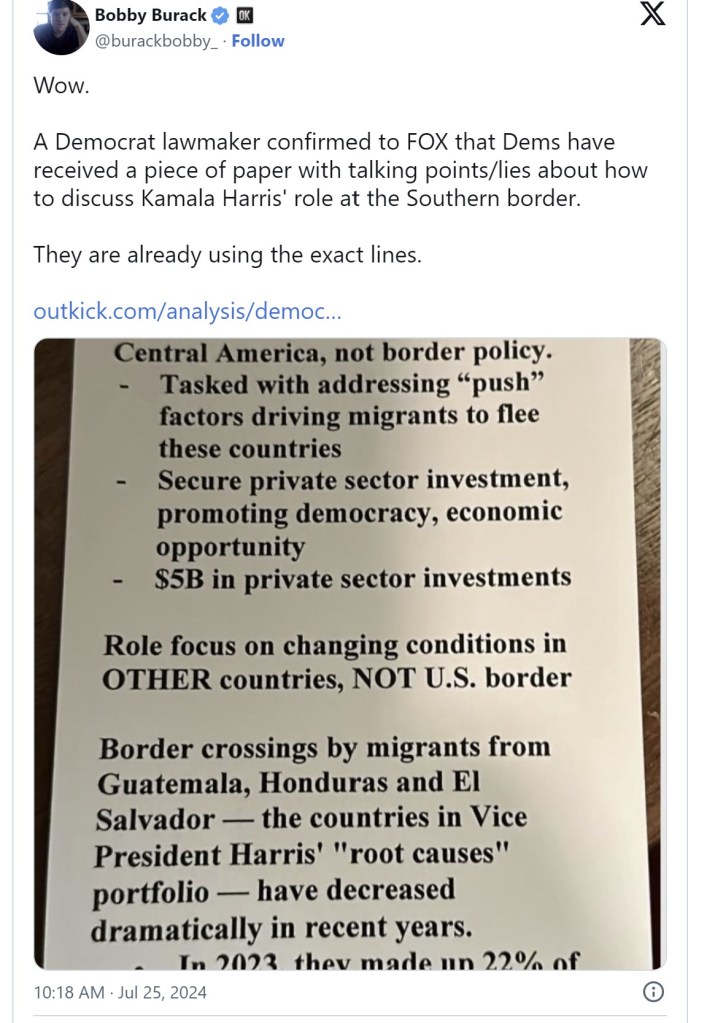
Got that? The border is “NOT” the focus of the new person in charge of the border. Further, Harris’ team would have us believe, it never was. Rather than taking Ms. Harris’ word for it on social media, I attempted to find the original March 24, 2021 White House Briefing Room memo. And I quote President Biden directly:
“I’ve asked her, the VP, today – because she’s the most qualified person to do it – to lead our efforts with Mexico and the Northern Triangle and the countries that help – are going to need help in stemming the movement of so many folks, stemming the migration to our southern border.”
It is Harris herself, not Biden, who uses the term “root causes”:
“And while we are clear that people should not come to the border now, we also understand that we will enforce the law and that we also – because we can chew gum and walk at the same time – must address the root causes that – that cause people to make the trek, as the President has described, to come here.”
At first glance, this sounds sensible: Harris will address the present-day flood of illegal border crossings, while at the same time developing a forward-looking strategy to help mitigate conditions that cause the problem in the first place. This, however, is entirely contradicted by what she has actually done, as well as by her own team’s leaked talking points, as seen above. Ms. Harris was not asked to disregard Mexico and limit her “expertise” to the Northern Triangle of Central America, which is comprised of El Salvador, Guatemala and Honduras. She was asked to “lead efforts with Mexico and the Northern Triangle.” Given her abysmal failure in Mexico as evident from the tsunami of border crossings by Mexican citizens (to be discussed later), it is no wonder she may want to distance herself from Mexico. It didn’t take long for some Democrats to get “lock, stock, and barrel,” producing a highly selective massaging of the facts to counterprogram against what they claimed was “disinformation.” This is exactly the kind of frantic spin-doctoring that Snopes or other fact checkers would say “requires more context/information.” Funny how that works! Refer to Outkick’s post for more details. At the end of the day, VP Harris’s efforts to “stem the migration at our southern border” didn’t amount to much. Instead, a collection of low-key procedural changes such as the ending of the relatively toothless Title 42 and reinstatement of the stricter Title 8, along with a remolded version of the Trump-era Migrant Protection Program (MPP), plus an unintentional assist from – wait for it – China’s growing influence in the region, were far more successful at putting a dent in illegal border crossings than any of Harris’ efforts!
Border Czar Title – Sudden Controversy
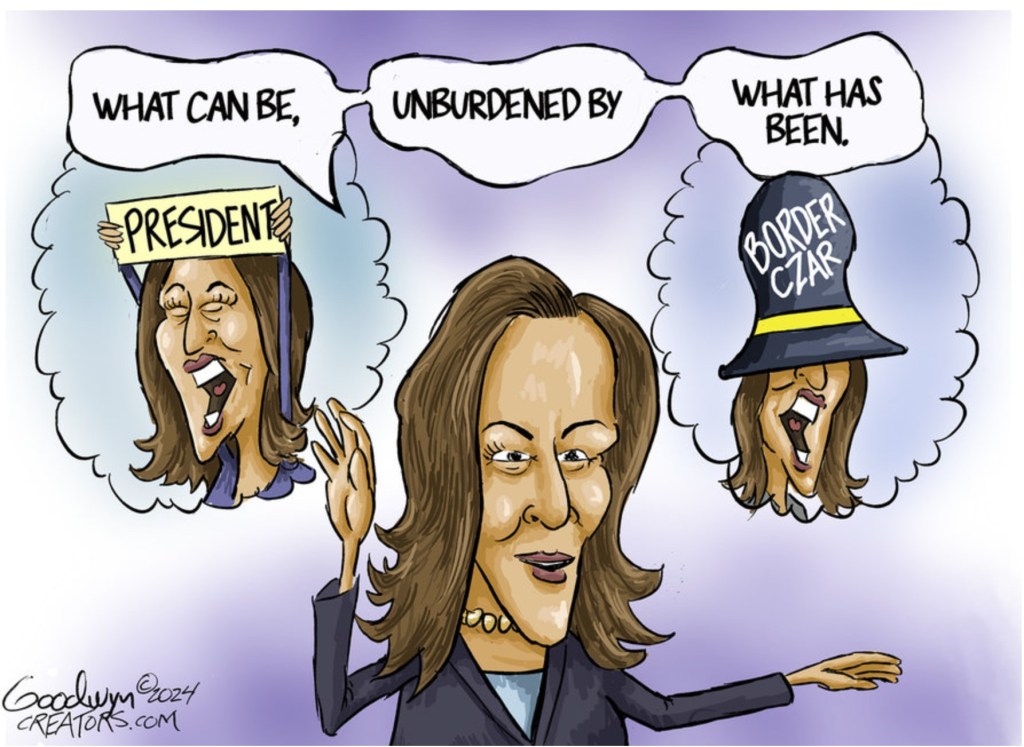
Root causes and long-brewing regional issues aside, one can reasonably assume that any self-respecting border czar would, first and foremost, jump with take-charge urgency to the immediate challenge of getting the sheer volume of illegal crossings on our southern border under control. Or so one would think. Clearly however this was not at all what Harris herself had in mind. Predictably, the MSM had a panic attack when they realized that they, like the rest of the world, previously accurately described Harris as the “border czar.” Oh my gosh! What are we to do? Three-plus years and endless columns extolling Harris the Border Czar later, they scrambled to issue a retraction. Time Magazine came out with a piece titled, “Kamala Harris Was Never Biden’s ‘Border Czar.’ Here’s What She Really Did.” According to Time:
“Harris was never put in charge of the border or immigration policy. Nor was she involved in overseeing law-enforcement efforts or guiding the federal response to the crisis. Her mandate was much narrower: to focus on examining and improving the underlying conditions in the Northern Triangle of Central America – El Salvador, Guatemala, and Honduras – which has been racked by decades of poverty, war, chronic violence, and political instability.”
And her success according to Time:
“Harris spearheaded a public-private partnership that, as of March 2024, had secured commitments from major U.S. and multi-national companies to invest more than $5 billion in the region.”
You will see how utterly laughable that is in just a moment.
Anyone who has a platform, talk show, or similar outlet that is also in the Harris-friendly “Anyone but Trump” camp tried to distance themselves from the “border czar” term. Symone Sanders went on liberal Joe Scarborough’s Morning Joe show to address the matter. Sanders commented, “You already hear folks talking about the ‘border czar.’ She wasn’t the ‘border czar.’ She did diplomacy in Central America, but the campaign is going to have to make that case.” When I read Sanders’ “diplomacy” comment I nearly fell out of my chair, and I was sitting on the floor!
Kamala’s ‘Border Czar’ Predecessor – Same Title, Same Job
The sudden controversy over assigning Kamala Harris the title of border czar is very interesting, given that her immediate predecessor, Roberta S. Jacobson, was unofficially referred to by that very title. According to The York Times, “Roberta S. Jacobson, the former ambassador to Mexico whom President Biden chose as his “border czar” on the National Security Council, will step down at the end of the month.” Ms. Jacobson was stepping down from the position at the end of April 2021. Her replacement: none other than Vice President Kamala Harris. The New York Times wrote that Ms. Jacobson’s position was “eclipsed late last month when Mr. Biden announced that Vice President Kamala Harris would lead the government’s diplomatic efforts with that region.”
In describing her job responsibilities, Jacobson spoke of her travels to Central America to “work with government officials on reducing the flow of migrants north toward the United States.” She also mentioned her role in discussing with theleaders of Northern Triangle countries “ways to combat illegal immigration and bolster shelter capacity for migrants . . . to find ways to collaborate with Central American countries, as well as potentially Canada, to reduce pressure on the United States border . . . But right now, we’re focused more on how we can work with Mexico and the Northen Triangle countries.” It is interesting how closely these responsibilities align, at least on paper, with those of her successor, VP Harris. Given that Jacobson was viewed by most everyone at the time as the ‘border czar,’ it seems apropos that Harris should inherit the same title.
As the announcement of Ms. Jacobson’s departure from her role as border czar was released, Biden’s national security advisor, Jake Sullivan, praised Jacobson for “having shaped our relationship with Mexico as an equal partner, having launched our renewed efforts with the Northern Triangle nations of El Salvador, Guatemala and Honduras, and having underscored this administration’s commitment to re-energizing the U.S. immigration system.” Sounds like Ms. Jacobson gave Harris a running head start!
The difference is that Ms. Jacobson took a hands-on approach that included visiting the border and speaking with Border Patrol Chiefs. Harris, on the other hand, only visited the border once, and reportedly still hasn’t spoken to either of the two Border Patrol Chiefs that have occupied the position in the Biden-Harris Administration. This, they argue, affirms Harris’ claim that because she had no active hand in shaping or enacting border policy, she bears no responsibility for any of its shortcomings. Even if you agree with this assertion, which I personally do not, it would also mean she either cared very little about what was happening at the border, or very likely shunned the advice of experts in the field (something a recent former president has also been frequently accused of). It would also explain the lack of success she had in her diplomacy efforts, particularly when compared to, say, China’s stunning and alarming gains in the region.
Kamala Harris’ “Root Causes” Strategy is a Repackaged Trump Era Strategy
The Congressional Research Services released an updated document titled “Central American Migration: Root Causes and U.S. Policy” on November 30, 2023. This document mentions recent migration trends from 2011-2023, which we will discuss in a moment. More importantly, however, the report states:
“the Biden Administration developed a U.S. Strategy for Addressing the Root Causes of Migration in Central America that focuses on long-term socioeconomic, security, and governance challenges. The root causes strategy is similar to the prior U.S. Strategy for Engagement in Central America, for which Congress appropriated more than $3.7 billion from FY2016 to FY2021.”
What does this mean? It means that while the MSM is falling all over themselves to credit Kamala Harris for establishing a “root causes strategy” for Central America, it is ALL A RUSE! In damningly neutral bureaucratic language, the government itself acknowledges that all Harris did was simply rename and repackage, as the Biden administration’s own, a strategy that was established under Donald Trump. Wow! But it gets better. Keep reading.
Evaluating the Success of Harris’ “Root Cause Strategy”
How successful has Harris been in curbing illegal immigration through her “diplomacy?” Apparently not as successful as she and other Democrats would have you believe. USAFacts, an online site established by former Microsoft CEO Steve Ballmer to make “government data accessible and understandable,” updated a report in March 2024 that details the “nearly 10 million unauthorized border encounters between October 2019 and January 2024.” The report provides several very informative illustrations to assist one’s understanding of the illegal U.S border crossings. While a large spike in such crossings prior to the reinstatement of Title 8 under the Biden Administration is clearly evident, that is not the topic of this discussion. What I would like to focus on is who is crossing the border, so we can ascertain how successful VP Harris’ diplomatic efforts have been. According to USA Facts, including data obtained by the Customs and Border Protection Agency, “roughly 80% of people apprehended or denied entry between October 2019 and January 2024 were Latin American citizens. Nearly 30% came from Mexico, 9.1% from Guatemala, 8.9% from Honduras, 7.6% from Venezuela, and 5.8% from Cuba [emphasis added].” They provide the following graph for clarity (reprinted sans permission):
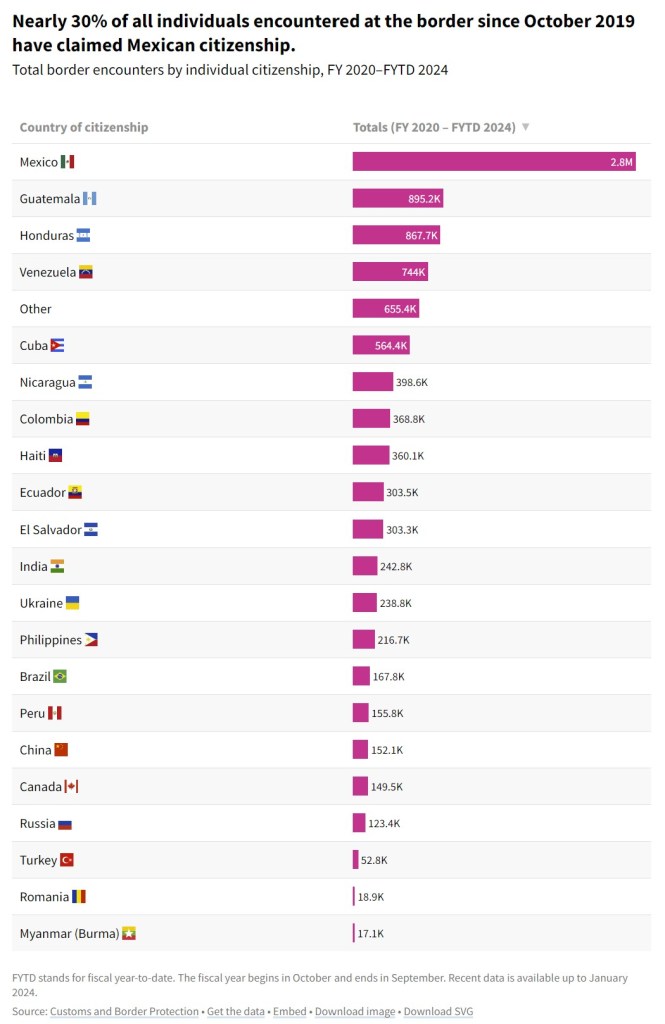
To reiterate: in the given time period, almost as many apprehended migrants came from Mexico alone as from the next four quoted countries combined. Yet astoundingly, Mexico is off the table as far as Harris is concerned. Further, given that not only Mexico, but also two out of the three Northern Triangle countries are at the top of the list, one has to wonder how successful Harris’ diplomatic outreach has been. And as outlined above, any modest drop in illegal crossings from these countries is far more attributable to procedural adjustments than to bold new initiatives from the office of the Vice President. According to the liberal Migration Policy Institute:
“More migrants than ever before who are reaching the United States without prior authorization to enter are now arriving at ports of entry as a result of the parole programs and use of the CBP One app [an appointment scheduling app]. The numbers arriving at ports of entry more than doubled from FY 2022 [FY2022 to FY 2023], even as the Border Patrol had 160,598 fewer encounters of migrants crossing illegally in FY 2023 than the prior year—the result of policies to channel arrivals to ports of entry.”
In addition to Border policy changes (such as the parole program), the removal of immigrants from other western hemisphere countries, such as Venezuela, is complicated due to the lack of repatriation agreements between the U.S. and several countries in the Americas. Therefore, while agreements between the U.S. and “governments in Mexico, El Salvador, Honduras, and Guatemala facilitate repatriation of nationals from these countries,” these agreements were established prior to Vice President Kamala Harris being tasked with the job of “Border Czar.” It should come as no surprise that the Migration Policy Institute, being “supportive of liberal immigration policies,” attempted to wrongly attribute a Trump era achievement to the Biden Administration, stating “The Biden administration negotiated, for the first time, removals to Mexico of non-Mexicans, including Cubans, Haitians, Nicaraguans, and Venezuelans.” In reality, a February 12, 2019 U.S. Immigration and Customs Enforcement (ICE) document describes the “Implementation of the Migrant Protection Protocol” (MPP), a Trump era policy that details “an agreement between the United States and Mexico to address the migration crisis along our southern border.” This policy states:
“Consistent with the MPP, third-country nationals (i.e., aliens who are not citizens or nationals of Mexico) who are arriving in the United States by land from Mexico may be returned to Mexico . . . “
Therefore, it was Trumps’s Migrant Protection Protocol that changed longstanding U.S. – Mexico Border Policy by returning non-Mexican migrants back to Mexico while awaiting their immigration proceedings.
Thus, while Harris’ professed focus on root causes and slow-motion solutions may realize some hypothetical benefits at a future time unknown, the current moderate reduction in illegal crossings appears to be the result of legacy polices including the reinstatement of Title 8 (see below) combined with the remolding of Trump era policies, the diplomatic efforts of the U.S.’s Latin American Diplomat Brian Nichols, and even some inadvertent assistance from China (See below). The systematic failure of Kamala Harris to substantively contribute to any of these policies or efforts, yet take credit for the positive results derived from them, only further cements the loathsome leadership skills she has been notorious for throughout her political career.
The Expiration of Title 42
Further, while Harris and her supporters have credited the reduction in migrants from Central America primarily to Harris’ “diplomacy skills,” let’s not forget that Title 42 expired on May 11, 2023. This was significant. It meant that Title 8, with its higher deterrent value, would instantly go into effect. Recall my prior article, Hubris: Its Impact on the U.S. Democratic Party, which highlights the major differences between the two U.S. Codes. Under Title 42, migrants could attempt multiple illegal border crossings without fear of prosecution. Title 8 has no such allowance. Rather, migrants attempting multiple illegal crossings face repercussions, including imprisonment and being barred from re-entry into the U.S. for up to five years; longer for repeat offenders. Therefore, we went from having no real migration deterrent under Title 42, to having one under Title 8. As a result, things appear to be slowly returning to pre-pandemic levels. Central American U.S. Embassies also helped to get the word out for anyone considering the making the trek to the U.S. No input or guidance from Ms. Harris was required for any of this to occur.
Brian Nichols, U.S.’s Latin America Diplomat
While the U.S. has recently made a concerted effort to patch things up with El Salvador’s President Bukele, that success has been attributed solely to the efforts of Brian Nichols, the State Department’s top Latin America diplomat. Bukele won office in 2019, and was unanimously reelected in 2024. His platform included cracking down on gang violence, which reportedly decreased 70% in 2023. This in turn substantially reduced the exodus of Salvadorans headed northward in an effort to escape the violence in their country. In addition, the newfound warmer relations between the U.S. and El Salvador have enabled both countries to cooperate on polices to further reduce pressure on the southern U.S. border. It is factors such as these, not Kamala Harris’ diplomacy, that are attributed to any nominal decline in migration.
Let’s not fool ourselves: Central America, inclusive of the Northern Triangle, has long been a region beset with climate, socioeconomic, violence, oppression and corruption issues (admittedly in which past U.S. policies have sometimes played a material role). Various news reports have described a backsliding toward more authoritarian and corrupt regimes in the last few years. It always was, and continues to be, a tough job for any U.S. President. But to campaign on making significant strides in the region, while the U.S. is struggling simply to maintain a precarious and ever-deteriorating status quo, is a questionable alignment of priorities.
China’s Growing Presence in Central America
The Council on Foreign Relations released an updated report on June 15, 2023 on “China’s Growing Influence in Latin America.” The article provides a succinct historical summary on the origin of China’s influence in the region, and what has enabled its continued growth. One of China’s primary successes is the growth of its Belt and Road Initiative (BRI). According to Chinese President Xi, the goal of this initiative is to “expand the international use of Chinese currency, the renminbi, and break the bottleneck in Asian connectivity.” However, many western and Asian leaders believe, “the BRI could be a Trojan horse for China-led regional development and military expansion.” How successful has China been with its BRI? As of February 2023, “147 countries – accounting for two-thirds of the world’s population and 40 percent of global GDP – have signed on to projects or indicated an interest in doing so.” Of these countries, however, not all who committed have been happy with their decision to partner with China. Many agreed to large loans, which they are now having difficulty paying back. They have consequently been forced to contract with Chinese firms at inflated costs, resulting in the cancellation of much-needed projects and the strangling of economic development, as the bulk of their already-meager fiscal resources are diverted to servicing Chinese debt. Yet, despite some countries’ apprehensions, a number still choose to align themselves with China.
Of the 7 countries that comprise Central America (Belize, Guatemala, El Salvador, Honduras, Nicaragua, Costa Rica, and Panama), all have aligned themselves with China on “Priority Issues,” namely, military and defense, energy, space and satellite and infrastructure matters. El Salvador (2018), Panama (2017), Costa Rica (2007), Nicaragua (2021) and Honduras (2023) have already signed onto China’s BRI while also agreeing to recognize Taiwan as a territory of China. Belize and Guatemala are the only two Central American countries that have not done so.
El Salvador’s Bukele has been accused of strategically playing the U.S. and China against each other to get what he wants. All the while, China is patiently “waiting in the wings” to swoop in where the U.S. falters, while willing to look the other way on humanitarian issues that may muddy the waters. Similarly, Honduras recently (6/2024) took steps to advance its strategic partnership with China. China’s influence in Central America comes with international ramifications, as it of course includes the expansion of their geopolitical goals, including the designation of Taiwan as a Chinese territory. In the last three years alone, Honduras and Nicaragua struck deals with China that included said recognition. Simply put, China is eating our lunch in Central America while a distracted US counters with small-ball initiatives.
Inside Out Odyssey’s Fact Check Rating – “Misleading: Needs More Context”
So, Harris and her campaign may trumpet her diplomatic success in Central America, saying she helped raise commitments (not actual dollars) for “$5 billion to invest in the economy in these countries, with the private sector,” the benefits of which are yet to materialize. She can also cite the technically correct but cherry-picked statistic that migration from the Northern Triangle started at 41% in 2023 and has come down to 21%. While true, Harris is largely riding the coattails of a mix of policies, diplomatic efforts and geopolitical factors that were well in play before she assumed so-called responsibility for the border and immigration. She can even selectively omit the elephant in the room: the far less flattering statistics from Mexico, as these alone do much to offset her rosy framing of the migration picture in a highly unfavorable direction (i.e., way up). But as Nanette Diaz Barragan, Congressional Hispanic Caucus Chair, unironically said in her defense of Harris, “So don’t come and start the false lies because we’re going to make sure to correct them.” To that I agree. We have shown that Harris herself has done little to advance any tangible new diplomatic policies in the region. However, Harris and her team would like to paint you a very different picture. They would like you to conveniently disregard any mention of Mexico in relation to her “root causes” responsibilities, because those migration numbers have not improved much. She would also like you to believe that it is she who deserves credit, not the elimination of Title 42 and reinstatement of Title 8, for any slowing of migration from Northern Triangle countries. Further, Harris would like you to believe that repatriation agreements and Trump’s MPP never existed, nor that China has expanded their power and influence in the region. That’s a lot of spin and inconvenient facts to turn a blind eye to. Therefore, Inside Out Odysseys’ Fact Check assigns the Democratic defensive spin on the “Border Czar” and associated talking point fiasco as “Misleading: Needs More Context.”
Most Far-Left Senator Rating
GovTrack, an online site that purports to monitor and publish the congressional voting record, quietly removed their 2019 rating of Kamala Harris as that year’s “most liberal U.S. Senator.” As Fox News correctly reported, Harris outranked even Bernie Sanders and Elizabeth Warren to receive the honor. Anyone seeking to revisit that page was greeted with, “Page Not Found.” GovTrack attempted to justify their curiously timed removal by stating “the page was removed because the company adopted a policy ‘several years ago’ to end its single-year ratings of lawmakers in favor of ratings based on Congressional sessions, which are two years.” The timing of the page’s removal is interesting indeed. Apparently, after “several years” of leaving the report on the website, they only found it necessary to remove it after Biden handed Harris the Democratic nomination for President. Rather than amending, or notating the 2019 entry with verbiage that explains their new policy, they simply opted to delete it. Doesn’t appear that the self-proclaimed “government transparency site” believes they need to be transparent themselves. What they have accomplished, however, is to raise doubt about their independence in reporting the “facts.”
Before anyone cries “foul, it’s coming from Fox news,” CheckYourFact.com, an online fact-checker site, rates the story as TRUE. More specifically they report the following:
“This claim is accurate. An archived version of the GovTrack Report Card for 2019 ranked then-California Sen. Harris as the “most politically left.” In 2020, she was ranked second most politically left behind Democratic Vermont Sen. Bernie Sanders. “
It is noteworthy that if you go directly to GovTrack’s website, Kamala Harris sits atop the podium of the “most politically left” Democrat for 2020. When all Senators, regardless of party affiliation are considered, only then is Harris ranked second behind Independent Bernie Sanders. For those interested, Senator Harris was ranked third “most politically left” Democrat in 2018.
Why is this important? Because America needs to know who they are voting for. Most Americans, even a large percentage of Democratic voters, do not agree with the progressive left (See Hubris post). Today, our nation is more politically divided than ever. Harris has a thirty-plus year record of progressive political policies. How well have they worked? Just read the innumerable headlines showing the abysmal state of affairs in California, especially in her hometown county of Alameda in San Francisco. People are not vying to live in the San Francisco area. They are trying to figure out how to leave. Those who cannot leave are forced to endure the ravages left behind by many of the policies that Kamala Harris promoted and voted for.
Harris Being Handed the Nomination
Summarily handing Kamala Harris the Democratic nomination, with no input from voters, was very likely done out of desperation and expediency. Why? A decision needed to be made only three months before election day. To infer that people were voting for both Biden and Harris when they chose Biden alone as the 2024 Democratic nominee for POTUS is simply ridiculous. No one was voting for vice presidents Hubert Humphrey (Lyndon B Johnson), Nelson Rockefeller (Gerald Ford), Walter Mondale (Jimmy Carter), Dan Quayle (George H.W. Gush), or Dick Cheney (George W. Bush). Nor were they voting for Kamala Harris. Voters were casting their ballots for Biden, a feeble older man whose cognitive faculties had visibly succumbed to Father Time. Why? Most did so because they wanted “anyone but Trump.” Cynical beltway insiders aside, it is presumed that few did so because they thought, “I am really voting for Kamala Harris.” The fact remains Harris was even more unpopular than Biden.
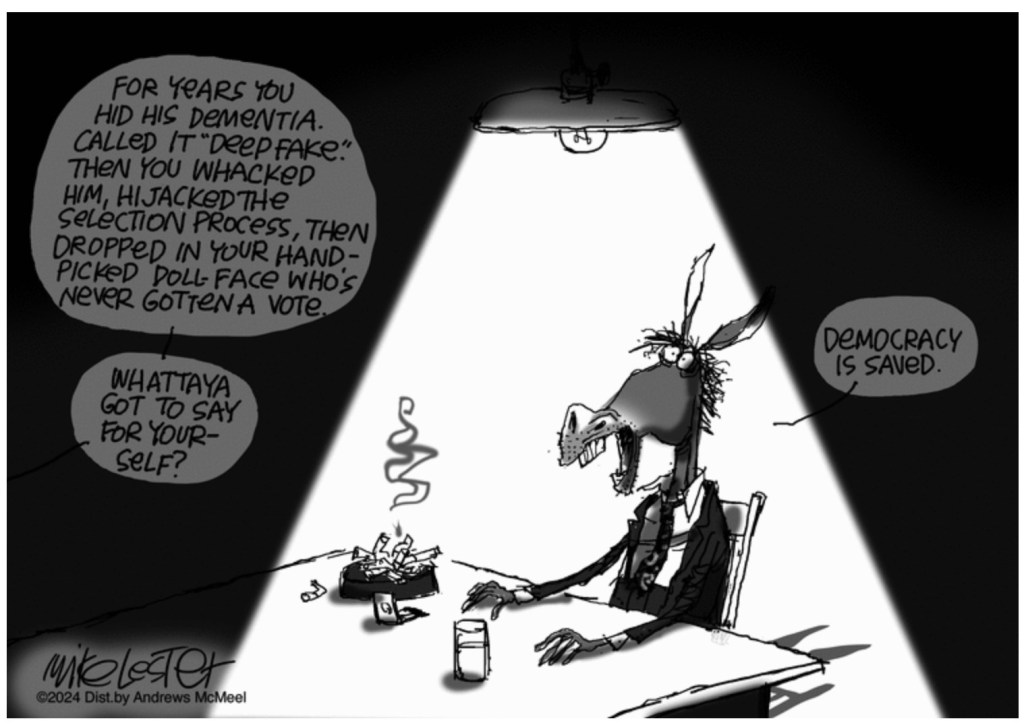
So, at the eleventh hour, the DNC made the decision to take the path of least resistance, and hand Kamala the nomination. Not everyone supports this decision. Even the Black Lives Matter movement came out and demanded that the DNC “host a virtual snap primary.” They stated, “This moment calls for decisive action to protect the integrity of our democracy and the voices of Black voters…. We do not live in a dictatorship. Delegates are not oligarchs…. Installing Kamala Harris as the Democratic nominee and an unknown vice president without any public voting process would make the modern Democratic Party a party of hypocrites” I’m sorry to break the news to the BLM activists, but the Democratic Party will prove they are a party of hypocrites. As sure as the sun will rise tomorrow, they will momentously appoint Kamala Harris as their Presidential nominee in Chicago.
Democratic strategists, and therefore the DNC as well, knew all along that it would be difficult for Harris to successfully compete for the Presidential nomination. They said so themselves, “If Harris does end up running for president and becomes the Democratic nominee, strategists say party operatives would help her win. But if she is involved in a primary, they predict it would be tough for her to clear the field.” Kamala was given the gift of a lifetime in Biden dropping out and endorsing her. She doesn’t have to compete in a primary. The position was just handed to her. She literally won the political lottery! If she fails to win the 2024 Presidential election, her future chances of holding the office will very likely all but vanish.
In Summation
Here is what should not matter: that Kamala is not a mother. Thirty years ago, this would have been an asset! Conversely, thirty years ago, if she were a mother she would have been accused of abandoning her children to run for any high office, let alone POTUS. There may have even been talk that anyone who is a mother would not have been tough enough for the position. In the 90’s, women started to distance themselves from these traditional viewpoints, and female career politicians have made substantial inroads over the years.
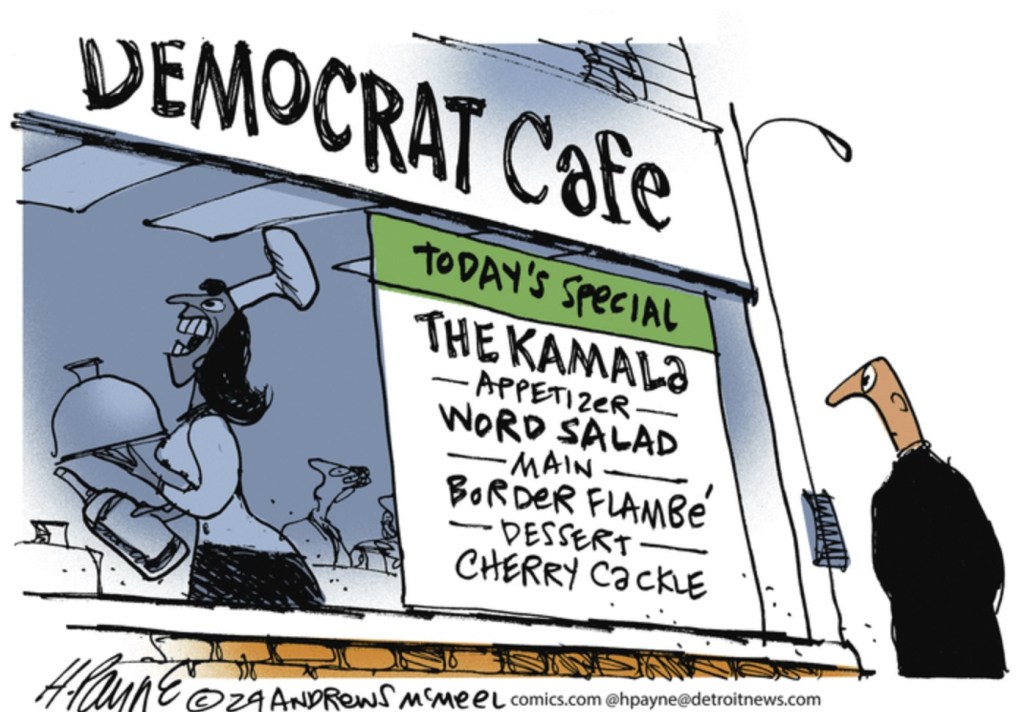
What should matter is Kamala’s moral failings, her giddy cackles, her proclivity for “word salads,” her long history of deflection, lack of accountability, chaotic leadership style, poor communication skills, and wishy-washy decision making. These are the overarching themes of Kamala’s Harris’ thirty plus years in politics. Do any of them matter? Maybe if the DNC had the luxury of more time in their search for the ideal candidate, they would. But right now, they don’t. The Democratic party is all too eager to overlook every last one of Kamala’s many troublesome attributes. They feel they have no choice. Because in the end, the only thing that matters to them is beating Donald Trump, and it doesn’t matter what they have to do, say, or report, in order to achieve that end.
This post has by design focused on Harris’ vulnerabilities, not as a hit piece, but to provide important context on the presumptive Democratic nominee that is missing from the sanitized MSM narrative. I am not one who believes that only half of the story – one which is spun in the candidate’s favor – should be the only story that is told. Until the MSM returns to the values of a time when truly independent reporting was held in higher esteem, I will endeavor to fill that gap.
 Inside Out Odyssey