
The unprecedented hatred of Israel and ever-growing antisemitism being directed at Jewish students on American college and university campuses is alarming. Pro-Hamas and pro-Palestinian protestors purport to be campaigning against the claimed genocide of Palestinians by Israel. Never mind the fact that it was Palestinian-backed Hamas who engineered the bloody October 7th attack on Israel that sparked the current war, knowing full-well that it would elicit an all-out response from Israel. Or the “little” detail that Hamas’s original 1988 “Covenant of the Hamas” and its 2017 updated version both seek the obliteration of Israel, which is aptly summed up in their favorite slogan: “From the river to the sea.” Supporters of Hamas and Palestine allege that this conflict is the culmination of years of oppression by Israeli “colonizers.” The misappropriation of such terminology was discussed on this site in a previous post: “American Colleges’ and Universities’ Stance on the Israel-Hamas War: Will Antisemitism, Morals or Money Prevail?” Interestingly, pro-Hamas and pro-Palestinian supporters (students, professors and mainstream media), appear to dislike it when their very own doublespeak and twisted rhetorical tactics are turned against them.
In the early days of the conflict, Hamas supporters decried the term “terrorist” being used to describe the individuals who brutalized, murdered and abducted Israeli citizens on October 7th. They preferred the use of the more watered-down term, “militants,” despite the fact that the attacks that day are the very definition of terrorism. Lest we not forget the ubiquitous attempt by Hamas supporters to recontextualize history – a means to enhance empathy for Hamas by selectively glossing over Hamas’ true narrative, actions and sworn covenant (i.e., the destruction of the state of Israel). This large cohort of ill-informed pro-Hamas students, professors, and administrators seek to persuade the rest of us to conveniently forget how field operations manuals recovered from the bodies of dead Oct 7th Hamas terrorists explicitly instructed them to employ “terrorism” as they deemed necessary in carrying out their mission.
We don’t hear accounts of Gazan citizens hunkered down in bomb shelters because apparently there aren’t any. In Hamas’ long years of methodical and secretive preparation of a vast and impressive network of well-appointed underground tunnels, some of them big enough to drive a truck through, they forgot to include any for the civilian population. Nor do they feel under any obligation to do so. Rather, Hamas prefers the population of Gaza above ground, and vulnerable, while they lob rockets over their heads into Israel; attacks which Hamas well knows are of zero military value, but maximum emotional and political impact, as they are guaranteed to provoke Israel into returning fire into Gaza. All as top Hamas leadership directs operations from the safety of their beneficent host and patron, Qatar.
Why the focus on words? Because words are powerful. Words influence our perception of events, and therefore our opinions and actions. Just ask any politician. They know this all too well, as do other, less visible actors who seek to shape public opinion for their own less-than-clear ends. Terrorist vs militant. Genocide vs counter-terrorism or casualties of war. The framing of the conflict in Israel and Gaza into these and other contexts often elicits a strong emotional response. Those who may agree with a given broad-strokes depiction of the principles and goals of the conflict, but disagree with the methods and tactics actually being employed on the ground, are often stigmatized for failing to agree unequivocally with activists. Administrators and professors who either foster, or are complicit in, such rhetoric deserve to lose their jobs. Their primary purpose on university campuses is ostensibly to educate the young, developing minds who are there to learn. The Middle East, of all places on this planet, requires historical context to understand practically everything that happens there. It has been a hotbed of conflict and geopolitical rivalry for generations. Yet rather than promoting open, civil discourse, universities are permitting blatant alienation, and outright menacing, of students and professors. It is as if some universities are advocating the illusory truth effect – aka the Big Lie – the more something is repeated over and over again, the more likely people are to believe that it is true.
The Illusory Truth Effect and the Overton Window of Political Possibilities
The problem with categorization, stigmatization and the illusory truth effect is that they often rely on the all-or-none principle. You either totally agree with me or you are totally against me. Every important issue is turned into a litmus test, with zero tolerance for any much-needed nuance or investigation that might muddy a neatly black-and-white characterization. As a result, if you are anti-Hamas, you are automatically anti-Palestinian. If you are pro-Israel, you are automatically for the killing of Gazan babies. However, with politicians, activists and the media (among others) all waging a constant effort to bend the public’s perception towards their preferred positions on any given topic, we are perpetually awash in the crosscurrents of their conflicting pulls. The Overton Window of Political Possibilities, a phrase introduced by conservative political scientist Joseph Overton in the 1990’s, explains that the key is identifying where on the spectrum of possibilities the public’s willingness to accept any given topic lies at any given moment in time
However, just as you can shift a topic from unacceptable to acceptable, you can also do the reverse. For example, the sexual harassment of women in the workplace up until the late 20th and early 21st century, while certainly never acceptable, was generally tolerated as simply a fact of life to be overlooked, dismissed, and in some environments, even encouraged. Hollywood’s “casting couch” got its name for a particular, predatory reason. Women who wanted to break through the glass ceiling of then male-dominated professions, had to be willing to tolerate more than their share of harassment, inuendo and the threat of career ruin if they didn’t play the game the right way. Today, significantly less of this is tolerated, and most workplaces have firmly taken a stance against such behavior.
In contrast, antisemitism prevailed on university campuses leading up to WWII and continued afterwards. However, while not totally eradicated, antisemitism appeared to wane in the latter part of the 20th century. Today however, it has reared its ugly head once again, with renewed vigor. A number of reasons can be attributed to this nationally, but only a few when narrowing the focus to college campuses. The failure of university administrators to heed the repeated warnings of many political, religious and corporate leaders in the immediate aftermath of the October 7th attacks enabled pro-Hamas activists (including students, professors and administrators) to virtually run rampant, while leaving Jewish students to fend for themselves. In so doing, many universities permitted their campuses to become playgrounds for antisemitic propaganda, in the guise of free speech. The result? Jewish students have experienced virulent, tacitly university-sanctioned aggression and hatred. Those who dared to speak out against this antisemitic behavior were shouted down, shamed, blocked from classes and events, and even attacked.
Follow the Money
It took congressional hearings, and the withholding of large donation checks by wealthy benefactors, for some university presidents to take a more aggressive stance against antisemitism. Following months of what would be deemed illegal behavior outside of university campuses, universities finally began to push back on protestors. Opponents to this “new stance” viewed it as universities caving in to corporate pressure. How dare they? After all, who funds their endowments, the US government? I think not. As the expression goes, “follow the money,” far overseas as it turns out. Wealthy American corporations, individuals and families are not the only ones contributing to American Universities, but the motives of these foreign entities are often very different from what we might expect.
In 2020, Dr. Charles Small from The Institute for the Study of Global Antisemitism and Policy (ISGAP), published a Newsweek Op-Ed piece titled, “Unreported Foreign Donations to Universities Foment Anti-Semitism.” In it, he presented some of the findings of a multi-year research project he conducted, titled “Follow the Money,” which was presented at a 2019 conference hosted by the Department of Justice. His research “uncovered billions of dollars of unreported funds, which, in turn, led to the launch of a federal government investigation in 2019.” Small reported that the Department of Education (DOE) was investigating several universities (Carnegie Mellon, Cornell, Georgetown, Harvard, Rutgers, Texas A&M, Virginia Commonwealth, Yale, and others) for collectively failing to report funds received from Middle Eastern countries in excess of three billion dollars; a large portion of which came from Qatar.
However, one of the most comprehensive reports on the infusion of cash from Arab countries into American universities was written by Mitchell Bard, PHD from the American-Israeli Cooperative Enterprise (2023). The report, titled, “Arab Funding of American Universities: Donors, Recipients and Impact” outlines the reason for, and result of, Arab countries underwriting certain programs, research and professorships at leading American universities. Bard’s research expands upon the previously reported findings of Dr. Small. He delves deeper into Arab countries’ donations to American colleges and universities, and how some of today’s university administrators cannot seem to turn away from Arab money. Bard cites Laurent Murawiec’s book, Princes of Darkness: The Saudi Assault on the West. Murawiec writes, “The Al-Sauds have used the enormous power of wealth that came from oil to buy countries, consciences, political parties, celebrities and mercenaries,” and as we have seen, it has also been used to buy some college and university administrators and faculty (via professorships, research grants, etc.). One sentence early in Murawiec’s book that I found memorable is “The Romans used to say money has no odor. It is like natural gas, and it is equally toxic.” Maybe it’s time college and university money had some odorant added, so it can’t lurk in unexpected places like an imperceptible toxin. This information should be made readily available on each institution’s website, so parents, students and concerned citizens can easily identify donations and contracts from unscrupulous sources – the same information that is currently concealed from the public’s eyes, conspicuous by its absence (when you know what to look for).
Why is this important? Because as is customarily the case, such largesse does not come without some hefty strings attached. Arab money is meant to peddle positive images, buy influence, promote political support for Arab agendas, and spread pro-Arab propaganda as a means to deflect inconvenient truths such as the deeply institutionalized mistreatment of women in Arab countries, Syria’s brutal repression and mass-slaughter of dissidents, Saudi Arabia’s murder, dismemberment and dissolving in acid of Jamal Khashoggi, or the trifling detail that fifteen of the nineteen 911 hijackers were from Saudi Arabia, etc.
How Much Money?
Qatar
How much money are we talking about? Roughly 44 billion dollars from 1986 to 2022, with approximately one quarter (almost 11 billion) coming from “Arab individuals, institutions, and governments.” As noted previously, Qatar easily surpasses all other Arab foreign investment in American universities, with Cornell University receiving the largest one-time gift of $151 million dollars in July 2020, along with subsequent yearly donations. Qatar reportedly also sent regular installments of several million dollars to Texas A&M and Carnegie Mellon – two universities that have satellite campuses at Qatar’s Education City. ISAGP’s Dr. Small was particularly troubled with the potential “safety and security concerns” stemming from Qatar’s partnership with Texas A&M, as it included “significant access to and ownership of intellectual property on many research projects, including nuclear energy research.” Small further expressed concern over specific language written into the agreement between Texas A&M and Qatar, which implies that Qatar can “shape academic standards to fits its preferences . . . [have] sway over course offerings . . . [subject] academics to Qatar’s strategic interests . . . [influence and appropriate] academic work . . . and require TAMU faculty and staff adhere to Qatar’s laws” no matter how restrictive or oppressive. While these issues may be stifling and politically motivated, what is extraordinarily interesting is Texas’s A&M’s willingness to so readily restrict their own academic and business latitude to establish “any competing engineering program in the Middle East without Qatar’s approval.”
In light of current student, faculty and administrator’s constant couching of protestors’ ‘rights’ to free speech and self-expression, no matter how discriminatory or harassing, is it not ironic that Texas A&M was willing to give up comparable rights in exchange for millions in funding to establish a satellite campus in Qatar? Given the content in Texas A&M’s agreement with Qatar, it doesn’t take a leap of imagination to connect the dots and conclude that other American universities, with satellite campuses of their own in Qatar, were also required to sign similarly restrictive agreements in exchange for millions of dollars. The often-wise advice for visitors in a foreign country to heed the laws and customs of their hosts is a whitewash here. These universities are not a gaggle of sightseeing tourists minding their manners on a weekend stopover between Riyadh and Dubai. They maintain a permanent presence in Qatar, cultivating lucrative financial interests, all the while looking the other way. That’s not a case of respecting one’s host, but of compromise and capitulation. Unsurprisingly, Texas A&M found themselves up to their necks with a foreign entity operating on an agenda and worldview that is in many ways hostile to America’s. But as further detailed below, and to the astonishment of many (most of all the Qataris), Texas A&M ultimately did the unthinkable and made the decision to pull out of Qatar. The same cannot be said for those institutions that remain.
Saudi Arabia
Additionally, according to the Middle East Monitor, Saudi Arabi contributed approximately $650 million to American Universities between 2012 and 2018, with an additional $1 billion paid for Saudi Arabian students to attend American Universities. Following an analysis of Department of Education records, Responsible Statecraft noted that Saudi Arabia donated roughly $440 million to colleges and universities in the United States between October 2018 and October 2022, with a roughly $105 million year over year increase (2018-2019). In addition, they contractually committed approximately $700 million to American colleges and universities – all following Khashoggi’s assassination, dismemberment and dissolution in acid. If this doesn’t say “blood money,” what does? American bastions of higher education would rather accept money as a substitute for penance from Saudi Arabia than hold Saudi Arabia or themselves accountable.
All Arab Countries
Below are two tables reprinted (sans permission) from Bard’s 2023 report. The first table lists funding by Arab countries in American universities, ranked by dollar amount. The second details the top fifteen American universities that receive Arab funds, again ranked by amount, and totaling nearly eleven billion dollars. Both tables cover the time period between 1986 and 2022.
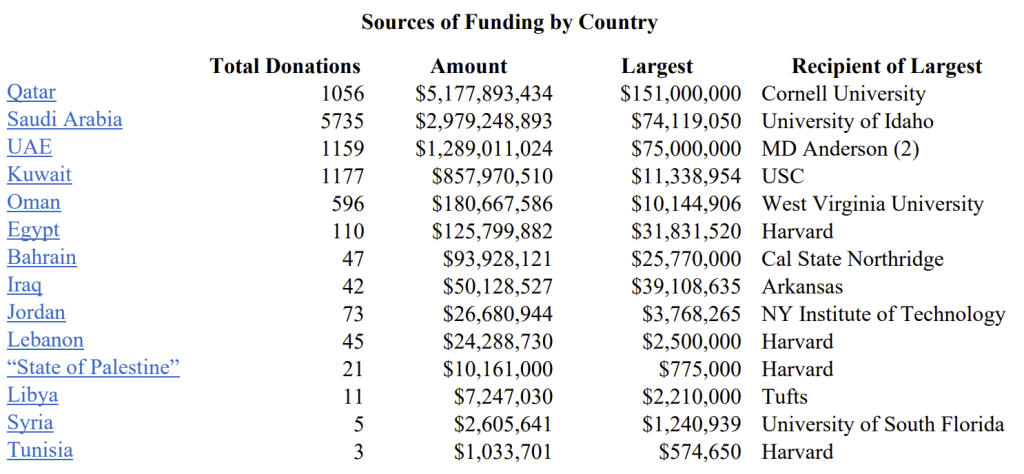
Bard points out that given the “economic problems” and low per capita GDP endured by Egyptian citizens, for example, it is surprising that their country finds the financial wherewithal to contribute so much to American universities. The same could be said about Iraq, Lebanon, Libya, Syria and Tunisa, all of whom have large numbers of their constituents living in poverty, and where a little could go a long way, but apparently goes much farther in the already-deep pockets of American universities. Furthermore, Bard notes the obvious: how can an American university receive funds from the “State of Palestine” when US policy does not recognize its existence? Ponder that.
Where Is the Money Going?
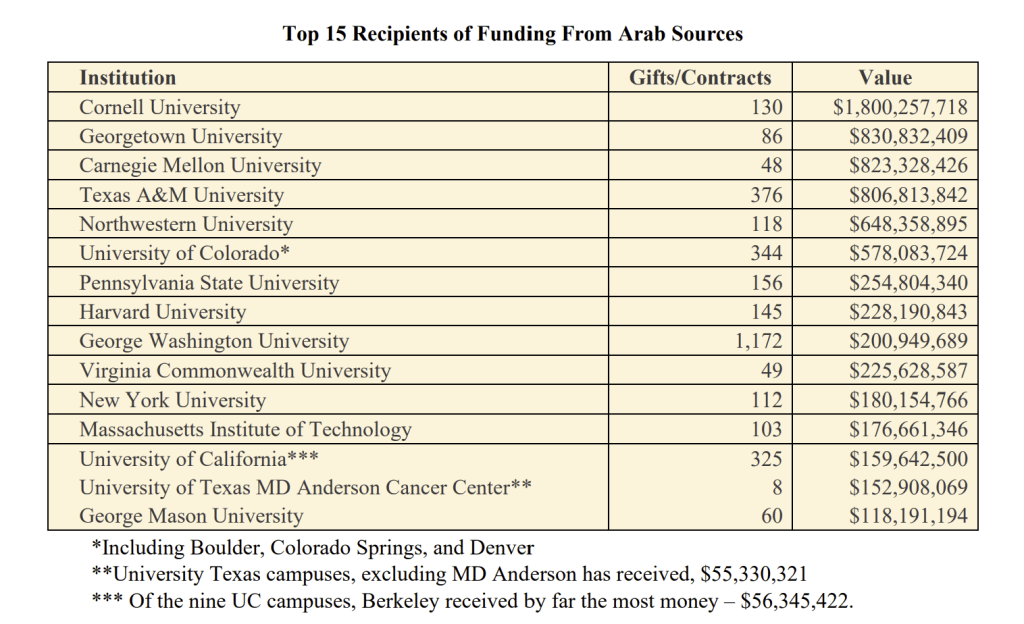
To no one’s surprise, elite American universities are the recipients of most of the gifts/donations from Arab countries. So, what do the Arab countries get in exchange for their largesse? On the surface, educational scholarships for Arab students, funded professorships, the establishment of Arabic-Middle Eastern programs, and lucrative contracts, both domestic and foreign for educational and healthcare purposes. Refer to Bard’s article for an extensive description of each.
It is not that one should be upset that Arab countries are providing funding and enhancing the endowments of universities to install Arab-friendly faculty. The problem arises when Middle Eastern departments at beneficiary universities are dominated by pro-Palestinian/Arab faculty, in the absence of counterweighting by faculty with opposing perspectives (for example, pro-Israel positions). Do these underwritten faculty and departments routinely discuss the negative geopolitical issues that plague the Middle East and Northern African (MENA) countries? Are they critical of the social, political and economic unrest internal to each country? Do they discuss the structural governance issues in countries on the verge of becoming failed states? How about the lack of representative governments (in favor of repressive monarchies and autocratic regimes), and the oppressive state of women’s and LGBTQ rights, often grounded in religious extremism? Most likely not, or we would be seeing many more protests about these issues on college and university campuses.
Qatar’s Education City
It would be inexcusable not to mention Qatar’s Educational City – a roughly 4.6 square mile educational “city” in Al Rayyan, Qatar. It was established in 1997 by the Qatar Foundation, “a state-led non-profit organization in Qatar.” Six US-based universities currently operate satellite campuses at Education City: Virginia Commonwealth University (est. 1998), Weill Cornell Medicine (est. 2001), Texas A&M University (est. 2003), Carnegie Mellon University (est. 2004), Georgetown University (est. 2005), and Northwestern University (est. 2008). It is no coincidence that these six universities are among the top ten beneficiaries of Arab money, with five of them comprising the top 5 (See above table). It doesn’t take a seasoned observer of Middle Eastern affairs to see the irony. America’s traditional definition of free speech (not the current weaponized version), not only does not exist in Arab countries, but is treated as a mortal threat to their rule.
Conveniently Ignored Truths About Qatar
In 2021, the Anti-Defamation League (ADL) criticized Qatar for “teach[ing] hateful antisemitic misinformation and myths” and its “failure to remove bigotry from its textbooks” over the last 18 years. The ADL concluded “Qatar’s stated policy is that it seeks peace with Israel upon the achievement of a two-state solution to the Israeli-Palestinian conflict. However, the school lessons cited above seem to undermine that goal by suggesting peace and coexistence may be impossible or even forbidden.” More recently, the Middle East Media Research Institute (MEMRI) detailed the rampant anti-Israel and antisemitic sentiment that continues to pervade Qatar’s educational system. They cite incidents where Judaism is branded a “fake and distorted religion,” with Jews described as “vengeful, treacherous, deceitful, scheming, weak, lowly, and as people who slandered and killed Allah’s prophets due to their ‘evil nature’.” MEMRI examples extend beyond K-12 classrooms to events that were permitted to take place at Qatar’s Educational City, such as hosting a function with a Qatari government minister where maps were displayed that omitted the existence of Israel, renaming the entire region “Palestine.”
Qatar’s Systematic Oppression of Women
Despite being able to attend college and establish themselves as doctors, lawyers and other reputable professionals, women continue to face systematic discrimination and repression in Qatar’s patriarchal society. Extensive male guardianship rules govern women’s lives, regardless of educational or professional status. For example, women still require permission to marry, those under the age of 25 require male guardians for travel, and although older married women may travel alone, this can be blocked by their husbands. Shockingly, foreign national women and women from the Gulf Cooperation Council have also been required to seek permission from their male guardians (fathers or husbands) to work in Qatar.
Crimes and Abuses Worthy of Protest: A Wealth of Choices
If today’s college faculty and students were truly concerned about systemic and structural racism, oppression, human rights abuses, mass killings, and blatant crimes against humanity, we would be seeing many more protests. Let’s consider a few of the more standout examples.
Syria
How about the actions of Syrian President Bashar al-Assad for the last thirteen years? As of 2024, the Syrian Observatory for Human Rights (SOHR) has verified 617,910 people killed, of which 164,223 were civilians, including 25,857 children. SOHR details more than 100,000 (documented and undocumented) civilians were tortured to death in Syrian detention centers and prisons. Accompanying the carnage, roughly 13 million Syrians have been displaced, with “infrastructure, hospitals, schools, and private and public property [having] been substantially damaged or destroyed.” Are the lives of Syrian men, women and children not as worthy of protestors’ outrage as the lives of Palestinians?
Türkiye
What about the Kurds? Türkish President Erdogan’s long-running and infamous repression of the Kurds has entailed the dissolution of Kurdish political parties, the replacement of Kurdish officials, the illegal imprisonment, torture and disappearance of Kurdish political leaders, activists, and regular civilians, and the “[denial of] equal access to political representation, economic resources and cultural freedoms” to Kurds. All of this from a long-standing NATO ally.
India
The fate of Muslims in India? The long-simmering mistrust and hostility between India’s Muslim and majority Hindu populations has only intensified – and indeed been actively inflamed – under the rule of Prime Minister Modi. Modi’s recognized and unabashed goal is to make India a Hindu nation. Toward this end, Muslims have been subject to: (1) evictions from their homes, (2) destruction of their homes and businesses, (3) the banning of headscarves, (4) passage of laws meant to prevent marriage between Hindu women and Muslim men, (5) erasure of Muslim history through the renaming of cities, (6) jailing (without trial) of Muslim journalists and activists, (7) the open acceptance of virulent anti-Islamic rhetoric, and (8) the “othering [of] Muslims, branding them dangerous and violent.” All of this despite the fact that India’s population makes it the world’s largest democracy.
Yemen
The Yemenis? The unrest in Yemen has been festering since its formation in 1990. Prominent foreign players include the United States, Saudi Arabia, Russia and Iran. Most western countries back the Saudi alliance, while Russia and Iran support the Iranian-backed Houthi rebels. The involvement of these international players in the backing of competing factions (insurgents, rebels, and terrorist groups) has served to exacerbate and prolong the conflict, and contributed to territory being repeatedly fought over by rivals. The result? According to the Council on Foreign Relations, “The country’s humanitarian crisis is said to be among the worst in the world, due to widespread hunger, disease, and attacks on civilians.” The blockage of humanitarian aid by coalition forces has only worsened the impact on civilians. The United Nations (UN) Development Program has been tracking the humanitarian crisis in Yemen for several years. In 2019, they reported that Yemen had “the greatest depth of poverty, second poorest imbalance in gender development, lowest caloric intake per capita, second greatest reduction in economic activity relative to 2014, and second greatest income inequality of any country in the world.” Unsurprisingly, as of 2021, the UN Development Program estimated nearly 400,000 deaths, of which 60 percent were the result of secondary causes attributed to the ongoing war – food and water shortages, and insufficient access to healthcare.
China
Of Uyghurs and other Türkish Muslims in China? According to Human Rights Watch (2021) “as many as a million people have been arbitrarily detained in 300 to 400 facilities, which include ‘political education’ camps, pretrial detention centers and prison.” Türkish Muslims are subject to “mass surveillance, controls on movement, arbitrary arrest and enforced disappearance, cultural and religious erasure, and family separation.” Further, there is no judicial due process, even for trivial offenses (“sending an Islamic religious recording” or “downloading e-books in Uyghur.”) Various governments around the world have imposed sanctions on China, to no avail. Human Rights Watch contends that the sanctions only result in an even greater number of abuses in Xinjiang and Tibet. Make no mistake: China, both global adversary and key US trading partner (and manufacturing hub for Apple), is engaged in the systematic persecution of selective minorities on a vast, industrialized scale.
Absence of Concern Over Long-Standing Human Rights Issues
Where is the outrage, or at least expressions of concern on university campuses, for the above referenced human rights violations? It is unfathomable that so many protesting students and faculty are blissfully wielding smartphones and tablets of such morally tainted origin (ahem, Apple products), and wearing clothing and accessories manufactured in China. Therefore, the uncomfortable truth for Türkish Muslims and Uyghurs is that it would be too disruptive, too unfashionable and just plain too inconvenient for these students and faculty to boycott China, and advocate for divestment from the fruits of systemic oppression, torture, and erasure of these people. These persecuted groups simply are not as in vogue as the latest iPhone or counterfeit Louis Vuitton backpack.
The balancing act in the Middle East is notably precarious. Given the number of systematically oppressive regimes there and elsewhere, why is it that American university student and faculty protestors only target Israel? Why not protest those who have long perpetrated the routine imprisonment, killing and displacing of individuals in the name of a non-Judaic religion? Why not call for the divestment of money from all countries guilty of acts against humanity? This is not about “what-aboutisms.” This is about understanding why only one country, Israel, is the target of such vitriol after experiencing what can legitimately be called their equivalent 9/11. Where are the protestors, encampments, calls for boycotts and divestment from any of these other countries? Compared to the many bad actors casting long shadows across the world, what somehow makes Israel’s shadow even longer? The fact remains that the harshest rhetorical hyperbole is reserved for Israel, and Israel alone.
This takes us back to elephant in the room – MONEY. The amount of money that American universities receive from Arab countries is staggering, but pales in comparison to that received by China. According to the US Foreign Affairs Committee, the People’s Republic of China pays American universities roughly $12 billion dollars per year to educate Chinese students. This is in addition to “donations or contracts worth more than $426 million . . . since 2011” Not unlike Arab money supporting pro-Palestinian campus groups, Chinese Communist Party money has “been found to support these groups…to influence on-campus debates and speeches…[as well as for] monitoring other Chinese students [thereby] undermining free speech and academic freedom.” However, the Chinese Communist Party (CCP) does not limit its influence to American universities, it has also established “Confucius Institutes” in K-12 schools, with funding conditional upon censure of select topics (Taiwan and Tibet).
Whitewashing of Atrocities
Are these universities whitewashing the atrocities taking place in and around Arab countries and China in exchange for money? It would appear so, as evidenced by the millions these foreign governments spend on American universities alone, not to mention think tanks and lobbyists. The Clarion Project is dedicated to exposing extremists’ threats in America. In an interview with the online journal The Washington Free Beacon, Alex Van Ness, a research analyst at the Clarion Project stated, “[Qatar’s] foreign influence operation is shaping public opinion to erode American ideas,. . . [it] is muddying the waters on issues relating to national security and relating to our relationships with our allies and it’s being done so by governments and entities that don’t have things like freedom of speech and are generally antagonistic to America and the American government.” Should this concern us? Hell yes! Is it concerning our elite institutes of higher education? Apparently not. For them, money is the driving consideration between good and bad.
For example, Qatar’s generosity has been extended to Northwestern University who has received in excess of $340 million from Qatar and the Qatar Foundation. One professor alone, Justin Martin, was the recipient of a $1.4 million grant from the Qatari government to study “Media Use in the Middle East.” What did Qatar get for their investment? They bought a professor to “promote the anti-Semitic Boycott, Divestment, and Sanctions (BDS) movement.” And he did not disappoint, espousing such rhetoric as, “Happy 9/11 more than 8,441 civilians died in Yemen this year helped by US arms dealt to Saudi Arabia & UAE. . . The US is complicit in far more terror than it has ever suffered.” While there is plenty of room for legitimate debate regarding the US’s long and sometimes questionable choice of partners in arms deals, it should not be conducted through the megaphone of a lobbyist dressed in academic’s clothing. Thankfully, some Northwesterners were having none of it and Martin issued an apology, albeit a forced one.
The Martin incident is just one of many examples that demonstrates the conflict of interest posed when American’s colleges and universities accept donations and gifts from foreign governments and lobbyists. The practice in academia of accepting money from foreign countries, individuals or their agents is dangerous. As Angela Morabito from the Department of Education noted “. . . some institutions solicit and accept large sums of foreign funding from nations hostile to our national security and economic interests.” Yet, while educational institutions are required to disclose whom they receive money from, not all do. And of those that do, opaqueness, rather than transparency appears to be the order of the day.
Given the aforementioned obfuscation of foreign money and interests on today’s American college and university campuses, it should come as no surprise that the infusion of Arab money has been discovered to be funding the formation of pro-Hamas/pro-Palestinian, and anti-Israeli groups. According to the ADL, the leading organizers of the protests currently taking place on university campuses today are: Students for Justice in Palestine, Palestinian Youth Movement, US Palestinian Community Network, Within our Lifetime-United for Palestine, Jewish Voice for Peace, If Not Now, and the Party for Socialism and Liberation. Are members of these groups being used as agents to incite protests and cultivate animosity toward anyone who is anti-Hamas/anti-Palestine? Based upon current reports of university Presidents dealing with the onslaught of campus demonstrations (see below), the answer is clearly yes.
While some universities are taking a firm position against disruptive campus activities, others are moving at a snail’s pace. These elite American universities are teaching our students that nothing – morals, ethics, or even human life – is more important than money. Money will buy you anything you want, including: the dissemination of propaganda, the whitewashing of the dismal human rights record in Arab countries, and even tolerance for any form of intimidation or discrimination one is willing to pay for (presently, antisemitism seems to be the one with the highest currency value).
In a surprising turn of events, Texas A&M’s Board of Regents voted to close its Qatar campus, a process that will be complete in 2028. Board Chairman Bill Mahomes was quoted as saying “the core mission of Texas A&M should be advanced primarily within Texas and the United States.” Mahomes further noted that the university does “not necessarily need a campus infrastructure 8,000 miles away to support education and research collaborations.” Who really does in today’s vastly networked world? In the Board of Regent’s official letter, they cited “heightened instability in the Middle East” as a reason for reassessing the need for a satellite campus in Qatar’s Education City.
As you can imagine, the news was not well received by the Qatar Foundation. Predictably, and in utterly ironic fashion, the Qatar Foundation reportedly criticized the board, stating it had “been influenced by a disinformation campaign aimed at harming the interest of QF [the Qatar Foundation].” They further expressed their grave disappointment that Texas A&M would allow themselves, “a globally respected academic institution,” to fall “victim to such a campaign and [allow] politics to infiltrate its decision-making processes.” Not that the Qatar Foundations allegations are true, but given the billions of dollars Qatar has peddled into American universities in exchange for political influence and image reformulation, they are still shameless enough to cry foul when others play the same game in reverse (again, no one is conceding Qatar’s counter-allegations are true). I guess, according to them, what is good for the goose is not so good for the gander.
Mind-Boggling Hypocrisy
The hypocrisy is astounding. These same individuals raged at administrators who dared try to curb the antisemitic hatefulness that percolated to the surface during the early weeks of the Israel-Hamas War, following the withdrawal of funds by corporate and wealthy donors. Sadly, top administrators displaying any degree of backbone at the large and mighty universities were in short supply. Rather than protecting those in need of support, laying down the law, and holding students and faculty to account, most instead pandered to the vociferous bullies. One notable exception, at least initially, was Columbia University’s President Nemat (Minouche) Shafik. Tensions on university campuses increased following her recent congressional testimony in which she dared to state, “antisemitism has no place on our campus, and I am personally committed to doing everything I can to confront it directly.” Shafik further expressed her disgust with several faculty members who supported Hamas’ actions. Her statements angered university protestors (students and faculty) and prompted the establishment of a large encampment on campus, which protestors called, a “Liberated Zone.” President Shafik warned protestors that the encampment violated new policies and gave students a deadline to voluntarily disband. When the deadline passed, she called upon the NYPD to facilitate its dismantling, and arrest trespassing protestors. More than 100 were arrested. Several students were also suspended from school and ordered out of university housing. However, when the remaining protestors ignored an order to clear out later that week, Columbia opted to simply extend the deadline. When that deadline also came and went, the university said only that it was engaged in “ongoing discussions” with the protestors. The university subsequently said they would not call the NYPD back to campus to take any further action against the protestors.
However, as discussions between administrators and protesting students failed, and demonstrators refused to clear their encampment, Columbia spokesman Ben Chang informed the student activists they would be suspended if they did not vacate the encampment by early afternoon on April 30, 2024. In response to Columbia’s ultimatum, “demonstrators seized an academic building and blocked the entrance with a human chain. . . . [They] broke into the building and barricaded themselves with wooden chairs, metal tables and trash cans.” They were, however, kind enough to “[release] people, including workers who were inside at the time of the takeover.” This time, demonstrators appear to have crossed the school’s proverbial ‘red line.’ Columbia reversed its earlier position and sought assistance from NYPD to clear demonstrators from both Hamilton Hall and the encampment set up on university grounds (04/30/2024). Police arrested approximately 100 protestors. Photos from inside Hamilton Hall showed the protestors were anything but “peaceful,” leaving behind damaged and broken furniture and panes of glass. In order to ensure no further disruptions on campus, or at graduation ceremonies, the university requested that NYPD “maintain a presence on campus through at least May 17th, two days after the scheduled graduation.”
As the rest of sane America has been forced to stand idly by and watch the pervasive acts of civil disobedience, violence and illegal activity taking place on some college campuses, many of us silently cheered from our homes as Columbia finally began to crack down on its protestors. Let’s hope it sticks this time!
Campus Protests
On campuses around the US, pro-Palestinian groups erected their own encampments or held demonstrations in solidarity with the Columbia students. Many of these protests and activities escalated from purportedly “peaceful” gatherings to violating school polices to crossing the line into vandalism, violence and other illegal activity. Does this really surprise anyone? The patients (students and agitators) are running the asylum (the colleges and universities). As their intolerance of ideological diversity borders on the insane, the term “asylum” seems apropos. The attempt of administrators and some mainstream media outlets to misrepresent these demonstrations as “peaceful protests” is an embarrassment to intellectual honesty. A few examples of the courageous few who have been willing to provide authentic accounts of what has been taking place at campus protests can be found in Annex I.
Protesting students and faculty are supporting Hamas, a known terrorist organization who not only suppresses dissent, but also women, LGBTQ, and non-Muslims all while using its own constituents (those who thought Hamas would protect them) as human shields. This Palestinian-elected terrorist group represents the uncensored “free society” that protestors are supporting. Administrators, professors and some in the mainstream media are “demanding” that we protect free speech at all costs. It is worth repeating: what is being demanded is that we not only tolerate pro-Israel and Jewish students being accosted on campus, but also that we protect the vitriolic hate speech directed at them. To be clear, even hate speech is generally protected under the First Amendment. However, this is no mere case of a polarizing figure invited to campus for a polite speaking engagement. As the ACLU notes, “the First Amendment does not protect behavior on campus that crosses the line into targeted harassment or threats, or that creates a pervasively hostile environment for vulnerable students.” Given this, I wonder if the same lack of enforcement would apply if Civil Rights-era segregationist language and behavior sprung up on campuses across the US in the present day?
Campus Protest Support from Iran and China
You also know things are terribly amiss when Iran and Chinese state media are backing pro-Palestinian protests at American universities. Yes, two of the most tolerant, nonviolent, uncensored, free speech democracies in the world (alert: I’m being ironic), where civil disobedience and anti-regime opinions are encouraged and dissidents are permitted to freely organize and protest the government (still being ironic) are expressing their concern over Biden’s “nonchalant response” to the activists and the “crackdown on Gaza campus protests.” How comforting to know that these two ‘friends’ of the United States are concerned for the integrity of our constitutional right to free speech.
Enough is Enough
After weeks of ratcheting escalation and testing of limits (and administrator’s resolve), some universities have had enough. Vanderbilt took the lead and expelled three students, suspended one, and issued twenty disciplinary probations following the protestors’ forceful entry into a closed building and assault of a community service officer. This news delighted many, including even left-leaning pundit Joe Scarborough and guests on his Morning Joe show (04/19/2024). On a subsequent episode of Morning Joe, co-host Mika Brzezinksi and prominent guests Donny Deutsch and the Reverend Al Sharpton weighed in on the Columbia University protests. Deutsch denounced the “violent hatemongers.” He also hit home when he said, “I’m going to say the quiet part out loud. If there was any group sowing hate and violence against any other group – Asians, Blacks, Hispanics, gays – it would be shut down.” Sharpton agreed, and poignantly noted “you cannot have a convenient moral code. You either have to stand for morality for everybody or nobody.”
To the dismay of the unruly protestors (students and faculty) and their supporters, some universities are, albeit belatedly, finally drawing a distinction between open dialogue, free speech and organized, non-disruptive protests versus the harassment of Jewish students and professors, the disruption of classrooms and invited speakers, and infringing upon university functions and the ability to learn (including the occupation of campus buildings). As mentioned previously, even Columbia University, the roisterous epicenter of encampments and protests (from both students and faculty) finally decided enough was enough on April 30th following the protestors’ take-over of a campus building. The police were called in, and protesters were arrested. Here’s praying that Columbia’s administrators do not lose the courage of their convictions. But is it too little too late? Remember: “Never Forget!”
Several news outlets have been following the protests on American campuses. The Guardian provides a nice summary. Feel free to read their summary and view the visual guides they have created.
Role of Non-Student Antagonists and National and International Groups
However, the rapidity with which these protests, encampments, and walkouts have been able to form on university campuses leads one to ponder the question: did they develop organically from within the schools themselves, or have they been planned and organized by non-student activist antagonists whose sole purpose is to orchestrate pro-Palestinian protests that disrupt campus activities? What involvement do national and international groups have in the organization of demonstrations by local chapters on American university campuses? Some schools, such as the University of Texas-Austin have recognized that the current disruption on university campuses has been spearheaded by “the Palestine Solidarity Committee [which] sought to follow the playbook of the national campaign to paralyze the operations of universities across the country . . . This outside group presence is what we’ve seen from the affiliated national organization’s efforts to disrupt and create disorder.” Indeed, as a movement of this type grows both in size and public awareness, it will inevitably attract others from beyond the orbit of its core constituency; non-students, in this case. Evidence of this will immediately be seized upon as proof that the whole thing is therefore somehow illegitimate, i.e., not truly the student’s doing, the work of outsiders. In this framing, the problem does not originate from on-campus. It is not with schools’ years of lax policies encouraging the growth of intolerance, hate speech and outright physical assault. It is not with the billions of dollars they have accepted from “generous” foreign entities or that money’s corrosive effects. And thus, the fault lies not with the schools themselves at all, but rather with the outsiders who have hijacked the well-meaning students’ legitimate means of self-expression. That is: hijacked by outsiders the schools don’t favor, as opposed to those they do.
The Semantic Transformation of “Liberal Arts Education”
What was once understood, objectively, as a liberal arts education no longer exists. It has been replaced with a political progressive liberal education funded in no small part by foreign countries, who would love nothing more than to have their own geopolitical ideologies imprinted upon America’s next generation of educational, professional, and political leaders. What is bewildering is how easy it has been. Student protestors, and many faculty members, have weaponized words and phrases. Concerted attempts have been made to recontextualize history. What are we left with? Semantic satiation, in which a term becomes so overused as to lose its meaning. And who is spearheading this charge? It is poignant when the answer to that question is “higher” education. How terribly ironic.
The Protestors Farce
The protestors committing disruptive acts, both on and off college and university campuses across the US, are trying their best to convince you that Israel is evil. They have all conveniently forgotten, or have never been educated, about the horrors of the systematic and structural oppression being perpetrated against many in Arab countries. And yet, Israel’s retaliation against the terrorist group Hamas (voted into power, lest we forget, by Palestinians), who committed the most brutal terrorist attack on Israeli civilians in the country’s history, and who have to date refused to release the surviving Israeli hostages, is somehow more deserving of vilification? Never mind that Hamas has no qualms about using their own civilians as human shields, or the unassailable fact that Hamas’ fundamental mission is to destroy Israel, as stated in their covenant.
It’s no surprise that students are not being taught to consider history when evaluating current events and thinking about the future. If they were, they would be considering what the “State of Palestine” would likely look like should Hamas, and other Middle Eastern agitators, succeed in annihilating Israel (which they won’t). These students don’t have to look too far. A quick glance at the existing, dismal social “contracts” many Arab countries and regimes have with their citizens is all they need. The degree of poverty, lack of women’s rights, and practically non-existent LGBTQ rights do not remotely resemble what people enjoy in Israel or the US. Sadly, these issues are conspicuously absent from “open” discourse. Anyone who dares to bring them up is automatically accused of being anti-Islamic or anti-LGBTQ, or the new “avant-garde” term “pinkwashing.” Therefore, the one lesson all these activists have learned is that if you find yourself on the losing end of an argument, the best way to respond is to simply pivot to ad hominem attacks.
The University Graduating Class of 2024
As for the easily outraged in the American university classes of 2024, you are encouraged to leave your rebellious and protected college personae behind, and quickly adapt to the expectations of the professional workplace – because the workplace is far less likely to adapt to you. Those who have spent much their time stridently protesting and intimidating other students without consequence, should keep in mind that the corporate world is far less tolerant of such behavior. Google’s firing of over 50 people for bringing their geopolitical ideologies into the workplace is no fluke. That is life in the real-world workforce, where actual accomplishment, meritocracy and, yes, people skills are valued. Protests and the weaponization of words are not. Such antics will likely earn you the reputation of a toxic employee, and you will quickly be shown the door. Likewise, if you take issue with a company’s business practices, please, for everyone’s sake just choose not to work for that company. No one is forcing you to work anywhere. Finally, before you rest on your academically anointed laurels, take note that there have been extensive layoffs in many industries of late (entertainment, technology, media, and even California fast food). Many incredibly talented, dedicated, experienced people – including some fairly recent grads – who had every reason to think their jobs were relatively safe, now find themselves on the market by the tens of thousands. With their resumes longer than yours, and larger networks of professional connections, they are jockeying for what they can find, including many of the same positions you are no doubt eyeing. With this in mind, you may want to think twice before turning up your nose to any real opportunity in the current job environment.
Money Makes the World Go Round
In the end, it is MONEY that makes the world go round. American universities take pride in their image as bastions of intellectually progressive thought, yet they have no qualms about accepting money from systematically and structurally repressive, racist regimes in the Middle East and China. These countries likely view their contributions as a cheap and effective form of foreign policy lobbying, and an unchallenged conduit for propaganda dissemination. And they are correct. Years of happily accepting donations, unfazed by a donor country’s scary humanitarian record, is testament to American universities’ self-righteous hypocrisy. Maybe it is time to stop boycotting companies, and start boycotting universities. Ultimately, most college graduates hope to land a well-paying job. That job will more likely than not be with a company run by actual grownups in the real world, not the artificial bubble of campus life. These companies are fully aware of social media, and evaluate the online presence of applicants. Perhaps the question these graduates – principled young activists among them – should be asking themselves is whether their pricey college tuition, together with the blood money received from countries with ulterior motives that supported their university, was worth the return on investment?
Summary
American colleges and universities have shown us that underneath their academic trappings, they are fundamentally profit-driven enterprises, no different than the venal billionaires and private corporations their protesting students claim to abhor. These institutions have no qualms about accepting millions and billions of dollars in the form of donations, gifts and contracts from internationally recognized repressive regimes, or their wealthy proxy associates. These governments, and the universities themselves, know full well that such largesse comes with some significant strings attached. Does this dissuade our illustrious elite administrators from accepting these “philanthropic” donations, in favor of providing an objective, well-informed, balanced education? Sadly, no. Rather, they gladly accept the money. In return, bought professorships, and even centers of study, are established and stacked with faculty whose ideology (genuine or espoused) aligns with that of the benefactor. How often are Qatari and Saudi-funded faculty positions and centers of Middle Eastern study staffed with even a single pro-Israel professor? Or similar Chinese-funded positions and centers staffed with pro-independent Hong Kong or Taiwan professors? Not frequently, or even at all. The simple truth is that such largesse buys geopolitical influence (massaged, embellished and strategically censored) on today’s American campuses. Truth, historical or otherwise, is no longer guaranteed. It is aspirational at best, and at worst up for grabs to the highest bidder. Any oppressive government seeking to buy influence, promote an agenda, recontextualize history, and more importantly mold young, developing minds with fallacious distortions of the truth, need only reach out to American university administrators, who appear all too willing to sell the soul of their oft-proclaimed academic integrity and honesty.
With the cost of higher education at many of these elite universities incrementally climbing to nearly 90K/year, it just may be time for parents and students to more closely evaluate where they will be spending their money. Are universities willing to provide a balanced education (incorporating balanced representation from pro-Israeli professors, or even conservative professors for that matter), or are they more interested in selling a geopolitical ideology that discriminates, intimidates and attempts to silence targeted groups of students, and, as we have seen, does not transfer well to the real-world workplace?
For Your Educational Entertainment
For your educational entertainment, I direct your attention to Bill Maher. On his April 26, 2024 broadcast, he addressed the issues taking place on college campuses, bridges and freeways around the US, as only he can. Maher took aim at the anti-Israel protestors blocking bridges and freeways in New York, San Francisco, Chicago, Seattle, and Los Angeles, thereby preventing people from going to work, picking their kids up from daycare, etc. He stated this sort of behavior happens when “activism merges with narcissism.” He called the protestors “privilege-y” quipping “you can glue your hands to the street because your hands don’t have to do any work today.” Maher then proceeded to do something America’s institutions of higher education have failed to do — educate the protestors. He explained what apartheid, oppression and genocide are, and provided examples: North Korea, China, Myanmar, Boko Haram, President of Burundi, Hamas, the Houthis, Hezbollah, and the Iranian Revolutionary Guard. He further explained, “Genocide is when you want to wipe out an entire people. That is the stated goal of Hamas. That is what ‘from the river to the sea means.’ Hamas would do that to Israel, but can’t. Israel could do that to them but doesn’t.” But my favorite line was when Maher accused the protestors of cosplay[ing] as revolutionaries. Kudos Mr. Maher!
Annex I
Authentic Accounts from Campus Protests
Columbia University – A protestor holding a sign encouraging Hamas to attack New York Jews (the sign read “Al Qasam’s [sic] next targets,” with an arrow pointing to Jewish students). Arab-Israeli journalist Yoseph Haddad was the recipient of death threats, antisemitic slurs, told to “put a bullet in your head,” “kill yourself,” and “commit suicide.” He was then encircled by the protestors, shoved and punched in the face.
UCLA – allegedly pushing a Jewish student off a ledge at UCLA, nearly cracking her skull (Sabrina Soffer interview), and Students for Justice in Palestine erecting a degrading sculpture of a “money hungry pig” which they claim represents Zionists.
Princeton University – Pro-Palestinian protestors displaying the flag of Hezbollah – a Lebanese-based designated terrorist group that has repeatedly attacked Israel and who has massacred or displaced thousands in Syria. The protestors must also be gun advocates, given that a stylized AK 47 assault rifle is prominently displayed on Hezbollah’s flag.
George Washington University (GWU) – Jack Elbaum, a junior at GWU, details the jarring incongruency between what he sees on campus versus what he sees and reads in the school’s newspaper (GW Hatchet) and the mainstream media. He reports that pro-Palestinian protestors were repeatedly screaming “intifada revolution,” and “we don’t want no two-state, we want ’48” (a reference to the time prior to the formation of the state of Israel in 1948). However, more alarming is the verbal attack an Israeli GWU student experienced, as protestors screamed “settler, settler go back home, Palestine is ours alone” at him.
If you like what you’re reading, or simply appreciate an alternate point of view, please consider subscribing. Thank you!
 Inside Out Odyssey