I have been following a plant-based diet for over 40 years. When the first wave of plant-based meat alternative (PBMA) products emerged for retail purchase in the late 1970’s and early 80’s, I lived in a small suburb of a major East Coast city. PBMAs were novel at the time, and typically not sold in regular supermarkets. Anyone in search of such foods generally ended up at a health food store. In my small town, the local health food store reserved one small area of its refrigerated section, about the size of a small college dorm fridge, for plant-based products.
Morningstar and Boca burgers were probably the first two commercially manufactured plant-based burgers that I consumed. As with most plant-based burgers at the time, neither one resembled a traditional meat burger in either taste or texture. However, it was a pseudo fast-food meat alternative for those who had neither the time nor the desire to prepare a PBMA from scratch. Soon thereafter, Gardenburger became readily available. If memory serves me well, the Gardenburger of that era lived up to its name. It looked and tasted more like an austere disc of compressed vegetables than any kind of “burger,” plant-based or otherwise.
Throughout my undergraduate education, eating away from home was a challenge. Vegan and vegetarian diets were far outside the mainstream, and not easily accommodated as part of a small college campus dining plan. At the insistence of my family physician, who was also a family friend, dairy and eggs remained in my diet to provide the necessary calcium and protein I needed to stay healthy and energized. Salads, vegetables, rice, cheese-based sandwiches, pasta, tofu and legumes made up a large part of my diet as well. After earning my Bachelor’s degree, I entered the workforce, and enrolled in graduate school soon after. Over the next decade or so, I made every attempt to prepare wholesome homemade PBMAs. To save time on busy weekday evenings, I prepared and froze large quantities of food in advance, enabling me to enjoy healthy meals later, when my time was most limited.
The Importance of Reading Labels
Fast-forward to the early 2000’s. My spouse was an omnivore who respected my decision to follow a plant-based diet. We were careful to not cross-contaminate meat-based and plant-based foods. Little did we know how invaluable this conscientiousness would prove to be later on. As our young family expanded, we discovered that our child had multiple food allergies and intolerances. Given the sensitivity of our child’s immune system and gastrointestinal (GI) tract, incorporation of select meats helped provide a balanced, nutrient-dense diet. Unfortunately, gluten, dairy and eggs were among the items that needed to be avoided. This meant diligent label reading, along with modifications to practically all recipes to make them allergen-friendly.
Our child is now grown. The trials, tribulations and heightened anxiety that come with having a child with food allergies and sensitivities is a topic for another post. But what is noteworthy is that for all the time my spouse and I spent endlessly scrutinizing labels for potential allergens, we realized that we had become complacent about evaluating them in terms of healthy eating. More specifically, while we routinely avoided well-known offenders such as high fructose corn syrup (HFCS), artificial dyes, and artificial sweeteners, we didn’t always fully evaluate the complete nutrient label. This leads me to the present day. A month or so ago, following my yearly exam, I learned that my LDL-Cholesterol was slightly elevated (at 108, when less than 100 is recommended). What? How? Given my family’s damning history of poor heart health, this seemingly innocuous bump was an unpleasant surprise – one I had spent much of my life trying to prevent. Had genetics finally caught up with me? Overall, my diet is fairly healthy. I drink an adequate amount of water, consume varied nutrient-dense foods, and include fiber in my diet. I monitor my protein, sweets and caffeine intake, and exercise 5-6 days/week. I don’t drink alcohol or smoke any substance. Aside from age and genetics, what could possibly account for this increase in my LDL-Cholesterol? Had I overlooked something? If so, what?
Unintended Consequences
A potential non-genetic culprit was elusive. Was I consuming something new? Although a few new foods, both homemade and store-bought (including desserts), had been added to our meal planning repertoire, none of these were consumed on a sufficiently regular basis to be the likely cause. Then the light bulb went off in my head! In an effort to get my young adult child to add more plant-based foods to their diet, we were purchasing more PBMAs; namely Impossible and Beyond Meat products. These two brands arguably taste most similar to “real” meat. And it worked! In particular, our child loved Impossible meat. Replacing the real meat in traditional recipes with Impossible products was a total success. To my delight, this prompted my child to expand their vegetable palate to include the occasional salad. Even better, it meant that a couple of days a week, I only needed to prepare a single meal for us all, rather than one plant-based meal and a separate meat-based one.
This recognition led me to the realization that my own personal consumption of Impossible and Beyond Meat products had increased along with my family’s. Rather than consuming these products 1-2 times per week, I was consuming them 3-4 times per week. Could my increased consumption of these PBMAs possibly be having a negative impact on my LDL-Cholesterol? Had I uncovered a blind spot in my own evaluations? As presumably healthy products (a notion promulgated by mainstream marketing), I had failed to even consider PBMAs as a possible source of the issue. As a result, I decided to take a closer look at the labels on these products; not just the list of ingredients, but also the complete nutrient profile. To my surprise, both Impossible and Beyond Meat brands had higher-than-expected fat, saturated fat and sodium content, especially when compared to my previous go-to brands (Dr. Praeger, Amy’s, Sprouts and Daring).
Empirically, I suspected my increased consumption of Impossible and Beyond Meat might be contributing to my slightly elevated LDL-Cholesterol level. Several questions sprang to my mind. Are these products as healthy as I assumed? Do they meet the FDA criteria for healthy food? How different are they from the versions of yesteryear? Is there any scientific evidence that these products may negatively impact one’s lipid panel?
The Evolution of Plant-Based Meat Alternatives
In seeking answers to these questions, I delved into the significant evolution that PBMAs have undergone from the 1970’s until today. Two seminal vegetarian brands of the late ‘70’s and early ‘80’s were Morningstar and Boca burger (Sun Burger). When these products first rolled out, those following a plant-based diet, including myself, were quick to sample them. Think of the time that could be saved in preparing meals! However, no one that I knew, including myself, would have branded them as plant-based meat analogues. Neither the texture nor the taste remotely resembled a traditional meat burger. A gap that they nicely filled though, was to serve as a base for other recipes: veggie lasagna, tacos, spaghetti, salad and potato toppers, etc. Morningstar and Boca products, either in crumble form, or finely chopped, could be grilled or sauteed with additional vegetables and spices to create wonderful dishes. Ingredient lists were minimal with soy, wheat, vegetable oil and seasonings being common.
Gardenburger, the first real “garden-burger” contained actual vegetables (in the United States): mushrooms, onions, and parsley, along with brown rice, oat, wheat, soy, dairy cheese and spices. Again, it was seen as a meat alternative, not an analogue. There was no attempt to embellish the fact that you were eating vegetables in patty form. Unlike Morningstar and Boca Burgers, however, the Gardenburger contained lower protein and higher saturated fat and sodium.
In the early 2000’s Quorn and Gardein entered the marketplace, followed by Beyond Burger in 2012 (with “chicken” strips). The much-anticipated Impossible Burger was first rolled out to restaurants in 2016, followed by retail stores in 2019. As these plant-based companies evolved, they developed additional products: bean-based burgers, varieties of chicken (breaded and non-breaded), turkey, beef, and sausages – all with various level of spiciness.
Not only did plant-based products evolve over the last 50 years, so too did their target consumers. Gregory Sams has been credited with creating the “Vegeburger” in West London in 1982. Reportedly, he developed it in an attempt to make a plant-based product that was more affordable than competing meat alternatives. The Vegeburger was originally sold in dehydrated form, and needed to be rehydrated with water and egg, shaped and cooked. He believed the result to be “superior to previous attempts at non-meat burgers, generally made with artificial Textured Vegetable Protein.”
Gregory Sams became a vegetarian at the age of 10, at the same time that his father did for “health reasons.” Improvement in one’s health has remained a fundamental aspect of Mr. Sams’ life and various business ventures, including his creation of the Vegeburger. In a 1984 interview, Paul Gorman of the Meat Trade Journal asked Mr. Sams who the target consumer was for his product, to which he replied: “It is targeted at the growing numbers of consumers concerned at the new links being made between high levels of animal food consumption and the degenerative diseases of modern civilization. It also satisfies the growing numbers who simply view animal farming as an immoral, unethical and unnecessary practice.”
Fast forward 40+ years, and the PBMA industry has grown by leaps and bounds. It has also changed. Of particular note: the vast majority of plant-based meat alternatives today contain either soy protein isolate or pea protein isolate.
Plant Protein Isolates: What are they? How are they Made?
Soy and Pea protein are two of the most common proteins found in plant-based foods. Both are considered to be functional foods, meaning that over and above simple nutritional value, they are believed to provide a physiological benefit (i.e., reduce the risk of disease). However, while the US Food and Drug Administration (FDA) has established standards for what constitutes select health claims (i.e., low fat, gluten free, organic, etc.) they have yet to develop a regulated classification system for defining functional foods. In response, the Functional Food Center in Dallas, Texas has proposed a methodology for their classification, although as of this writing it remains a proposal only.
Now that we have a basic understanding of what functional foods are, let’s take a closer look at soy protein and pea protein.
Soy Protein
Soy Protein Isolate has been used commercially for much longer than pea protein isolate. It is made from soybeans, which are a legume. Like whey (dairy) protein, soy protein isolate is a complete protein source. This means that it contains all the essential amino acids (building blocks of proteins) that our body needs to function properly, but is unable to produce on its own. There are a total of 20 amino acids, 11 of which the body produces on its own. These 11 have been labeled non-essential amino acids. The remaining 9 need to be obtained from one’s diet, and therefore are referred to as essential amino acids. A body process called protein synthesis uses these 9 amino acids to maintain and build muscles. The inclusion of plant-based protein isolates in meat alternative products is typically done to increase the product’s protein content, and produce a taste and texture that more closely resembles traditional meat.
| Amino Acids | |
| Non-Essential (Body Produces on Own) | Essential (Need to Obtain from Diet) |
| Alanine | Histidine |
| Arginine | Isoleucine |
| Asparagine | Leucine |
| Aspartic Acid | Lysine |
| Cysteine | Methionine |
| Glutamic Acid | Phenylalanine |
| Glutamine | Threonine |
| Glycine | Tryptophan |
| Proline | Valine |
| Serine | |
| Tyrosine | |
Genetically Engineered or Modified Soybeans (GMO)
According to the USDA, over 90% of US soybeans are grown with genetically engineered seeds. Genetically modified organisms (GMOs) are any organism whose DNA has been altered in a way that does not occur naturally. In food crops, this is done primarily to increase pest resistance and to control invasive weeds. While many scientists believe that GMO foods are safe, others believe there is insufficient research evaluating their potential long-term health impact. As it pertains to this article, it is notable that US soybean acreage increased 18% from 2002 to 2022, with yield per acre rising even faster. In other words, soy farmers are getting much more crop per acre than they used to. This rise is due in part to the use of genetically engineered seeds, along with precision farming methods and the application of fertilizers and pesticides. Interestingly, one of the advantages of GMO foods often cited by proponents is the reduction in the use of harmful pesticides (to control insects), fungicides (to control fungus), and herbicides (to control weeds). Yet, according to the US Department of Agriculture, “In 2002, fungicides were applied to just 1 percent of soybean acres. By 2018, 15 percent of soybean acres were sprayed with insecticide and 14 percent with fungicides.” Additionally, while the vast majority of GMO seeds are engineered to be herbicide tolerant, some weeds are themselves becoming herbicide resistant, thereby requiring farmers to apply additional types of herbicides to the soybean crop.
That leads one to question the rationale that further genetic modification of soybeans is essential in delivering on the promise of less reliance on chemical spraying. Given the dramatic increase in spraying cited by the USDA, are GMO soybeans serving their purpose, or is the law of unintended consequences kicking in, spurring an escalating cycle of genetic tweaks in a constant race against newly resistant organisms? Further, what are the long-term effects of these modifications on both humans and agriculture? Are long-term studies even possible if the ongoing genetic modifications themselves present a constantly moving target for researchers?
In the U.S., GMO soy is now an inescapable part of our food supply chain. Yet for families with allergenic limitations like mine, the field of available options is already too limited for us to be able to avoid GMOs entirely. But for those with a preference for non-GMO food, or who simply seek to be more informed as to the status of GMOs in products, it is recommended that you look for the non-GMO label on packaging, which is easily distinguished from the Bioengineering label.
Soy Protein Extraction Methods
All prepared soy-based foods are made with processed soybeans (including soymilk, tofu, tempeh, miso). However, soy protein isolate is the most processed form, created using one of three processes: an aqueous alcohol wash, acid wash or water wash with heat denaturation. All three of these processes result in the loss of isoflavones, with water wash considered to be the least destructive. However, manufacturers are not required to disclose which process was used, and there is no reporting requirement for isoflavone content on nutritional labels in the U.S.
Isoflavones are a form of plant estrogen (called phytoestrogen) that have a similar, albeit weaker, effect than human estrogen. Estrogen is a hormone that plays an important role in the development and regulation of the female reproductive system. Soy has been extensively studied, with mixed results, to determine its effect on one’s health. The conflicting results are often attributed to the variety of forms in which soy is consumed, ranging from soybeans in the pod to tofu, miso, tempeh (less processed) to soy powder concentrates and soy protein isolate (ultra-processed). Harvard’s T.H. Chan School of Public Health clearly distinguishes the difference between healthier soy isoflavone consumption (soybeans, mature, boiled, ½ cup – 55 mg of isoflavones) and less healthy soy isoflavone consumption (soy burger, 1 patty – 5 mg).
Given the highly processed and treated nature of soy protein isolate (SPI), and the inability to know whether (and which) isoflavones were retained in the production of the SPI, informed consumers should consider whether the protein boost from SPI outweighs the isoflavones and other nutrients that may have been stripped from the soybean in its original form
Soy Protein Clinical Studies
Researchers have been studying the impact of soy products on cardiovascular health for some time with mixed results. The American Heart Association Science Advisory for Professionals from the Nutrition Committee (2006) examined the results of 22 randomized trials related to the effectiveness of soy protein isolate with isoflavones (plant estrogen). Their assessment was unable to report a positive association between soy protein and a reduction in cardiovascular risk factors. More specifically, they noted “isolated soy protein with isoflavones, as compared to milk or other proteins, decreased LDL cholesterol concentrations; the average was 3%. This reduction is very small relative to the large amount of soy protein tested in these studies. . . No benefit is evident on HDL cholesterol, triglycerides, lipoprotein(a), or blood pressure . . . Soy protein or isoflavones have not been shown to improve vasomotor symptoms of menopause, and results are mixed with regard to the slowing of postmenopausal bone loss.” Furthermore, “the efficacy and safety of soy isoflavones for preventing or treating cancer of the breast, endometrium, and prostate are not established.”
In contrast, a study published by the Journal of Nutritional Science and Vitaminology (2009) reported a reduction in total cholesterol, non-HDL cholesterol and triglycerides together with an increase in HDL-cholesterol in subjects with moderate hyperlipidemia (elevated lipids, or fats, in one’s blood) following the consumption of 30 grams of soy protein isolate per day for 2 months.
More recently (2020), one of the largest studies on soy products analyzed data from the Nurses’ Health Study (1984-2012) comprising dietary data from 74,241 women. The study concluded that “higher intake of isoflavones and tofu was associated with a moderately lower risk of developing coronary heart disease” especially in young women and postmenopausal women who did not use hormones. The study also looked at soy milk consumption, and noted that although the results were not statistically significant, consuming greater than or equal to 1 serving of soy milk per week, was also associated with a lower coronary heart disease risk.
Relatedly, a 2021 systematic review and meta-analysis on the “Effects of Soy Protein Containing of [sic] Isoflavones and Isoflavones Extract on Plasma Lipid Profile in Postmenopausal Women” found that soy with isoflavones can have a positive impact on lipid metabolism in postmenopausal women, especially those 55 years and older; specifically, “a significant decrease in TC [total cholesterol], increase in HDL-C, albeit linked with insignificantly reduction [sic] in LDL-C and TAG [triacylglycerol].” These results would suggest a positive influence on the cardiovascular health of this subject population. Unlike the prior studies, this study focused on soy protein with isoflavones. As previously noted, isoflavones are beneficial compounds commonly found in legumes (including soybeans) that mimic the action of estrogen. Soy protein isolate produced using an alcohol extraction method has been shown to significantly reduce the resulting product’s isoflavone content. The inability to discern which processing method (aqueous alcohol wash, acid-wash, or water extraction with heat denaturation) was used in the production of any given soy protein isolate is likely a factor contributing to the varied results in soy protein studies.
Differing Results
Manufacturing methods aside, why the differing results? A myriad of factors related to research design and methodology play a role in the results of clinical studies. Dosages (quantities) of the plant protein (sometimes much higher than recommended), the type of plant protein, subject inclusion and exclusion criteria, and study endpoints all likely vary. It is noteworthy that the 2006 American Heart Association study looked at soy protein isolate (a more processed form of soy), while the 2020 Nurses’ Health Study looked at tofu (a minimally processed form of soy) and isoflavones, and the 2021 systematic review and meta-analysis considered soy protein isolate with isoflavones, respectively.
Pea Protein
Pea protein isolate is newer to the family of plant protein isolates. It is extracted from green and yellow peas, commonly known as split peas, either by a chemical process using the solvent hexane, or via water and a mechanical process. Unlike soy and whey protein, pea protein is typically viewed as a more allergen-friendly protein. However, those with an allergy or sensitivity to other legumes (such as peanuts and soybeans) should still proceed with caution when introducing pea protein into their diet. Pea protein is said to be easily digestible and low in carbohydrates and sugar. However, unlike soy and whey protein isolates, pea protein isolate is generally viewed as an incomplete protein. This is because, although pea protein contains all 9 essential amino acids, it is deficient in two of them: cysteine and methionine. Fortunately, this deficiency can be offset by combining pea protein with another incomplete, but complementary protein such as brown rice, or a complete protein such as quinoa.
Pea Protein Clinical Studies
Since pea protein isolate has not been in commercial use for as long as soy protein isolate, there are fewer clinical studies assessing its health benefits. However, a systematic review (a methodological summary of the medical literature) was performed by researchers in the United Kingdom and Poland. In this review, pea protein was found to have several health benefits: lower blood pressure and blood glucose, a reduction in total cholesterol and LDLs (only if combined with oat fiber or pectin), an increase in muscle thickness, strength and power, as well as an increase in satiety (feeling of fullness following consumption).
Pea protein has also shown promising results in the management of gastrointestinal disorders, such as irritable bowel syndrome (IBS) when combined with xyloglucan (carbohydrate), tannins (grape seed extract) and xylo-oligosaccharides (a prebiotic that fosters beneficial microorganisms in the GI tract).
Given the functional properties of pea protein, its low allergenicity and ease of availability, pea protein appears to be a promising addition to a balanced diet. However, since studies are limited, additional research is still needed to support current findings.
Are Plant-Based Meat Alternatives Healthier Than Meat?
Now that we have discussed the evolution and primary ingredients in most plant-based meat analogs, let’s consider whether or not they are healthier alternatives to traditional meat. First, one needs to decide what exactly is being compared. Are we comparing PBMAs to full-fat meats, low fat meats, processed meats, etc.? Are we looking at only those PBMAs that resemble traditional meat in taste and texture, and/or protein content? For PBMAs, Table 1 (below) attempts to provide an even comparison between some of the most popular gluten free PBMA products in terms of their caloric content, protein, total and saturated fat, total carbohydrates and fiber, and sodium content, along with each value’s respective percentage daily value (DV based on 2,000 calories/day). Table 2 applies the same breakdown to comparable, non-processed traditional meat products. For thoroughness, Table 3 provides a listing of mainstream PBMA products that contain gluten (primarily wheat). However, these are not otherwise discussed in this article.
FDA Guidance
The FDA provides general guidance on caloric consumption by gender and age, along with overall recommendations for % DV of nutrients. Basically, the FDA suggests that 5% DV or less is considered “low” in that nutrient, while 20% DV or more is considered “high.” Guidance recommends that people should aim to consume less of products that are high in “saturated fat, trans fat, sodium and added sugars.” Conversely, they recommend that people consume more of products that are high in “dietary fiber, vitamin D, calcium, iron, and potassium.” The American Heart Association echoes these recommendations, and provides the following general guidelines: 13 grams of saturated fat/day and 28 grams of fiber/day.
Color Coding of Tables
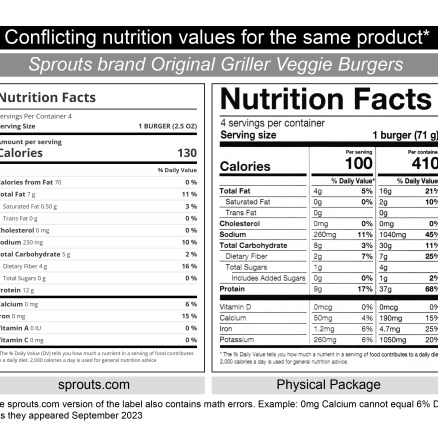
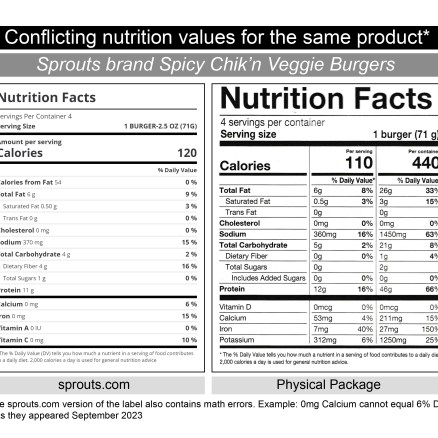
Using the FDA’s suggestions as a general guideline, high value nutrients in Tables 1 and 2 with high % DV are highlighted in green (good), while low value nutrients with high % DV are highlighted in red (bad). In the process of compiling this information, we discovered that even well-known products may change their ingredients and nutritional information more often than one might expect, and labeling may differ depending on the age and source of the information. Therefore, products and values are colored purple if the nutritional information printed on the label was inconsistent from store to store, or from store to manufacturer’s website.
Nutritional Comparison between PBMAs and Traditional Meats
Given the preferences of the human palate, it is unsurprising that PBMAs with the highest saturated fat content (25-65%) also receive the widest praise for being most similar to traditional beef patties in both taste and texture. This includes Impossible Burger, Beyond Burger, NotBurger, Before the Butcher Uncut Burger, Crave House Plant-Based Burger and Sweet Earth Awesome Burger. A similar fat content (23-35%) is found in PBMA sausage products from Impossible, Beyond and Crave House. Each of these PBMA patties and sausages contain coconut oil, which likely contributes to their high saturated fat content, and which has been shown to increase the risk of heart disease. Surprisingly, traditional beef patties of the same size (112-113 grams) reportedly have a saturated fat content ranging from 17.5-60%; with 93% lean beef patties reportedly containing 17.5% saturated fat – notably less fat than even the lowest PBMA.
As one may expect, plant-based burgers that contain visibly discernable vegetables (such as Dr. Praeger and Actual Veggie burgers) tend to be high in healthier nutrients such as fiber, low in unhealthy nutrients such as saturated fat, and are more likely to list easily recognizable ingredients on their labels. It follows that PBMA burgers that are less than 100 grams per serving (56-71 grams) have more favorable nutrient labels, given their smaller serving size.
Interestingly, traditional and PBMA chicken products are similar to each other in fat and sodium content. However, the PBMA versions tend to have higher protein and fiber in comparison to their traditional meat analogues. Unexpectedly, the PBMA Before the Butcher Uncut Turkey Burger (113-gram) has higher calories and total and saturated fat than its traditional meat counterparts.
Discussion
There are a variety of reasons why someone might elect to consume a plant-based diet, with many citing health benefits as a contributing factor. Unfortunately, as shown in Tables 1 and 2, not all PBMAs are healthier options when compared to their traditional meat counterparts, especially in comparison to 93% lean meat.
Not All Plant-Based Foods are a Healthier Option
A cursory review of the research has shown that while both soy and pea protein isolates (the primary protein sources in PBMAs) have some health benefits, not all isolates are created equal. Knowing the extraction method used to produce the protein isolate is important when evaluating any potential health benefit. This is particularly true for soy protein, where the extraction method has been shown to be fundamental to the resulting product’s isoflavone content. Therefore, not knowing either the extraction method used, or the isoflavone content of PBMAs containing soy protein isolate, how is one to evaluate the potential health benefit? At present, sadly, that remains a mystery.
This leads us to an interesting French study conducted by Gehring, et. Al., “Consumption of Ultra-Processed Foods by Pesco-Vegetarians, Vegetarians, and Vegans: Associations with Duration and Age of Diet Initiation” (2021). The aim of the study was to evaluate the quality of diet consumed by most vegetarians; specifically, the amount of ultra-processed foods (UPFs). Of note, the authors found that vegetarians (especially vegans) consumed more UPFs than meat eaters. Not surprisingly, meat and dairy alternatives comprised a large part of the diet of non-meat eaters. What was surprising, however, was that the nutritional quality of a plant-based diet was inversely associated with animal meat consumption. Specifically, vegans and vegetarians consumed more ultra-processed foods than pesco-vegetarians and meat-eaters. Even more troubling, the authors reported that this association persisted even after controlling for sociodemographic (age, income, etc.) and other lifestyle variables (physical activity). Given these results, it’s no wonder the authors noted that “Vegetarians or vegans following a diet with a higher contribution of UPFs could have the same risk of developing health problems as nonvegetarians.”
Ever-changing Nutritional Labels
Another unsettling factor is a review of some PBMA’s ingredient labels. Unfortunately, some labels contain a long list of ingredients, many of which are unpronounceable and unrecognizable to the average consumer. Are we to assume that all of these ingredients, many of which are heavily processed, are healthy? The ingredients for the PBMAs referenced in Table 1 are too numerous to list here. However, links to each product have been provided. Readers are encouraged to visit these links to ascertain each product’s ingredient list.
Finally, I found it both frustrating and confusing that the exact same product at two different locations may have different nutritional labels for the same serving size, whether visiting a store or searching online. The Food and Drug Administration (FDA) approved a new Nutrition Facts Label in May 2016. The date of mandated compliance varied based upon a manufacturer’s annual sales. Those companies with $10 million or more in annual sales were required to be in compliance by January 1, 2020. Manufacturers with less than $10 million in annual sales were required to be in compliance one year later (1/1/2021). As of March 2022, the FDA indicated they were “working cooperatively with manufacturers to meet the new Nutrition Facts label requirements.” In other words, an unknown number of manufacturers are still not in compliance with the latest labeling requirements. How much of this is attributable to the manufacturers, and how much to the process of implementing the requirements themselves, is beyond the scope of this article to discuss. Regardless, the fact that disparities exist further supports the necessity to carefully read even a plant-based product’s Nutrition Facts label to get a more complete picture of both its healthy, and potentially less-healthy, properties.
Conclusion
PBMAs have come a long way in the last 40 years, with significant improvements made in both taste and texture. Most PBMAs no longer look, or taste, like hospital food. However, a decision needs to be made by each of us as to why we elect to consume a PBMA. Most PBMAs can be grouped into either meat analogues which are intended to closely resemble traditional meat, such as Impossible and Beyond Meat, or veggie burgers – including Dr. Praeger and Actual Veggie brand burgers. Many of the manufacturers of the 113-gram traditional meat alternatives would have you believe that they are producing products that will have a positive impact on one’s personal health. But that may not necessarily be true, especially compared to those consuming 93% lean meat. The fact is, the goal of many manufacturers of popular PBMA’s appears to be to mainstream their products. Their target audience is no longer limited to vegetarians and vegans, rather most are hoping to capture the attention of meat eaters. Newer sales and marketing pitches have focused on the elimination of hormones and antibiotics often found in animal meat, reducing the environmental toll of industrialized farming, and providing a healthier equivalent product. Again, the question bears repeating: is a highly processed meat alternative with genetically engineered ingredients really a healthier option compared to a 93% lean meat product? For those (including myself) for whom meat is an unacceptable option, we deserve better answers from PBMA manufacturers.
As a long-time follower of a plant-based diet, I truly appreciate the advances made in the field. I was encouraged to follow the diet as a young athlete. Knowing my family’s damning history of heart conditions, along with my love of animals, led to my life-long commitment. That said, I do not seek to push such a diet on anyone. I truly believe it is an individual choice. In our home, eating one of the more mainstream meat analogues is now reserved for special occasions, like some families might enjoy brisket for Hanukkah, ham for Christmas, or turkey for Thanksgiving. Another option I have considered is to simply eat a half-serving of a standard 113-gram PBMA patty to reduce my saturated fat and sodium intake, and make up the difference with other foods that are not pre-prepared.
Take-away Message
If you take away one message from this post, I hope it is that just as all plant-based diets are not created equal, neither are PBMAs. Anyone electing to follow a plant-based diet, regardless of their reason (whether for health or ethically motivated concerns), is strongly encouraged to read the Nutrition Label of each PBMA they consider, to gain a better understanding of its true health properties.
Table 1: Gluten free Plant-Based Meat Alternatives (Burgers, Sausages and Chicken)
| Calories | Protein (grams) | Total fat (grams) | Saturated fat (grams) | Total carbs (grams) | Fiber (grams) | Sodium (mg) | |
| 113-gram (4 ounce) Plant-Based Patties | |||||||
| Impossible Burger, 113-grams Soy Protein | 230 | 19 (38%) | 13 (17%) (Coconut Oil, Sunflower Oil) | 6 (30%) | 9 (3%) | 5 (18%) | 370 (16%) |
| Beyond Burger, 113-grams Pea Protein | 230 | 20 (40%) | 14 (18%) (Expeller-pressed Canola Oil, Refined Coconut Oil) | 5 (25%) | 7 (3%) | 2 (7%) | 390 (17%) |
| NotBurger, 113-grams Pea Protein | 270 | 16 (18%) | 21 (27%) (Coconut Oil, Vegetable Oil (Sunflower &/or Canola Oil) | 13 (65%) | 8 (3%) | 6 (21%) | 470 (20%) |
| Before the Butcher Uncut Burger, 113-grams Soy Protein | 260 | 19 | 17 (22%) (Expeller Pressed Canola Oil, Refined Coconut Oil) | 9 (45%) | 8 (3%) | 6 (21%) | 260 (11%) |
| Kroger Simple Truth Emerge Burger, 113-grams Soy Protein | 230 | 20 (26%) | 14 (18%) (Refined Coconut Oil) | 9 (45%) | 6 (2%) | 0 (0%) | 390 (17%) |
| Crave House Plant-Based Burger, 113-grams Pea Protein | 260 | 21 | 17 (22%) (Sunflower Oil, Refined Coconut Oil) | 6 (30%) | 5 (2%) | 1 (4%) | 390 (17%) |
| Sweet Earth Awesome Burger, 113-grams (NOTE: Nutritional Info varies) Pea Protein | 280 260 280 | 18 26 25 | 19 (24%) 15 (19.23%) 16 (21%) (Coconut Oil, Canola Oil) | 6 (30%) 7 (35%) 8 (40%) | 8 (3%) 9 (3.27%) 9 (3%) | 2 (7%) 6 (21.43%) 2 (7%) | 440 (19%) 400 (17.39%) 360 (16%) |
| Dr. Praeger, All American Veggie Burger, 113-grams (NOTE: Nutritional Info Varies) Pea Protein | 230 | 22 | 12 (15.38%) (Canola and/or Sunflower Oil) | 1.5 (7.5%) | 10 (3.64%) | 6 (21.43%) | 530 (23.04%) |
| Dr. Praeger, Perfect Burger, 113-grams (NOTE: Nutritional Info Varies) Pea Protein | 230 220 | 20 (27%) 20 (27%) | 13 (16%) 12 (15%) | 2 (11%) 1 (6%) | 8 (3%) 9 (3%) | 4 (13%) 3 (11%) | 380 (16%) 530 (23%) |
| Actual Veggies: The Actual Black Burger, 113-grams No Soy or Pea Protein | 190 | 8 (16%) | 1.5 (2%) (No Oils) | 0 (0%) | 28 (10%) | 10 (36%) | 320 (14%) |
| Actual Veggies: The Actual Green Burger, 113-grams No Soy or Pea Protein | 170 | 7 (14%) | 2.5 (3%) (No Oils) | 0 (0%) | 26 (9%) | 8 (29%) | 320 (14%) |
| Plant-Based Sausages | |||||||
| Impossible Sausage, Spicy, 95- grams Soy Protein | 240 | 14 (28%) | 16 (21%) (Sunflower Oil, Coconut Oil) | 7 (35%) | 8 (3%) | 5 (18%) | 570 (25%) |
| Beyond Sausage, Hot Italian Style, 76-grams Pea Protein | 180 | 16 (24%) | 11 (14%) (Expeller-pressed Canola Oil, Refined Coconut Oil) | 4.5 (23%) | 6 (2%) | 1 (4%) | 440 (19%) |
| Crave House Italian Style Sausages, 85-grams Pea Protein | 180 | 15 (22%) | 12 (15%) (Sunflower Oil, Refined Coconut Oil) | 4.5 (23%) | 3 (1%) | 1 (7%) | 610 (27%) |
| Calories | Protein (g) | Total fat (g) | Sat. fat (g) | Total carbs. (g) | Fiber (g) | Sodium (mg) | |
| Less Than 100-gram Plant-Based Patties | |||||||
| Dr. Praeger, California Veggie Burger, 71-grams Soy | 130 | 5 (8%) | 6 (8%) (Pressed Canola Oil) | 0.5 (3%) | 13 (5%) | 5 (18%) | 250 (11%) |
| Dr. Praeger, Drive-Thru Burger, 56-grams Pea Protein | 110 | 10 (4%) | 6 (8%) (Canola and/or Sunflower Oil) | 0.5 (3%) | 5 (2%) | 2 (7%) | 260 (11%) |
| Sprouts Original Grillers, 71-grams (Note: Nutritional Info Varies) Soy Protein | 100 130 | 9 (17%) 12 (Not listed) | 4 (5%) 7 (11%) (Expeller Pressed Sunflower Oil) | 0 (0%) 0.5 (3%) | 8 (3%) 5 (2%) | 2 (7%) 4 (16%) | 260 (11%) 230 (10%) |
| Amy’s Kitchen Organic Sonoma Veggie Burger, 71-grams Tree Nuts: Walnuts | 130 | 4 | 5 (6%) (Organic High Oleic Safflower and/or Sunflower Oil) | 0.5 (3%) | 18 (7%) | 3 (11%) | 410 (18%) |
| Plant-Based Chicken | |||||||
| Daring Original Chicken Pieces, 70-grams (@2.5 ounces) Soy Protein | 90 | 14 (28%) | 2 (2%) (Sunflower Oil) | 0 (0%) | 5 (2%) | 5 (18%) | 400 (17%) |
| Daring Breaded Chicken Wings, 85-grams (@ 6 pieces) Soy Protein | 190 200 | 11 (19%) 11 (22%) | 10 (13%) 10 (13%) (Sunflower and/or Canola Oil) | 1.5 (8%) 1.5 (8%) | 15 (5%) 17 (6%) | 4 (14%) 4 (14%) | 340 (15%) 340 (15%) |
| Before the Butcher Uncut Chicken Burger, 113-grams Soy Protein | 260 | 19 | 15 (19%) (Expeller Pressed Canola Oil, Refined Coconut Oil) | 7 (35%) | 11 (4%) | 6 (21%) | 350 (15%) |
| Dr. Praeger Chick’n Spinach Pesto Burger, 113-gram Pea Protein | 240 | 23 (34%) | 11 (15%) (High Oleic Sunflower Oil) | 1.5 (7%) | 13 (5%) | 7 (24%) | 410 (18%) |
| Sprouts Spicy Chik’n Burger, 71-grams (NOTE: Nutritional Info Varies) Soy Protein | 110 120 | 12 (16%) 11 (Not listed) | 6 (8%) 6 (9%) (Expeller Pressed Sunflower Oil) | 0.5 (3%) 0.5 (3%) | 5 (2%) 4 (2%) | 0 (0%) 4 (16%) | 360 (16%) 370 (15%) |
| Plant-Based Turkey | |||||||
| Dr. Praeger Perfect Turk’Y Burger, 113-grams Pea Protein | 230 | 20 (29%) | 12 (15%) (Expeller Pressed Canola Oil, Sunflower Oil) | 1.5 (8%) | 11 (4%) | 6 (20%) | 470 (20%) |
| Before the Butcher Uncut Turkey Burger, 113-grams Soy Protein *May be Discontinued* | 310 | 21 | 21 (27%) | 9 (45%) | 7 (3%) | 5 (18%) | 230 (10%) |
Table 2: Gluten free Traditional Meat Products that are Comparable to PBMAs (Burgers, Sausages and Chicken)
Table 3: Common Plant-Based Meat Alternative Brands that Generally Contain Allergens
| Brand | Allergen(s) |
| Boca | Wheat, Dairy |
| Gardein | Wheat |
| Morningstar | Wheat, Egg white |
| Quorn | Wheat, Egg white |
| Tofurky | Wheat |
 Inside Out Odyssey