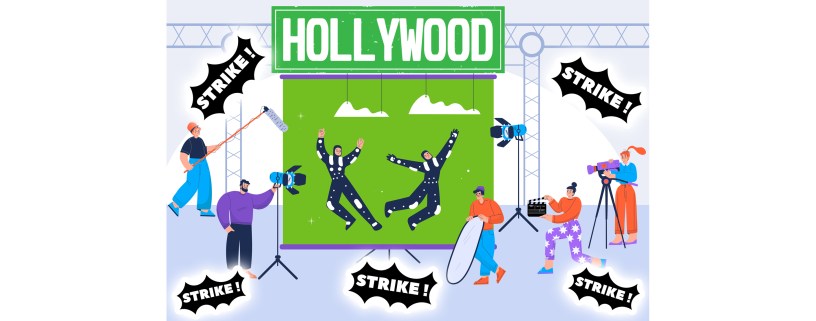
It is so encouraging to see The Nanny (Fran Drescher), Jason Sudeikis, Susan Sarandon and other A-list celebrities on the picket line. Each fighting the good fight, speaking up for the little people who have no voice. It is reminiscent of Christopher Nolan’s plight three years ago, when he voiced his objection to Warner Brother’s decision to simultaneously release their full slate of 2021 movies on both HBO Max and in movie theaters during the pandemic. How dare they! Mr. Nolan bemoaned: “Some of our industry’s biggest filmmakers and most important movie stars went to bed the night before thinking they were working for the greatest movie studio and woke up to find out they were working for the worst streaming service.”
Don’t You Know Who We Are???
Fast forward three years, and now writers and actors are lamenting their treatment by studios as contract negotiations falter. Fran Drescher, SAG-AFTRA union president lamented, “I cannot believe it, quite frankly . . . It is disgusting. Shame on them . . . We demand respect! You cannot exist without us!”
Those Unworthy of SAG-AFTRA’s and WGA’s Support
However, Ms. Drescher’s very outrage, like Mr. Nolan’s, is what makes them both all the more stunningly, glaringly hypocritical. Ms. Drescher purports that she, and SAG-AFTRA, support all actors. However, as William Mersey details in his Daily Beast article, “SAG-AFTRA Can’t Play the Victim When it Treats Extras So Badly,” SAG has a long history of making it difficult for background actors, or extras, to join the exclusive SAG-AFTRA club. As a result, many extras are non-union workers that have union-imposed barriers to climb, which are tantamount to on-set, back-of-the-bus treatment and pay.
Many extras are non-union workers
that have union-imposed barriers to climb,
which are tantamount to on-set,
back-of-the bus treatment and pay.
But SAG-AFTRA’s apathy does not stop with non-union extras, it also extends to another tentpole of the entertainment industry, and seemingly natural ally: visual effects (VFX) artists. Over the last decade, as TV shows and feature films were produced, and countless actors performed their craft, huge swaths of the film industry in Southern California were systematically drained, eviscerated and shipped out of state (and largely out of the country) thanks to deeply predatory tax incentives offered, most notably, in Vancouver. Where was SAG-AFTRA’s, or the writer’s Guild of America’s (WGA) concern for the armies of visual effects workers and auxiliary personnel who had to choose to either uproot their lives to head north, separate from their families for long periods of time (while taking a pay cut thanks to the US-Canadian exchange rate), or leave the industry they love entirely? The financial loss experienced by many VFX artists as Vancouver poisoned the salary well for those remaining in Los Angeles was devastating. How was anyone residing in the Los Angeles area, once the pinnacle of VFX, to compete against the trio of heavily subsidized wages (up to 50+% of an artist’s salary), lopsided US-Canadian exchange rate, and bottom-line obsessed studios whose entire business model had become addicted to this money-saving contrivance?
What are Visual Effects?
Visual effects have been mentioned several times up to this point. For readers who are less familiar with the inner workings of film production, visual effects, or VFX as it is known, refers to the wonderful imagery seen in movies that it is not possible to capture during live-action filming. This includes computer-generated physical effects (explosions, water, smoke, etc.), literally out-of-this-world scenes (such as Star Wars, Gravity, Interstellar, the Matrix, and Rogue One), superheroes (Tobey Maguire/Andrew Garfield in Spiderman and Robert Downy Jr in Avengers), animals and creatures (such as Life of Pi and Planet of the Apes), and even the “invisible” de-aging of actors (Brad Pitt in The Curious Case of Benjamin Button, Samuel Jackson in Captain Marvel and Robert De Niro, Al Pacino and Joe Pesci in The Irishman), not to mention the many fully animated movies (Nemo, Toy Story, Hotel Transylvania, etc.). Given the enormous talent and hard work it takes from hundreds of artists to create these visuals, without which many top-earning features would literally be impossible to make, you would think that not only would the studios be inclined to adequately compensate these artists, but that the directors and actors would fully support them. Because, at the end of day, VFX artists often make actors and scenes look better. Sadly, however, you would be mistaken. Movie making is no different than any other business, and inside those luxurious studio C-suites, it can be more viciously competitive and cutthroat than some. CEO’s, producers, directors (like Mr. Nolan), and celebrity actors and actresses often make 100-1000 times more than the artists working on the movies. Additionally, unlike “above-the-line” actors, visual effects artists don’t receive residuals. But, just as in other industries, if we remove the artists, leaving only the CEO, producers, directors and actors, there would be no final product. Rather, your big-screen effects extravaganza would consist of actors running around in green suits with motion tracking dots on them.
. . . if we remove the artists, leaving only the CEO, producers,
directors and actors, there would be no final product.
Rather, your big-screen effects extravaganza
would consist of actors running around in green suits
with motion tracking dots on them.
Film production is an International Affair
Most feature films today are international affairs, with the various stages of production distributed across multiple continents. It’s not all Hollywood-centric any longer. Such is the natural evolution of business in the age of globalization. Or so one would think. In reality, there is nothing “natural” about what has been going on under the writer’s guild and SAG-AFTRA’s complacent noses for years. Prior to the aforementioned foreign film tax incentives, a cohort of big-name studios colluded for years to systematically suppress the salaries of VFX and animation artists. Refer to the class action lawsuit, viewable on Cohen Milstein’s website (https://www.cohenmilstein.com/case-study/vfxanimation-workers). And after the studios got caught with their hands in the proverbial cookie jar, subsidies were already well on their way to causing far more severe and lasting damage to the LA-based VFX community. This is not the free market in action. It is a deliberate and cynical warping of the “free” market, in which the studios, and by association the producers and directors who work with them (many of them actors, or former actors), enthusiastically take part.
Complicit, Complacent and Sanctimonious Hypocrisy
So, where were Mr. Nolan and Ms. Drescher, or more broadly, directors, actors and writers while all of this was happening to their visual effects extended family? Absent. They were all self-absorbed in their own worlds, collecting their fat paychecks (in comparison to VFX artists). However, as soon as the tables turned, both Mr. Nolan and Ms. Drescher, representing their respective disciplines, attempted to draw upon the average viewer’s empathy and outrage. Mr. Nolan stated, “And these are important principles that when a company starts devaluing the individual assets by using them as leverage for a different business strategy without first figuring out how those new structures are going to have to work, it’s a sign of great danger for the ordinary people who work in this industry,” While Ms. Drescher commented, “What happens here is important because what’s happening to us is happening across all fields of labor, when employers make Wall Street and greed their priority and they forget about the essential contributors that make the machine run.” Well said, Mr. Nolan and Ms. Drescher. But in contrasting these laudable sentiments against the actual struggles of VFX artists (among others), they smack of little more than sanctimonious hypocrisy.
While Actions Speak Louder than Words, No Words Speak Volumes
As the old adage goes, “actions speak louder than words.” The past actions, or lack thereof, of the WGA and SAG-AFTRA with regard to the thousands of visual effects artists who had salaries suppressed, were forced to relocate outside the US, or lost their jobs, is notably missing from Ms. Drescher’s most recent diatribe. Why, you may ask? Because neither Mr. Nolan nor Ms. Drescher, nor their respective guilds, did anything to help any of these artists and their families. To the contrary, Mr. Nolan worked with a visual effects house with 500+ employees in Vancouver, and only 20 in Los Angeles. Countless writers and actors went merrily about their way, either unconcerned about the VFX artists’ struggles or too ignorant to care as VFX artists were too beneath them to warrant awareness of their quandary. Therefore, it is all the more ironic, if not shameful, that WGA and SAG-AFTRA members are whining when the tables are turned. How dare the studios do anything to jeopardize the well-being of the downtrodden Hollywood elite in their glorious mansions! After all, keeping up the lifestyle they have become accustomed to is far more important than the thousands of formerly California-based VFX artists who either left the state, or left the industry entirely. These unnamed, unseen faces are of little importance, as evidenced by the director’s guild, WGA and SAG-AFTRA’s implicit support for their wage suppression, job-outsourcing and relocation out of the country.
Countless writers and actors went merrily about their way,
either unconcerned about the VFX artists’ struggles
or too ignorant to care as VFX artists were too beneath them
to warrant awareness of their quandary.
Tables Have Turned
So, what is different now that warrants the world’s attention? Now, writers and actors are in a position to be negatively impacted by the growing use of technology, in particular AI. No one knows this threat better than VFX artists who have already begun to utilize this technology on a daily basis to make movies into the phenomenal audience experience they are. Just think how (non) captivating many of the hit movies would have been without visual effects.
Enter Artificial Intelligence (AI)
Many celebrities have taken to Twitter to voice their support for the concurrent strikes. The general consensus is that actors’ and writers’ livelihoods need to be protected, and the financial inequity between the studios and the union members needs to be corrected. Both writers and actors fear the uncertainty of what AI will bring. Will it be used as an asset to improve scripts and acting, or will some writers and actors become redundant as technology continues to improve? VFX artists have been aware of this emerging technology for some time. A few artists have incorporated it into their work in a limited capacity. Others have left the industry to work in non-entertainment related AI professions. Despite this slow infiltration into feature film production, it was apparently inconsequential to writers and actors until they felt threatened by the introduction of ChatGPT, the natural language processing AI Chatbot. Now, it is a problem worthy of shouting from the rooftops. At long last they are publicly outraged – for themselves. Now they bristle at the imperious indifference of the studio masters, who remind the WGA and SAG-AFTRA members that they are simply useful objects.
These very people walking the picket lines have built their careers and fortunes on the backs of those whose passion and livelihoods are to this very day being squeezed and discarded like empty tubes of toothpaste. Yet in their fight against AI and other technological advances, writers and actors still have yet to acknowledge the challenges that have long faced VFX and animation artists. In spite of actors’ and writers’ “Come to Jesus” moment with AI, VFX artists remain faceless lackeys, unworthy of their voice and respect. Ms. Drescher stressed how important it is for everyone to care about what is happening to actors. Sadly, the fact remains that if studios, directors and actors had been able to continue making money without interruption while VFX artists were slowly, inconspicuously eliminated, Ms. Drescher, Mr. Nolan, and the vast majority of actors and writers would have happily gone about their business.
” . . . industry insiders say shifting pay models
are causing a “gold rush” for TV actors looking for a big per-episode payday,
while showrunners get rewarded for keeping a series on the air
for at least two years with longevity bonuses, and experienced directors
can use a “track record as a blunt object” in negotiations.”
Higher Salaries than Most Americans
Why should the rest of America care? According to Jason Gordon, WGA East Director of Communications, “The WGA’s average minimum for a staff writer on a scripted series is about $4500 a week.” Liz Wolf, writing for reason.com, tells us “Though WGA writers make, on average an eye-popping $250,000 a year, the structure of writers’ rooms is such that most creatives go through boom-and-bust times.” Contrast these statements to those reported by The Hollywood Reporter (THR) in October 2022. THR notes, “industry insiders say shifting pay models are causing a “gold rush” for TV actors looking for a big per-episode payday, while showrunners get rewarded for keeping a series on the air for at least two years with longevity bonuses, and experienced directors can use a “track record as a blunt object” in negotiations.” A further breakdown by THR revealed the following:
- Actors: Most actors, outside of the top A-list celebrities, “get paid in the $2 million to $4 million range . . . little-known actors leading their first feature can expect SAG-AFTRA scale of $65,000.”
- Directors: First time directors can expect up to $450,000-$750,000 (according to the Director’s Guild Pay scale), established directors $4-7 million, with top directors commanding upwards of $20 million.
- Feature Writers: Entry-level feature writers generally earn $75,000-$100,000, increasing to $150,000-$160,000 once established. Top feature writers see upward of $1-2 million.
- Showrunners (those possessing overall creative authority): Generally, showrunners are paid on a point system which is typically tied to “longevity, ranking and critical acclaim.” The longer a show is on, the more lucrative each point becomes. So, it is not unheard-of for showrunners receiving $1.00 per point in season 1, to receive $150,000-$189,000 per point in season 6.
- TV Writers: While WGA’s Mr. Gordon noted that the “average minimum for a staff writer on a scripted series is about $4500,” THR more thoroughly describes the payment structure, stating that “Writers earn from $7,600 to $12,500 a week while they break the entire show. If it goes into production, those weekly payments count toward their episodic fees, which range from $4,000 per week for staff writers to $15,000 to $22,000 per episode for more experienced scribes, and as much as $40,000 to $75,000 at even higher levels.”
- TV Directors: For pilots, inexperienced directors are reportedly paid according to DGA’s pay scale, while experienced directors earn $250,000-$500,000. If the show is picked up, TV Directors receive “the standard $30,000 to $60,000 an episode.” Any director fortunate enough to have an executive producer credit will earn an additional $30,000-$50,000 per episode.
- Studio Chiefs: Unsurprisingly, the salary for studio chiefs is also wide ranging. THR reports studio chiefs make anywhere from $2 million to $20+ million. CNN Business reported Bob Iger, Disney’s CEO, “agreed to an annual base salary of $1 million with a potential annual bonus of $2 million. The agreement also includes stock awards from Disney totaling $25 million” when he rejoined the Studio in November 2022 replacing Bob Chapek.
- Agents: Like everyone else in Hollywood, the pay scale for agents is dichotomous, with starting salaries ranging from $65,000 to $75,000, partners garnering $400,000-$600,000 and elite agents upwards of $4 million, prior to bonuses.
Who Should Make More Money? Studios? Actors? Writers? VFX Artists?
The top 5 studios in the United States, generally referred to as the big 5, are: NBCUniversal Pictures, Paramount, Warner Brothers, Walt Disney Pictures, and Sony Pictures Entertainment. Arguably next in line would be Metro-Goldwyn-Mayer, Lionsgate Pictures, and DreamWorks Pictures (now part of NBCUniversal). Each of these studios are owned by larger business conglomerates, whose primary business may not even be movie production. Think Amazon and Apple. Consider Mr. Iger. He oversees Walt Disney Pictures, Disney’s numerous theme parks, and Disney cruises. Given his apparent greater number of responsibilities, is it not reasonable to assume that he should get paid more than an actor starring in a feature film? Striking actors and writers apparently don’t think so.
Let’s examine the reported salaries of studio executives and the top salaries of film actors in 2022. Both are at the top of their respective food chains; with legions of employees and lesser-known actors beneath them.
2022 Hollywood Salaries
| CEO | SALARY | ACTOR | SALARY |
| Bob Bakish (Paramount) | $32 million total compensation ($3.1 million base + $28.8 million in incentives) | Tom Cruise | $100 million+ ($12-$14 million base plus $100+ million from ticket sales for “Top Gun: Maverick” (Paramount) |
| Donna Langley – Chairman of Universal Film Entertainment (Comcast NBCUniversal) | Not listed | Leonardo DiCaprio | $30 million for “Killers of the Flower Moon” (Apple and Paramount) |
| David Zaslav – CEO (Warner Brothers Discovery) | ~ $39.9 million in total compensation | Brad Pitt | $30 million – untitled Formula 1 Drama (Apple) |
| Bob Chapek CEO 2022 and Bob Iger – CEO 2022 (Walt Disney) | Chapek: $24 million Iger: $14 million total compensation. Iger’s salary will increase in 2023 to $27-$31 million | Will Smith | $35 million for “Emancipation” (Apple) |
| Tony Vinciquerra – Chairman and CEO (Sony Pictures Entertainment -Columbia Pictures) | ~ $5million | Dwayne Johnson | $22.5 million for “Black Adam” (Warner Brothers) |
It is noteworthy that in 2022, the top 5 actors, on average, earned more than the big 5 studio CEOs; even after removing the top earners in their respective categories (Tom Cruise and David Zaslav). These actors are not making business decisions that will impact the lives of thousands of employees that work for their respective companies. They are not surgeons, pilots, air traffic controllers, or one of the many other professionals who deal with life and death issues on a daily basis. They are there to entertain you, just like the myriad of influencers on YouTube, TikTok and other video platforms.
Supporters of WGA and SAG-AFTRA strikers are quick to remind everyone that most writers and actors are gig workers (freelancers, independent contractors, on-call and temporary workers), and therefore do not have reliable and consistent full-time employment or benefits. Welcome to the real world! According to McKinsey and Company (2022), a global management consulting firm, “There is a seismic shift in how Americans work and support themselves: 36 percent of employed survey respondents say they labor as independent workers, up from our estimate of 27 percent in 2016.”
Which Video Platform Reigns Supreme? Do Actors Deserve More Money?
Traditional media companies, facing ongoing challenges to their dominance, may be less receptive than ever to calls for greater compensation from WGA and SAG-AFTRA. According to Omdia, who describe themselves as a “technology research and advisory group,” while YouTube continues to reign supreme as the number one app for people under the age of 35, TikTok now occupies the number 2 slot in the United States, surpassing Netflix. With “over 138M active users in the US and an average screen time of 26 hours per month,” it is TikTok, not Netflix, Amazon Prime, Apple, or Disney that appears to be most likely to challenge YouTube for the coveted top spot in this age group.
Similarly, YouTube also holds the desired number one spot for app usage for those over 35 years, followed by Netflix and Amazon Prime Video. Should this trend continue, it is no wonder the big 5 studios are not too eager to award WGA and SAG-AFTRA members with better streaming contract deals. It appears non-union influencers may be the better option.
Inclusive and Equitable Pay in the Era of Streaming
The overarching question then, is: do actors and writers warrant a pay raise? Considering that the above-reported salaries are substantially higher than gig workers in most other professions, together with the streaming statistics from newer video platforms, the empathy and outrage from the average citizen simply may not be there. Maybe the WGA and SAG-AFTRA could structure their membership in such a manner that high earners share their wealth with other members (as Dwayne Johnson has reportedly done), rather than seeking the same from studios. As the proverb goes, “charity begins at home.”
Does the Average American Owe WGA Writers and SAG-AFTRA Actors Anything?
The sheer self-absorbed nature that Hollywood is so known for was on full display when Ms. Drescher was asked “what is your message to the fans and consumers who aren’t interested in the nuances that we’re discussing here today? They just want their favorite TV shows and they want to go to the movies.” Ms. Drescher replied, “Well, what makes you think they’re not interested in what’s happening here? I think that they have an allegiance to all of us because they, we bring joy to their lives! We bring entertainment to their lives!”
An “allegiance to all of us?” So, Ms. Drescher wants everyday citizens, many of whom pay hard earned money to watch tv shows and movies, where the actors have been more than adequately compensated, to care about what happens in their contract negotiations. How much should they care? Should the average citizen care as much about the WGA and SAG-AFTRA strikers as the strikers themselves care about background actors or visual effects artists? After all, both of these groups are part of the Hollywood family. Should one conclude that the WGA and SAG-AFTRA has set the standard for how to compensate those who give so much of themselves to enrich the lives of others, yet are being terribly taken advantage of? Or would the WGA and SAG-AFTRA prefer that their audience watch a green screen with actors dressed in green outfits and covered in dots recite their lines, and battle imaginary objects with imaginary weapons because the visual effects artists have not worked their magic? Or should the average person care that as WGA and SAG-AFTRA salaries increase, so likely will movie theater tickets; which are already more than the minimum wage in most states, averaging @ $14-$15 or more?
Real World Concerns
The fact remains, Ms. Drescher, the vast majority of Americans are more concerned about how AI is going to impact their own lives and jobs, not those of entertainment writers and actors. AI has already had a significant impact on manufacturing jobs. Business insider reported companies have already announced AI related job cuts. Worse, they cited a University of Oxford study (2013) that “found that 47% of US jobs could be eliminated by AI over the next 20 years.” The same article cites a Goldman Sachs study indicating that “300 million full-time jobs worldwide” could be impacted by AI leading to a “significant disruption” in the workforce. Business Insider spoke with industry experts and conducted their own research, and identified the following ten professions as those most at risk for being replaced by AI:
- Technology jobs: coders, computer programmers, software engineers, and data analysts
- Media jobs: advertising, content creation, technical writing and journalism
- Legal industry jobs: paralegals and legal assistants
- Market research analysts
- Teachers
- Financial jobs: financial analysts, and personal financial advisors
- Traders
- Graphic designers
- Accountants
- Customer service agents
So, Ms. Drescher, we average citizens have as much allegiance to the WGA and SAG-AFTRA strikers as you do to each one of us, which appears to be the same as the WGA and SAG-AFTRA have to their background actors and visual effects colleagues. We owe you nothing. While you all remain focused on yourselves, we will enjoy decades of reruns. Perry Mason, anyone?
Return to Values
Maybe it’s time for people to return to the family values of yesteryear. Parents can teach kids that celebrities, like professional athletes, are not role models. What is portrayed by studios, agents and professional sports teams is what they want you to see. The actual person behind the façade is very often different, many not worthy of idolization. So, rather than clamoring to see the latest feature, turn instead to familial, religious, spiritual and community leaders that exemplify important aspects of life and society. Do more volunteer work. Visit a local community theater. Take up a hobby. Read a book, graphic novel, or even a comic – you know, those things that many movies are based on.
At the end of the day, there remains a group of vociferous striking Hollywood actors and writers employing persuasive marketing techniques – some might call it propaganda – to emotionally manipulate average citizens to support their cause. Before you allow this to happen to you, educate yourself! Now is the perfect time to pull back the curtain on Hollywood’s Wonderful Wizard of Oz, and expose the self-absorbed people behind the curtain.
 Inside Out Odyssey